November
So often gardeners talk about January and February as the hardest, grimmest months of the year. Not so for me. Prone as I am to perpetually turning over new leaves, I face these two months full of energy and the fresh optimism of resolutions made on New Year’s Day and revised and renewed on my birthday (Feb 1st). The crisp cold resonates with the sense of as clean slate and I set about my roses and apples with a fresh gusto as I feel the pull of the lengthening days and the sap beginning to flow beneath my feet.
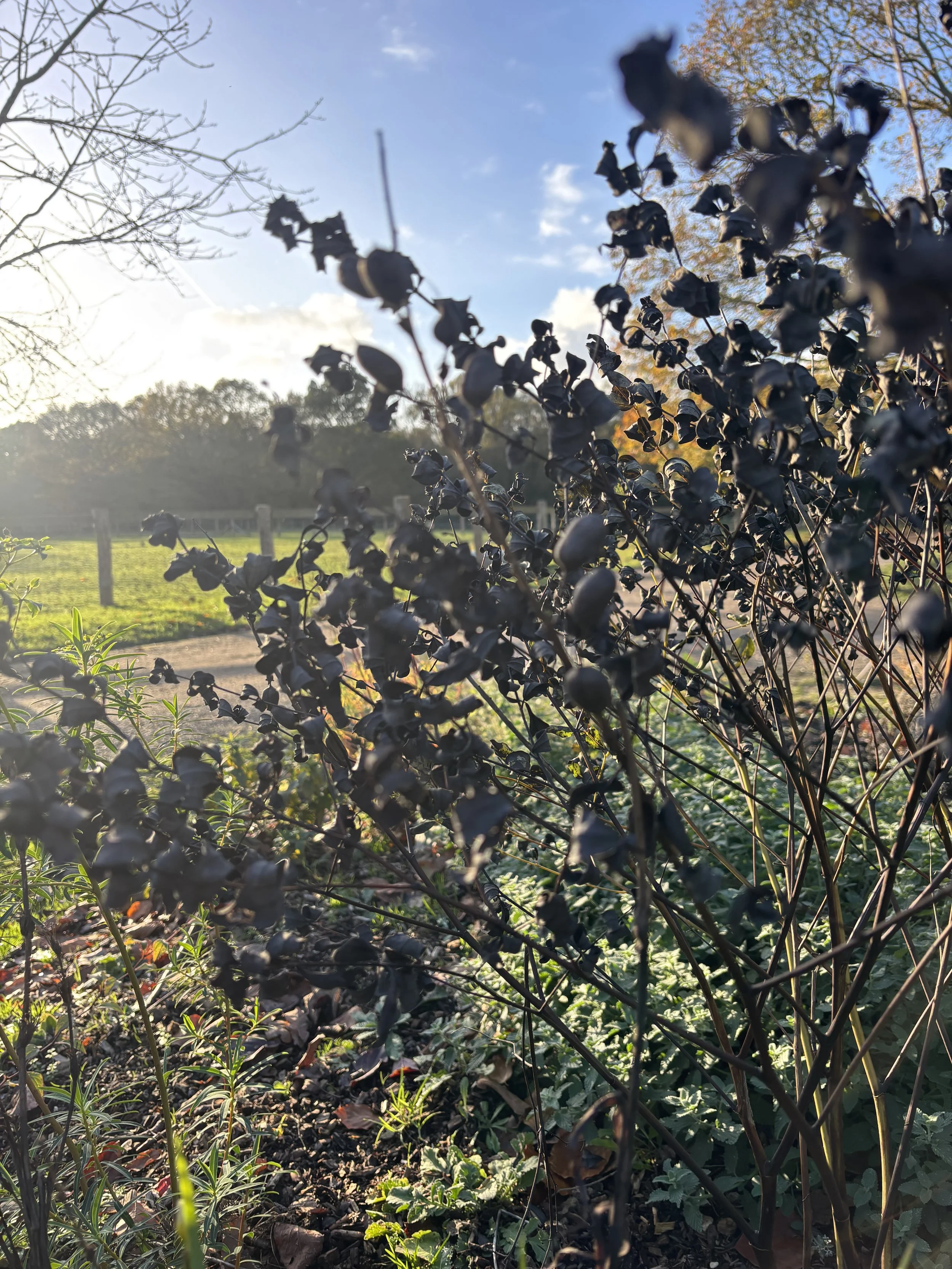
Baptisia foliage
November is my bleakest month. Even with such a warm November as this, I watch the plants around me fade and blacken and I feel a huge part of who I am slipping through my fingers. Having spent much of September and October with a clear sense of vision and excitement, dividing and rotating plants into a new iteration of the kaleidoscope for next year, suddenly the beds look chaotic and dishevelled, and weaknesses in my planting are laid bare. As the days shorten towards December I lose my thread and the sense of mission which has sustained me through Autumn collapses around me.
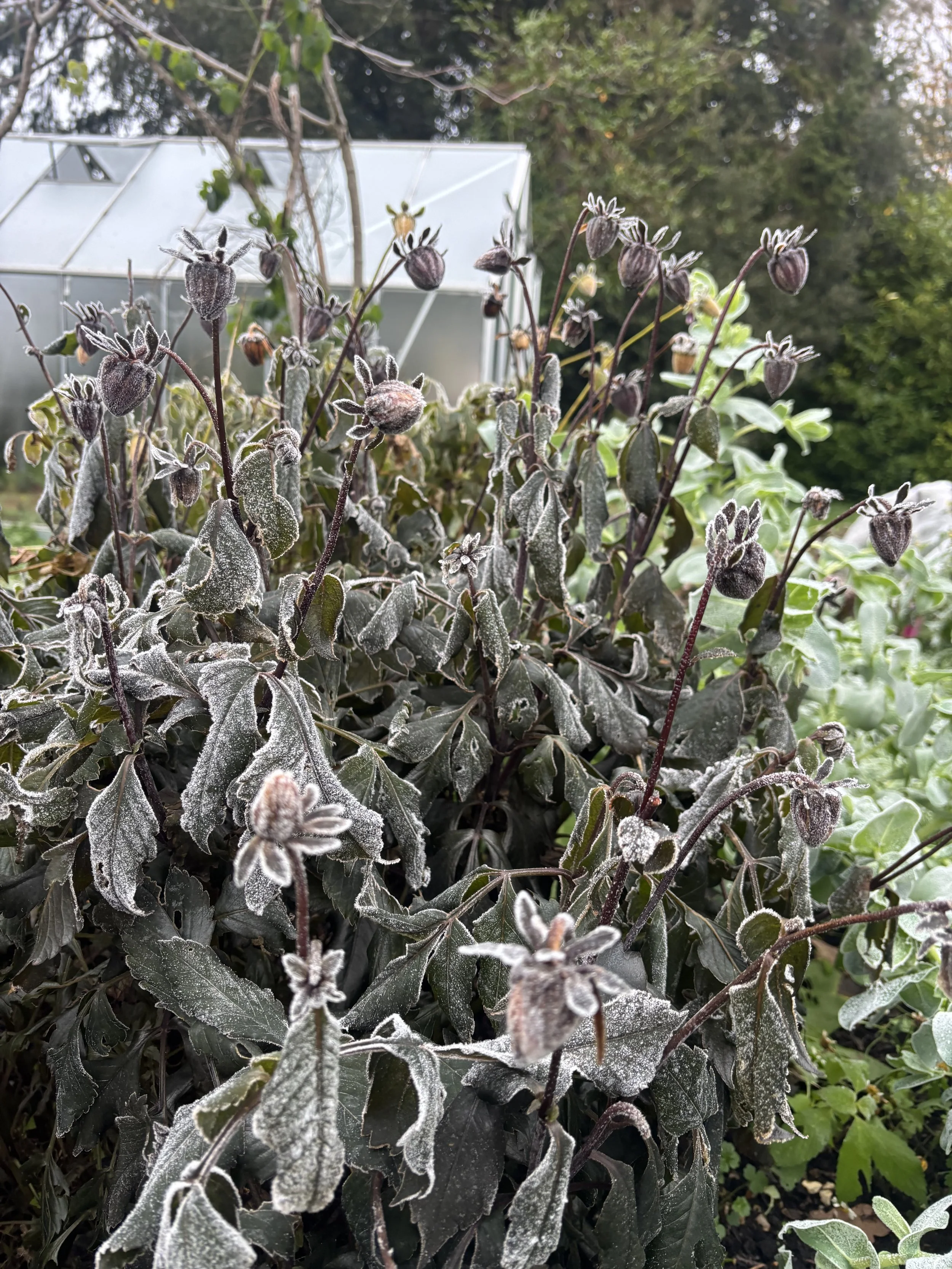
Frosted dahlias
This last week I have felt like I’ve been cut down at the knees, doubled over and crumpled up by the frost like the soggy blackened remains of my un-lifted dahlias. I pride myself on being a relatively hardy person, but I suspect that like plants, people benefit from a gradual period of hardening off and ripening, acclimatising to the gently falling temperatures. This year’s swing from low teens to sub-zero within days has felt particularly brutal. The impact on the garden was instant. After a few beautiful hours in which my tender plants were perfectly suspended, crystallized, they all collapsed into great scars of blackening sludge in the borders.
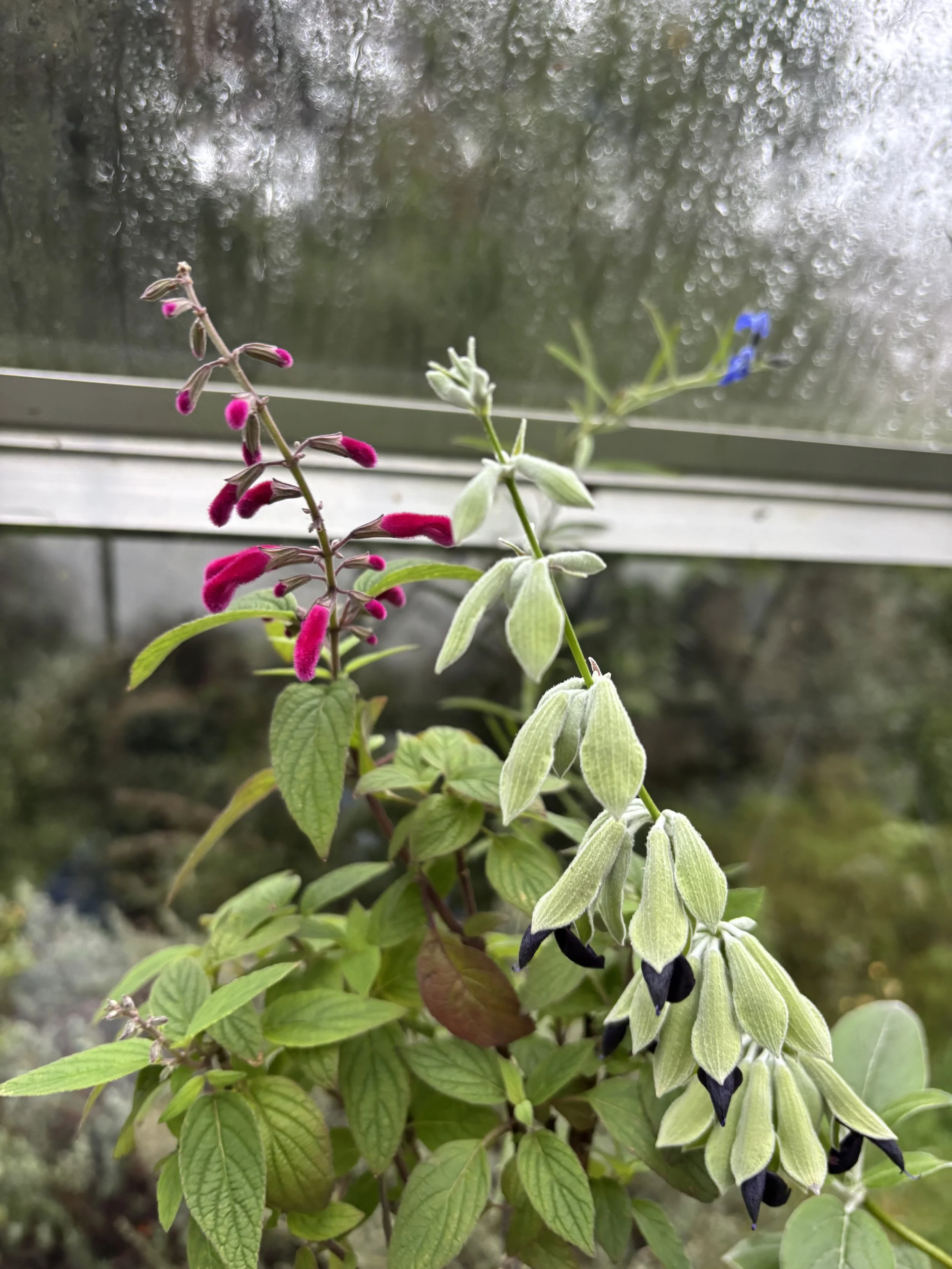
Huddled salvias
As I pulled on another jumper against the cold I considered how to insulate and protect my more delicate plants. I’ve started collecting various interesting salvias but am not yet at a stage where I can tell how hardy a new salvia will be based on its lineage or characteristics. Perhaps this is unsurprising given that a salvia’s ability to survive winter is based as much on the condition of its roots as the nature of its top growth. To be safe I brought all my new salvias into my unheated greenhouse at the start of November. Even then, when the frost hit, I came out to find some like Salvia ‘Discolor’ scorched and blackened. Not a problem (as I say it is largely their roots that count) but to be safe I have huddled them together for security and I tuck them beneath a layer of fleece at night before I go to tuck in my own children. On the coldest nights I have taken to co-sleeping with my 2yo daughter whose room is Baltic, and as my 5 year old dived in to join us for warmth at 3am I couldn’t help but think of my family of young salvias huddled beneath their duvet outside.
Other delicate plants I collect in beds around the walls of the house where, from my experience, the frost never settles. Our house is woefully poorly insulated and after an initial shock at the heating bills when we arrived, I have resigned myself to putting that heat to good use. I keep my favourite tulbaghia in one of these beds and they survive happily although I am now gradually moving them further and further out into the garden to see how well they cope. As back-up I lifted one of each of my treasured plants to keep under cover and propagate from in spring. I have other quite tender delights planted against the house walls which I’m too embarrassed to name until I’ve seen if my theory holds. Time will tell.
I’m sorry to say that with my more readily available plants I am rather lazy about leaving them through the winter. I’m yet to fall in love with dahlias and those few that I have are cut down and mulched unceremoniously with a haphazard bucket of woodchip or compost. So far, a successful strategy but they are in a raised bed and the last 2 winters haven’t been too cold. Salvia ‘Amistad’ which grew with great gusto this year I leave in situ, its great ugly mop of blackened foliage left in place as a sort of tatty blanket to protect the crown below. Not a big asset to the aesthetic winter garden but low effort. I have 2 lifted plants as back up in the greenhouse, but my outdoor plants have done well for 2 winters outdoors.
November the hardest month for keeping faith in the cycle and renewal of gardening. Hopefully when I have been a concerted gardener for 20 years, I will finally trust that next year mother nature and I will somehow pull it all off again. For now, green as I am, I find within weeks of the garden’s decline I lose all faith in its ability to return and my own ability to create. It seems impossible that my new beds which were lawn in Spring were a confection of delicate silvers and sugar pinks by summer. Impossible that it will do the same next summer, let alone that it might be better, the plants stronger, and that I might improve it.
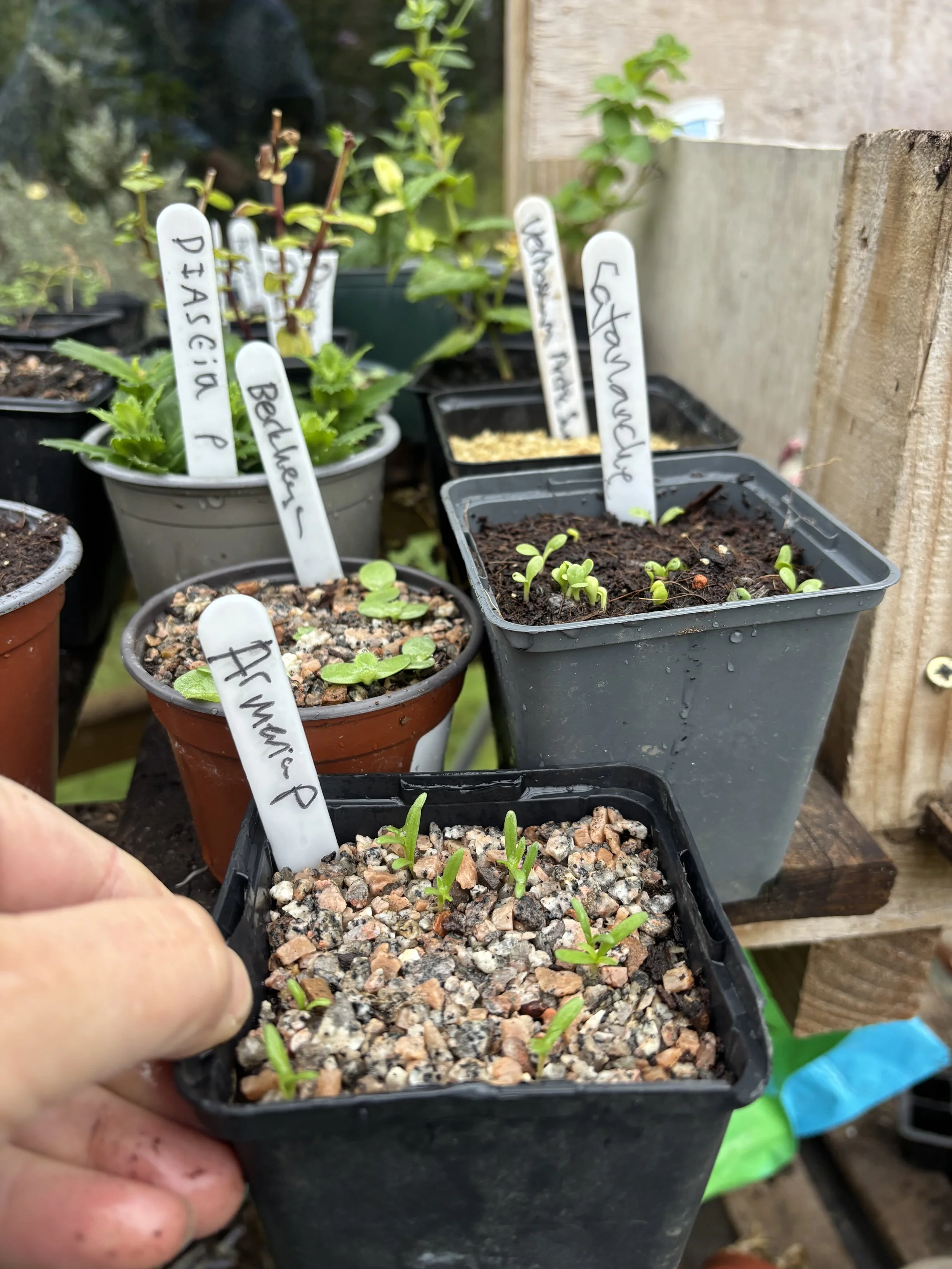
Seedling ready for pricking out
I find that small propagative acts help a lot with this, and in quiet moments I have been delicately pricking out seedlings of perennials and hardy annuals for next year. Tucked in tight but unheated against the cold, these tiny acts of faith won’t do much for now, but if they can survive the coming months they will grow away early next year. In the cold and dark their tiny frames look hopelessly fragile, but I find this sowing and overwintering ends up being the thread of hope and creativity that pulls me through to the new year.
Finally, in November I feel exhausted. September and October have been incredibly busy, working against the clock to take formative action for others in their gardens as well as in my own. The thought of the effort required to whip the whole circus back into shape next year feels crippling. For now, I am slowing my pace. Having output so much through spring and summer it is a luxury to spend the winter focussing on input: reading, listening, studying, researching. Hard as it is to have the year come abruptly to an end, I have faith that from this inputting of knowledge, this intellectual horticultural nourishment, a new gardening season of inspiration and experimentation will grow.
