Gardening in a corridor
A brief introduction to our garden
When Toby and I were looking for our home, we visited so many places that were more spacious or already renovated, but all with no garden or only a small patch of paving at the back. In the end, we opted for a place that’s only slightly wider than a train carriage and that took 2 years to do up, with a completely rotten roof, illegal wiring and mould on all the walls. In the end, we bought a garden.
Our garden is 13ft wide and 60ft long – effectively a verdant bowling alley but a good stretch of ground. It receives sun in the spring when the trees are bare, but has a high wall on one side and a fence on the other and is narrow enough that a sunbather has to put down their mojito to move their chair across the patio every 40 minutes. When Monty Don walks us down his ‘cricket pitch’, a liminal space between his gardens which he block plants (beautifully) with anything from Acanthus to wildflowers, I watch and think ‘that’s pretty much the size of our entire plot’. A long corridor with striking planting looks stunning, but when it’s all you have to work with there’s a lot more you need to get from it: a patio, grassy space for Arthur to run around, a veg patch and of course plenty of space to explore my ever-growing list of favourite flowers. Most of these do best in full sun and every centimetre of the garden’s layout has been a weary territorial battle with myself. A battle between my love of alpines and my love of alliums, my need to grow carrots and my desire to grow cardoons and, most painful of all, between Arthur’s wish for a sandpit and Toby’s need for a barbeque, neither of which have anything to do with gardening and therefore qualify as a waste of good fertile ground in my book.
In the end, we have divided the garden into 4 sections: a patio, flower beds with a bit of lawn, a vegetable section and the somewhat blighted nether region of dry shade beneath a walnut tree. This last area presents the ultimate in difficult planting, which houses our compost heap, a tool shed and my best efforts at woodland planting. In each of these areas my desire to cram in as many plants as possible defies both practicality and good taste. We finally had the patio levelled and redone this spring and after 24 hours of it looking elegant and tidy I had covered it back over with pots full of tulips and spring bedding whilst waves of seedlings and unpromising pots of dahlias colonise the outdoor ‘dining table’. In the raised veg beds I have tried over the years to fit flowers for cutting around the borders, often to comically disastrous effect, as in the case of my wallflowers and cabbage bed (see below).
But there are some big benefits to having a small garden. You get to know the space well and can enjoy the challenge of making the whole area work as much as possible. In the dark winter days, the first sparks of spring are close enough to the window to be enjoyed. In the recent baking heat, a bit of shade from surrounding trees has been a blessing both for us and the plants.
Our flower beds suffer inevitably from the incompatibility of a plant addict with a small canvas and any kind of colour scheme, but for now I have decided that enjoying exploring new plants is more important. I should learn to re-gift plants but I grow too attached to part with them. My brilliant, scarlet poppy ‘Beaty of Livermere’ spends May gunning away, enthusiastically covered in huge red flowers that make your eyes water next to the subtleties of Allium schubertii and Dicentra spectabilis, like someone’s embarrassing cousin who didn’t get the memo on dress code. I shall develop good taste when I have the space for it. Or when I have grown every plant I can think of under the sun and settled on some favourites.
For now, our garden is chaotic, much used and well-loved. It’s imperfect, and whilst that’s largely down to me, I like to blame the conditions I work with. It has taught me about the joy of care, the illusion of control, and above all the necessity of letting go.
Return to the wild
Rediscovering the garden after weeks away
Most gardeners probably face the same fate in August. Returning to a garden that has spent much of the summer without you. Like parents who have bravely left their teenage kids at home for the first time, you return to find they have had a wild time in your absence, with pizza boxes and empty beer cans strewn across the floor. The lawn is shaggy and unkempt, flowers have gone over and the ‘fridge’ is full of stringy runner beans and enormous marrows left uneaten.
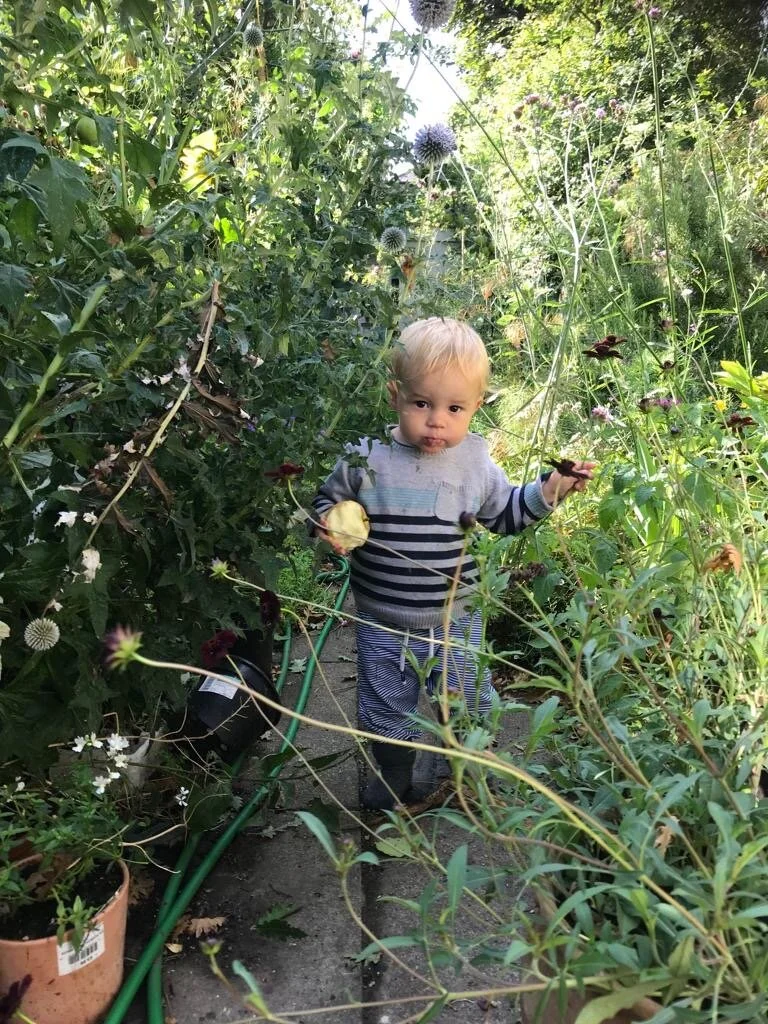
After a wonderfully busy summer (we took our old camper van to WOMAD, I spent a week singing in the Prague early music festival and we then had 10 blissful days with my parents-in-law in France), we have returned to find the garden in chaos. I think the effect was exacerbated by some unwise planting on my part. I like the garden to look a bit wild with a lot of tall plants, but the result was that our garden path was an impassable and hazardous maze of echinops and eryngium. Only Arthur was small enough to pass underneath unharmed.
Once we had hacked our way into the garden there was plenty to do. The first step was to deadhead everything in sight and pray for a new flush of flowers. With a good water and some tomato feed we should be in business. Then there was sorting out the state of ‘the carpet’. Mowing a lawn that has gone a bit wild is always scary, and it can be hard to trust that it will recover when you first see it shawn. Cutting it back by a third to begin with gives it a chance to recover before you gradually bring it under control.
Saddest of all are the dropped tomatoes and our apples which are early to ripen and many of which had fallen to the ground. Toby bravely tackled the very bedraggled windfalls and we have a freezer full of apple compote for Arthur. Once all this had been taken care of things began to settle down, but a week in and we are still turfing out unwelcome houseguests in the form of annual weeds, deadnettle and the dreaded Ranunculus repens. It always amazes me how fast weeds can grow when left unchecked.
Although there was a bit of work to do on our return, there are some wonderful positives to leaving the garden to flex its unruly independence. As with children, living with a garden day to day sometimes it is hard to see how much it has matured and, having left it for a while, it was a wonderful surprise to see it burgeoning on our return. As with children, it can be hard to acknowledge that they can grow without our aid and need some independence. Seeing what your garden does when left to its’ own devices is always eye opening. Plants often have more vigour and confidence than I give them credit for, and whilst they are now back under my careful control, I will endeavour to give them a bit more room to express themselves from now on.