Gardening with a child. Gardening as a child.
Trying to let go of saying ‘NO!!’

Rosemary with lamb… a classic combination
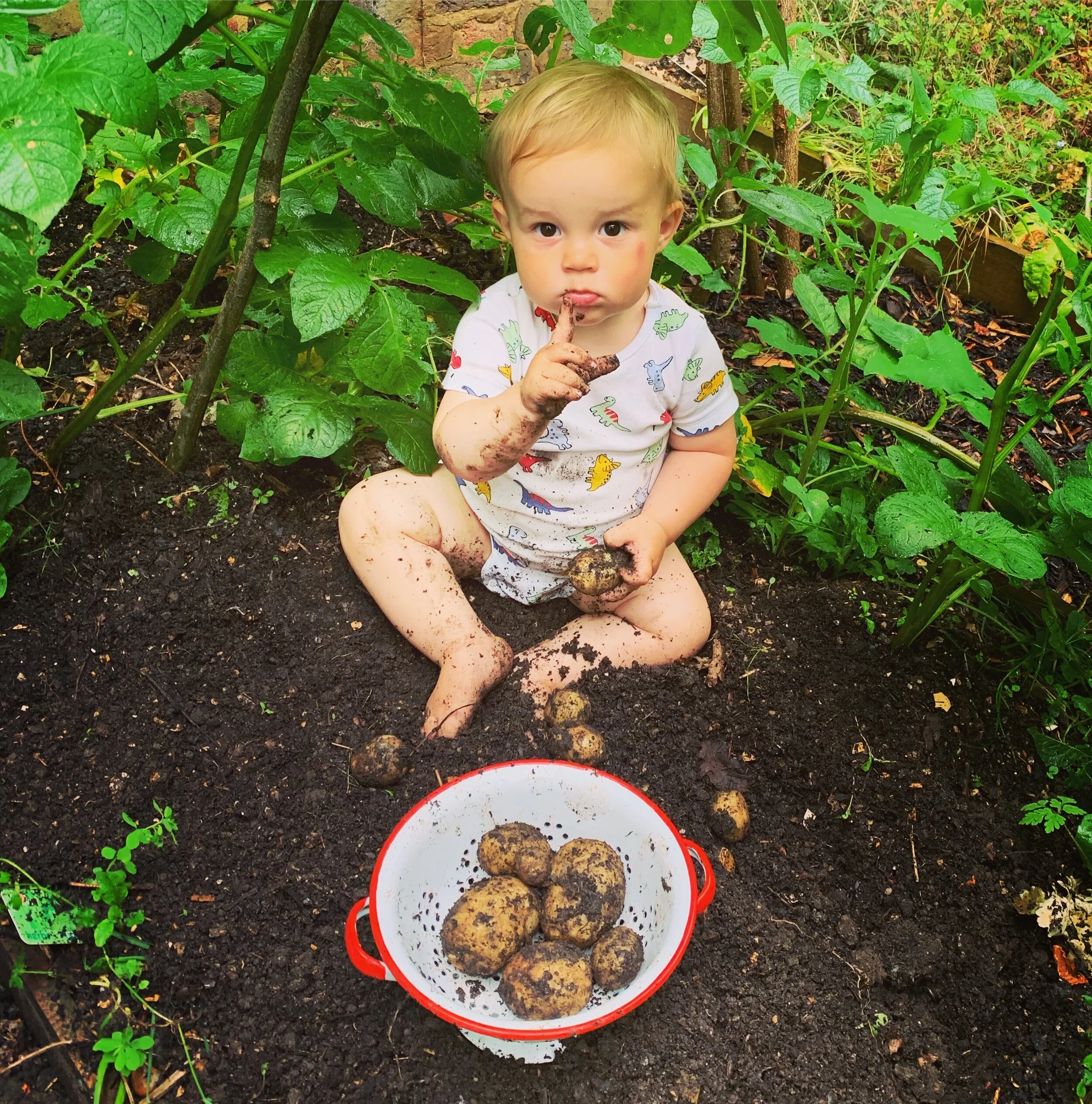
This week is National Children’s Gardening Week, and to honour it I have been making a concerted effort to spend as much time gardening with my 2 year old son, Arthur, as possible. When I was pregnant with him I imagined hazy hours together exploring the wonders of nature as I tended a perfect garden in a new life as an earth mother in which I had great stretches of unscheduled time for gardening (HA!).
In reality, almost every activity we have tried in the garden has ended in chaos and a lot of the knee jerk ‘Arthur, NO!!’.

‘Look Mummy! CROCKS!!’
He loves the process of harvesting, and it’s a great way to get small kids to enjoy veg, but as soon as he could walk we found all our cherry tomato plants stripped of their fruit, ripe or otherwise. He runs in at dinner time calling ‘Look, I picked some radishes’, his hands full of tiny radish too small to eat. Then there are his efforts at what I call ‘live heading’ where he helpfully lops all the flowers off my plants for me, or discovers an exciting insect right in the middle of a flower bed and charges after it full of enthusiasm. I had no idea that I was sowing the seeds of disaster when, last autumn, I got him to help me pot up my spring bulbs, placing crocks in the bottoms of pots, scooping in compost and arranging the fat bulbs for me. This spring, months later, I wasn’t sure if I was more horrified or impressed when I found him proudly smashing flower pots calling ‘Look Mummy! CROCKS!’. He helped me sow all my seeds this spring, and then rearranged all the labels. This has done wonders for testing my horticultural knowledge but when it comes to distinguishing my ‘wok broc’ from my collard greens I am still stumped. Above all I find smatterings of certain plants growing in everything and can only assume a certain degree of compost mixing has taken place behind my back.

But maybe the problem lies with me as an adult rather than with him. A toddler’s curiosity and wonder in a garden is to be treasured and, as is so often the case in parenting, it is our adult preconceptions about what a garden ‘should’ be that causes friction. Perhaps we could all learn something by watching children in our gardens, and by thinking back to the magic of our own early experiences with gardening and nature.
I grew up with a garden big enough to have shrubs to hide in, a little pond and various other secret corners to inhabit. According to family mythology, one of my first words was mesembryanthemum (an interesting reflection of gardening trends in the 80s), and as soon as I could toddle I was off exploring the garden, terrifying my parents as I gorged myself on wild strawberries and returned stained red. I used to fish for newts in the pond with my brother and sister (my brother was brilliant at drawing them), and whilst other girls began to show an interest in mainstream cosmetics, I was trying to make garden perfume (notoriously giving my 5 year old sister a rash with my ‘day-lilly dreams’ concoction) and trying to wash my hair with horse-chestnut leaves. The old greenhouse was a place of secret magic and the discovery of a bucket of golden vermiculite was as thrilling to us as Tutankhamun’s tomb to Howard Carter. In all these memories, the garden was a place of mystery, of exploration, of experimentation and, above all, of freedom and independence.
Reflecting on these experiences, I realise I want to give Arthur freedom to explore and a sense of adventure alongside helping him discover the joys of nurturing that come with growing plants of your own. Nature can entertain and teach children in a way that indoor toys never can. It changes and develops, it’s unstructured, it’s dirty and immersive. But giving him these experiences is much harder than I had expected. We are lucky to have the garden we do, but it’s pretty small and there’s very little space for him to ‘run wild’. In the rush to perfect what little space we have and, maybe I have lost the childhood magic of chaos and dirt, mud pies, beetles, sticks and dens. Plants used to be precious regardless of how healthy they were looking or whether they were weeds or some coveted cultivar. I used to enjoy the garden without it having to ‘be’ anything other than itself.

Yesterday as Arthur abandoned sowing sunflower seeds with me and instead sat in the compost bucket and began to shovel it down his shorts I drew a long breath, smiled and continued with the seeds myself. I have sown enough seedlings that when he decided to try to feed our cat cosmos this morning I was able to remain philosophical as I scooped them into the bin. I am trying to set parameters that will keep him safe and me sane, but in the end I am just grateful that he takes an interest, grateful that we have a garden to share with him and time to enjoy it, and determined not to crush the spark of discovery.

Arthur and Toby picking Pak Choi

Finding Time to Garden
A past-time with no cheating and no shortcuts
I’ve had a baby! Little Laurie (Laurence) arrived 4 weeks ago and is thriving! The last month has flown by and every moment has been filled with the joy and exhaustion of being a family of 4. It’s been a good few weeks since I last wrote here but life has finally settled down so I’m back!
Yesterday Toby took Arthur to football, Laurie fell asleep in his crib, I poured my coffee and just like that, I was alone in the garden for the first time in weeks. I’ve been in and out in the last few months, mainly to help Arty strip the veg patch of nearly 900 cherry tomatoes one handful at a time, and to hoof buckets of veg scraps to the compost heap, but between ‘pregxhaustion’ and clutching a newborn, I hadn’t touched the ground in nearly 2 months. Yesterday, coffee in hand, the world stopped spinning for a moment and it was bliss. Taking stock in the warm September sun; tackling some woefully overdue weeding. Best of all, having my hands in the soil again after 9 months of wearing gardening gloves.
10 minutes later, Laurie woke up and the spell was broken.
At the moment, it feels like there is never enough time to do anything, let alone enough time for the garden. But the garden shows no sympathy for the stress of early maternity and refuses to wait for me, galloping wildly ahead without me. Every time I step outside the list of what needs to be done grows longer. Rather like my tummy I find my ‘post-partum garden’ looks nothing like it used to and falls far short of any societal ideals. But none the less I’m still super proud of what we’ve managed this year. We’ve grown an awful lot of veg and even if some corners of the garden are looking neglected, when I look out of the kitchen window I can still see flowers.
One of the greatest charms of gardening is that our creations exist independently of us. Unlike a ‘finished’ piece of art, our relationship to our garden is a continuously developing one: the art we create in a garden is open-ended and our medium has a life and opinions of its’ own. This enriches the art of gardening but makes it an exhausting and exacting hobby at times. Unlike so many past times, there’s no quick fix, no cheating, and very little control over the time frame for getting things done. Much of gardening consists of critical day to day jobs which, when skipped, can have disastrous consequences (RIP to the trays of seedlings I left un-watered earlier this spring). You can’t really take a break: If you decide to leave the garden to itself for 6 months and then return, you pay for it and at the back of our flower beds I’m now facing mountains of well-established weeds as penance for months where I couldn’t bend down!
The pay-off is the huge satisfaction of knowing that what beauty there is in your garden is the result of hard labour. When I flick through images of people’s private gardens and allotments on social media I find myself quite moved by the sheer scale of collective human effort that has gone into them. No one can grow vegetables or arrange bunches of cut flowers from the garden without showing up week after week, digging, weeding and watering for months beforehand. I’m full of respect for all those gardeners who squeeze in time for their gardens between work hours or kids or whatever else life throws at them.
I’ve just started to volunteer at Brockwell Park again which feels fantastic, and so far Laurie sleeps contentedly in his pram while I get busy gardening, but how long that will last, who can say. I look forward to a time when I have long, uninterrupted spells in the garden, but for now, it looks like my relationship with the garden will continue to be one of snatched moments of freedom to get on with things. Perhaps gardening will still feel this way long after all my children have flown the nest. Perhaps it is this that makes gardening feel like such a luxury and a pleasure: making time in the garden has come to represent making time for myself.
And on that note, Laurie has drifted off and I have some foxglove seedlings in urgent need of potting on, so I shall wish you a pleasant day, close my laptop and dive outside before it starts to rain.

Digging into toxoplasmosis
Advice for any pregnant gardeners
I am currently 34 weeks pregnant and gardening is getting complicated. I can garden standing up, or I can garden sitting down, but switching between the two regularly is now completely impossible. At Brockwell Park where I volunteer, I think the team are genuinely concerned I’m doing more damage than good to the garden as they see me lumbering into the middle of the borders, plants parting before me as before an elephant through the thicket.
Once you’re pregnant you are presented with a whole list of things you can’t do and mustn’t eat (coffee, alcohol, sushi, soft cheese). I was therefore thrilled when a friend recommended a brilliant book called ‘Expecting Better’ which debunks many of the myths around maternity and is incredibly permissive (perhaps why it’s so successful). Having read that I could drink the odd glass of wine and enjoy a coffee a day, I turned to pages about dangerous activities (hot tubs, flying, tattoos, cats) and on the last page I read:
‘The Bottom Line: Changing the cat litter is fine… but gardening is associated with an increased risk of toxoplasmosis. It should be avoided.’
I couldn’t believe it. At the time I was in my second trimester, sitting drinking a cup of tea with garden mud under my fingernails from a morning on the veg patch. I’d researched what I could and couldn’t do quite thoroughly, but no one had told me not to garden.
Toxoplasmosis is a disease caused by one of the world’s most common parasites, toxoplasma gondii which is found in infected meat, in cat faeces and, most frustratingly for gardeners, in the soil (thanks to the cats). For most adults, toxoplasmosis is completely harmless and symptomless. Unfortunately, whilst some risks are flagged in pregnancy to avoid discomfort to the mother rather than any risk to the baby (eg salmonella or lifting heavy bags), toxoplasmosis is not one of them. Catching it in pregnancy really is often disastrous, causing miscarriage and still birth, and for those babies that do survive, leading to ongoing complications, some of which only manifest themselves in a child’s teens. Reading about it as a pregnant gardener it is easy to get pretty scared.
Reassuringly, the transmission of toxoplasmosis is actually extremely rare and the most common way people catch it is through rare or cured meat. It can live in the soil for up to 18 months but would only get there if an infected animal had died there OR if an infected cat had defecated. Luckily, cats who are infected are only infectious for about 2-3 weeks, and most adult cats have already had it, so the chances are still fairly low. But because it poses such a huge problem if you do catch it, it is still definitely worth protecting yourself during pregnancy.
The first bit of good news is that once you’ve had it you’re immune for life and it is possible to be tested for it. In my first pregnancy, I wasn’t tested and didn’t even know you could be, but it turns out you can ask your midwife or GP to run a test for you if you garden a lot and you’re concerned. The test can tell you if you actively have it, but also if you have had it in the past and are now immune. If that result comes back, congratulations!! You can garden happily, safe in the comforting knowledge that cysts full of the little worms are snug and dormant, buried within your muscle and organs, protecting you for life.
I was convinced I had had it because:
I spent most of my time singing in France eating rare steak and vast quantities of salami
I have had cats and gardened since childhood
My London garden is a latrine for every cat in the neighbourhood
I never wore gardening gloves
I ate veg fresh from the garden
I was, therefore, a bit disappointed to discover that I haven’t had it, but I suppose that goes to show how rare it really is.
If you haven’t had it, gardening with good gloves and then washing your hands when you finish is the best thing you can do to protect yourself. Wash all your garden vegetables thoroughly (and shop-bought veg for the same reason). Some people suggest wearing a mask while gardening and perhaps in very dry weather if the soil is dusty that might be worth it…. I suspect in a British summer this isn’t really necessary.
So I am ploughing on through my last few weeks of pregnancy, and to be honest I can barely touch the ground anyway. I love gloves a lot of the time (e.g. slug collection) but there are moments where trying to protect myself from my own soil feels sad and disconnecting. Whilst other expectant mothers look forward to a martini, a rare steak and some opinionated cheese to follow, I am just looking forward to taking off my gardening gloves and putting my hands in the soil for the first time in 9 months.
Gardening in a corridor
A brief introduction to our garden
When Toby and I were looking for our home, we visited so many places that were more spacious or already renovated, but all with no garden or only a small patch of paving at the back. In the end, we opted for a place that’s only slightly wider than a train carriage and that took 2 years to do up, with a completely rotten roof, illegal wiring and mould on all the walls. In the end, we bought a garden.
Our garden is 13ft wide and 60ft long – effectively a verdant bowling alley but a good stretch of ground. It receives sun in the spring when the trees are bare, but has a high wall on one side and a fence on the other and is narrow enough that a sunbather has to put down their mojito to move their chair across the patio every 40 minutes. When Monty Don walks us down his ‘cricket pitch’, a liminal space between his gardens which he block plants (beautifully) with anything from Acanthus to wildflowers, I watch and think ‘that’s pretty much the size of our entire plot’. A long corridor with striking planting looks stunning, but when it’s all you have to work with there’s a lot more you need to get from it: a patio, grassy space for Arthur to run around, a veg patch and of course plenty of space to explore my ever-growing list of favourite flowers. Most of these do best in full sun and every centimetre of the garden’s layout has been a weary territorial battle with myself. A battle between my love of alpines and my love of alliums, my need to grow carrots and my desire to grow cardoons and, most painful of all, between Arthur’s wish for a sandpit and Toby’s need for a barbeque, neither of which have anything to do with gardening and therefore qualify as a waste of good fertile ground in my book.
In the end, we have divided the garden into 4 sections: a patio, flower beds with a bit of lawn, a vegetable section and the somewhat blighted nether region of dry shade beneath a walnut tree. This last area presents the ultimate in difficult planting, which houses our compost heap, a tool shed and my best efforts at woodland planting. In each of these areas my desire to cram in as many plants as possible defies both practicality and good taste. We finally had the patio levelled and redone this spring and after 24 hours of it looking elegant and tidy I had covered it back over with pots full of tulips and spring bedding whilst waves of seedlings and unpromising pots of dahlias colonise the outdoor ‘dining table’. In the raised veg beds I have tried over the years to fit flowers for cutting around the borders, often to comically disastrous effect, as in the case of my wallflowers and cabbage bed (see below).
But there are some big benefits to having a small garden. You get to know the space well and can enjoy the challenge of making the whole area work as much as possible. In the dark winter days, the first sparks of spring are close enough to the window to be enjoyed. In the recent baking heat, a bit of shade from surrounding trees has been a blessing both for us and the plants.
Our flower beds suffer inevitably from the incompatibility of a plant addict with a small canvas and any kind of colour scheme, but for now I have decided that enjoying exploring new plants is more important. I should learn to re-gift plants but I grow too attached to part with them. My brilliant, scarlet poppy ‘Beaty of Livermere’ spends May gunning away, enthusiastically covered in huge red flowers that make your eyes water next to the subtleties of Allium schubertii and Dicentra spectabilis, like someone’s embarrassing cousin who didn’t get the memo on dress code. I shall develop good taste when I have the space for it. Or when I have grown every plant I can think of under the sun and settled on some favourites.
For now, our garden is chaotic, much used and well-loved. It’s imperfect, and whilst that’s largely down to me, I like to blame the conditions I work with. It has taught me about the joy of care, the illusion of control, and above all the necessity of letting go.