March
The Glorious Race
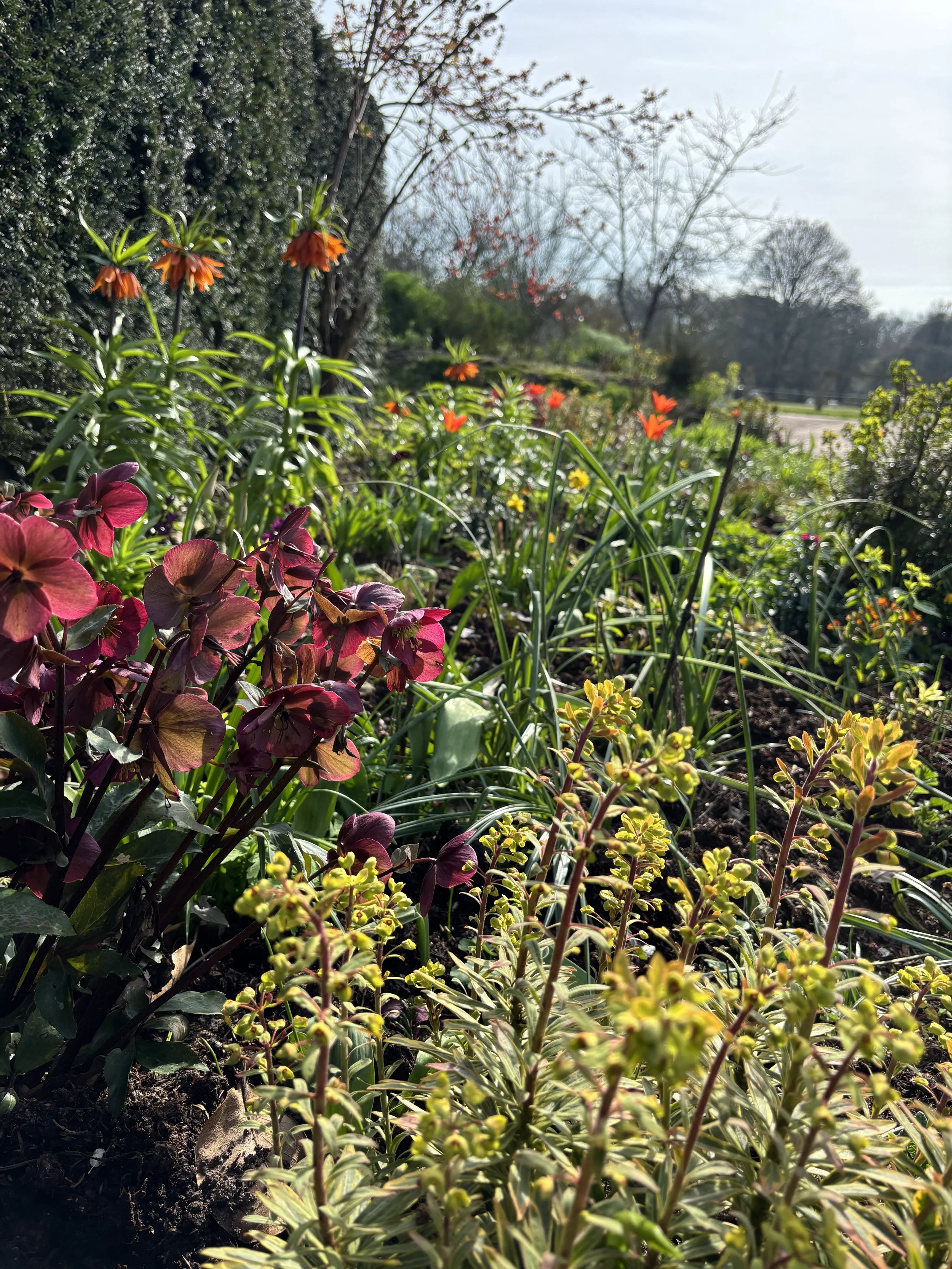
As I stepped into the sunshine this week, I was hit by a sudden panicked queasiness in realising that spring is now here, and that so many of the plans I wanted to achieve will slip through my fingers for another season. No one warns you when you first dip your toes into the world of gardening that time will suddenly telescope in upon itself, and you will always feel that you are racing to catch up with the seasons. Fleet footed spring runs ahead with joyful abandon, gathering strength and confidence daily. Every year I try to race her, and if not to get ahead then at least to keep pace beside her, but I know I will never achieve it. There is sometimes joy to be had in watching others win and this is one of those occasions. By the end of May I will be defeated, muddy and exhausted, but relishing the taking part and in awe of the pace with which she accelerates to victory, particularly after such a cold, wet standing start as she has had this year.
The idea that I feel out of time in my own garden will seem mad to most people. It is after all just my garden, I spend a lot of time in it, it is not paid work and not really very important. Although I do work with and for others, I have decided to dedicate a portion of child free time (I have 3 days where my youngest is out of the house) to my own garden until my daughter starts school. I quickly realised that if this is the time of life for learning, the best most flexible education I could muster and fit around the limiting schedule of small children (who are endlessly ill or on holiday) was to teach myself. I may have serious limitations as my own tutor, but at least I can be both flexible with hours and rigorous. I am also a diligent student , trying hard to think about what I am doing and how it might be relevant to others. I carefully document my successes and failures as a form of homework to expiate my guilt at the luxury of so much time gardening for myself. I like to think it already pays dividends in my ability to help others, and I hope will accelerate my progress of understanding over time.
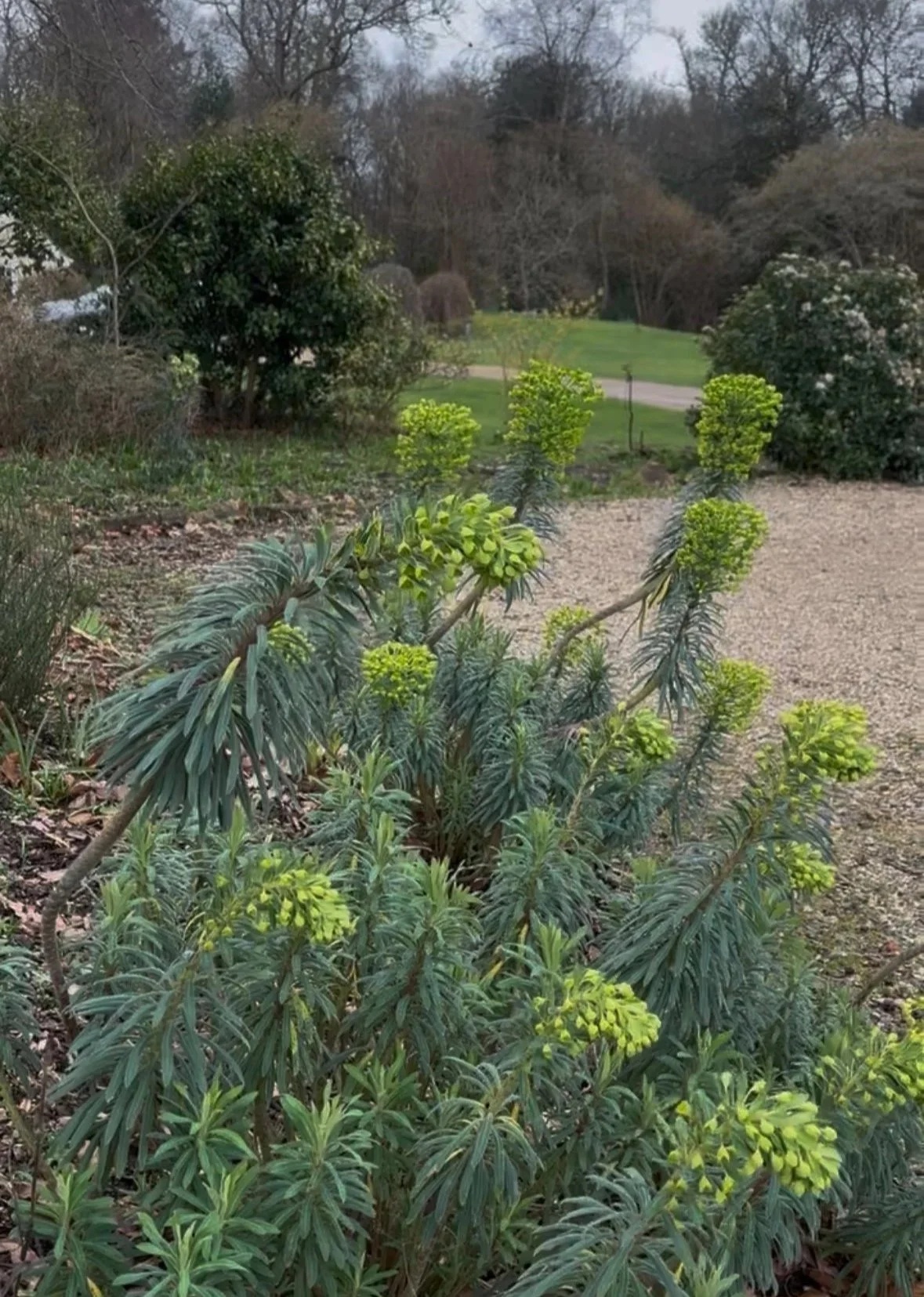
As to one’s own garden not being very important, it is hard to explain the sense of drive and fixation that I have developed over my own space. No one around me seems to understand it and they remind me that it is a lifelong project, that I really have bitten off a lot of space to chew, and that I have so much time there’s no hurry. Surely I would be better clearing out our chaotic house, or having my daughter at home full time or taking on more work? I know this is true but can’t get away from who I am and the fact that once I set my eye on a particular project, I find it very hard to drop it and be patient. I had hoped to expand our front banks substantially this year, reworking what is currently a sea of Spanish bluebell, brambles and dead shrubs as well as doubling the size of one of our borders. Despite working as hard as I could on getting things done, (and enlisting the help of Riley whose patience on the days he visits knows no bounds) these projects have ended up slipping and slipping. As with last year I suspect I will end up doing much of the planting far too late in spring when the nights are light enough to allow progress after the kids have gone to bed.
It's important to note that just because I care a lot about my garden it doesn’t mean that I have transformed it into a ‘good’ or elegant garden. It is a great sea of chaos (much of it of my own making) with small corners of what I hope is characterful planting. I feel ill equipped to make long term, woody decisions, let alone concrete ones, and so the place feels like the loose playground of a plant collector more than a designed garden.
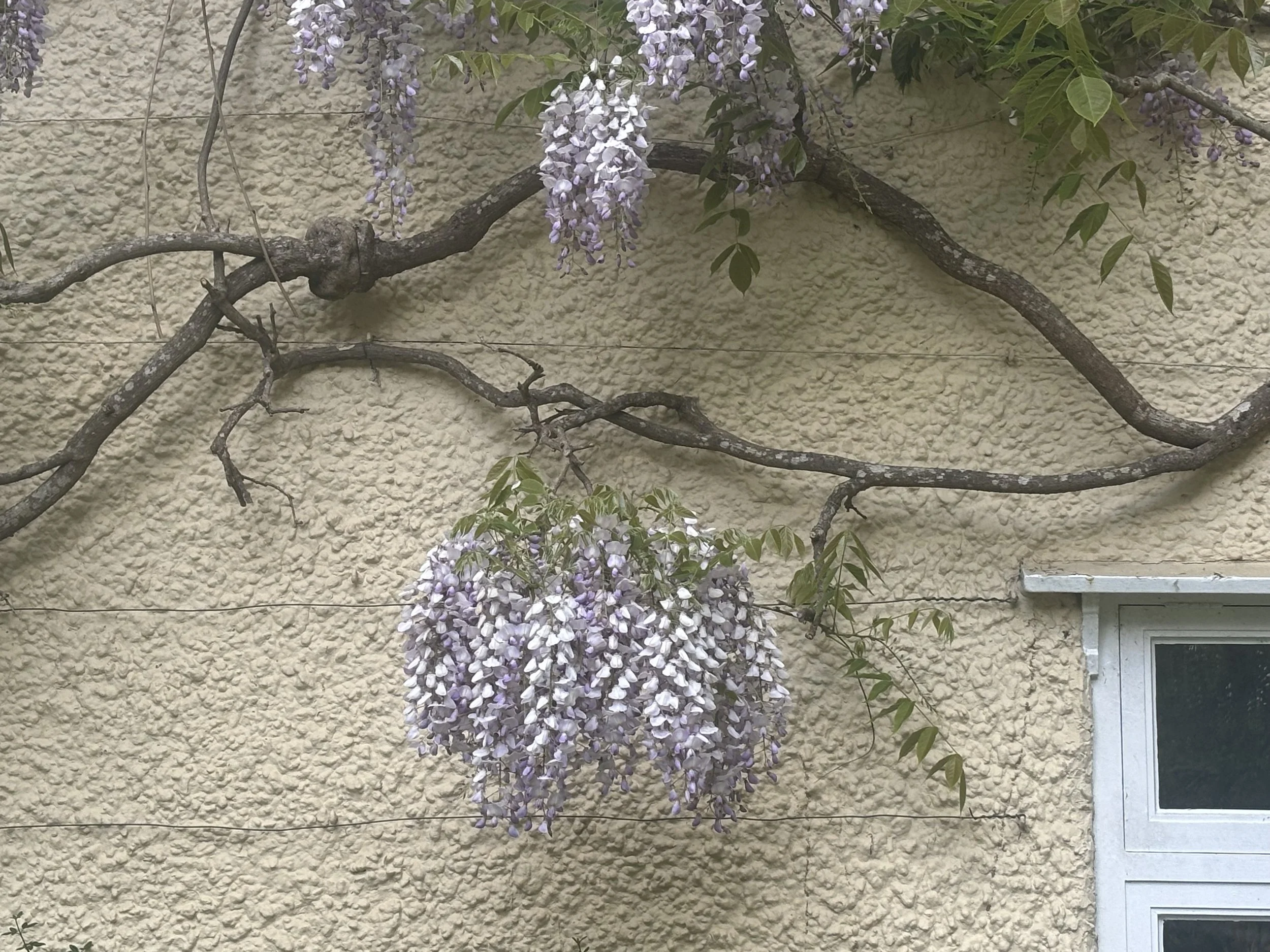
As well as the tasks that I have not had time to get to, there are all those I have been putting off. Last week I finally climbed a ladder and tackled our wisteria which I have left woefully unloved for the last year. Every time I turn the corner and pass it I feel a big whoosh of shame as it writhes about on the wall neglected. I am terrified of being up a ladder when no one else is around to hear me fall and since I largely garden alone the wisteria has suffered. It doesn’t help that the wisteria itself is pretty average and non descript . When we first arrived I was so excited to see it flower but the flowers are a sort of muddy, pale lilac grey. Obviously it’s 100 years old so I’m not going to rip the thing out, but I often think resentfully of the formidable and dour Beatrice Webb who planted it. If she’d only had some spring in her step and a hint of a smile I feel she might have chosen me a good one. It is what it is. I hacked it back in a frenzy whilst listening to The Clash and vowed to do better by it next year.
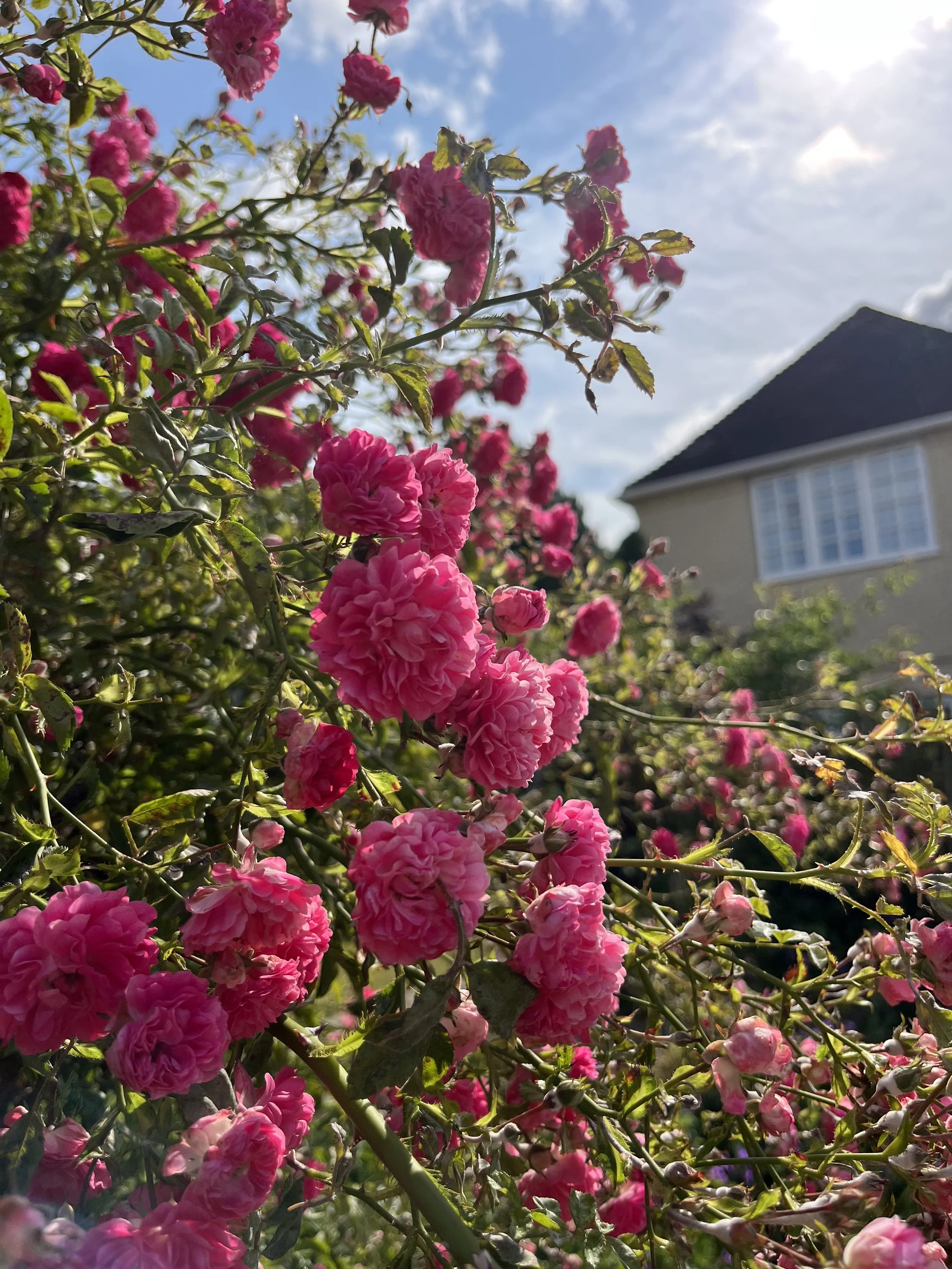
I’ve also been putting off the taming of my two great wild rambling roses, planted before my arrival over a narrow archway. They defy my understanding. I can identify the lovely whippy growth that will flower well, and cut out the flowered branches fine, but each plant sends out so many tentacles each year, great 4m long thorny whips from ground level with which they lash at ankles and eyes. It is too much of a job to completely untie and retrain them over the arch each year, so I am forced to don protective gear and roughly restrain them as best I can. It’s frustrating to be coping rather than excelling at a job.
Beside that I’ve been busily planting out hardy annuals, some into rich improved soil and others into my unimproved powder. Interesting to compare their progress. A steady stream of plants continues to arrive at the house – Toby expressed concern that he thought I might have taken out a standing order with Beth Chatto by mistake. Things shuffle forward, empty pots are strewn about, the picture gradually improves. Most delightfully of all I’ve been raiding anything amenable for basal cuttings. Partly a learning exercise, partly born of a sort of plant related rapacity that I can’t fully explain, but also with the new justification that I’m growing plants for clients’ gardens this year. I’m hoping this will combine my love of propagation with the practicality of knowing gardens well, on similar soil, and being able to slot in useful plants without a big carbon (or faff) footprint.
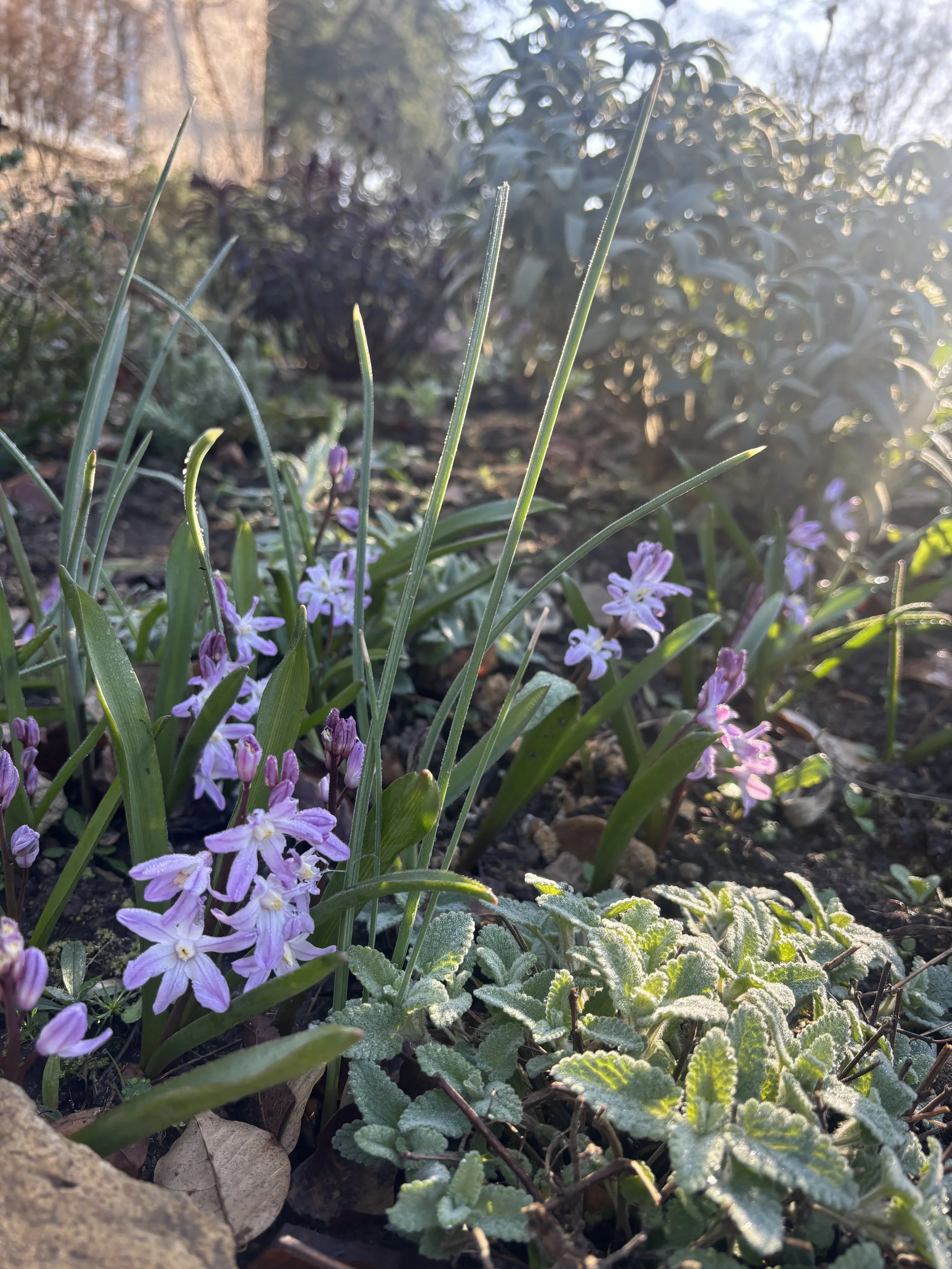
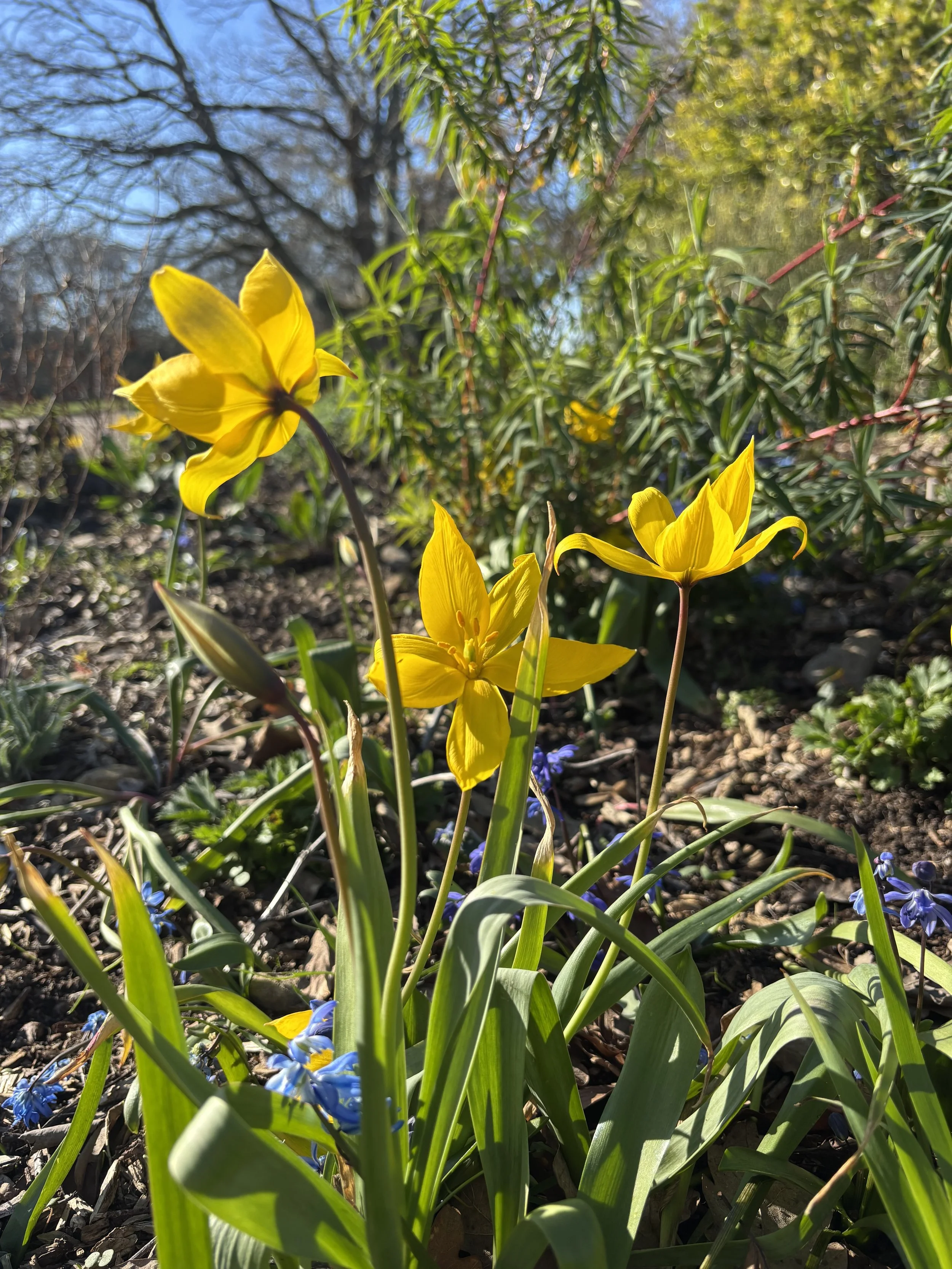
In March it feels like every day there is a new treasure open in the garden. The first flowers of Anemone blanda, blue Scilla Siberica, Chionodoxa and best of all the elegant yellow flowers of Tulipa sylvestris. Checking for such happenings daily is no doubt a considerable sink of time as I hunt them out and measure their progress. Dropped in my path, like golden apples, these delights slow me down in my race to the finish line. If I walked past such details I would get a lot more done. If I walked past such details there would be little point in doing much in the garden. Better to lose the race and enjoy the moment.
February
Narcissus and Echo
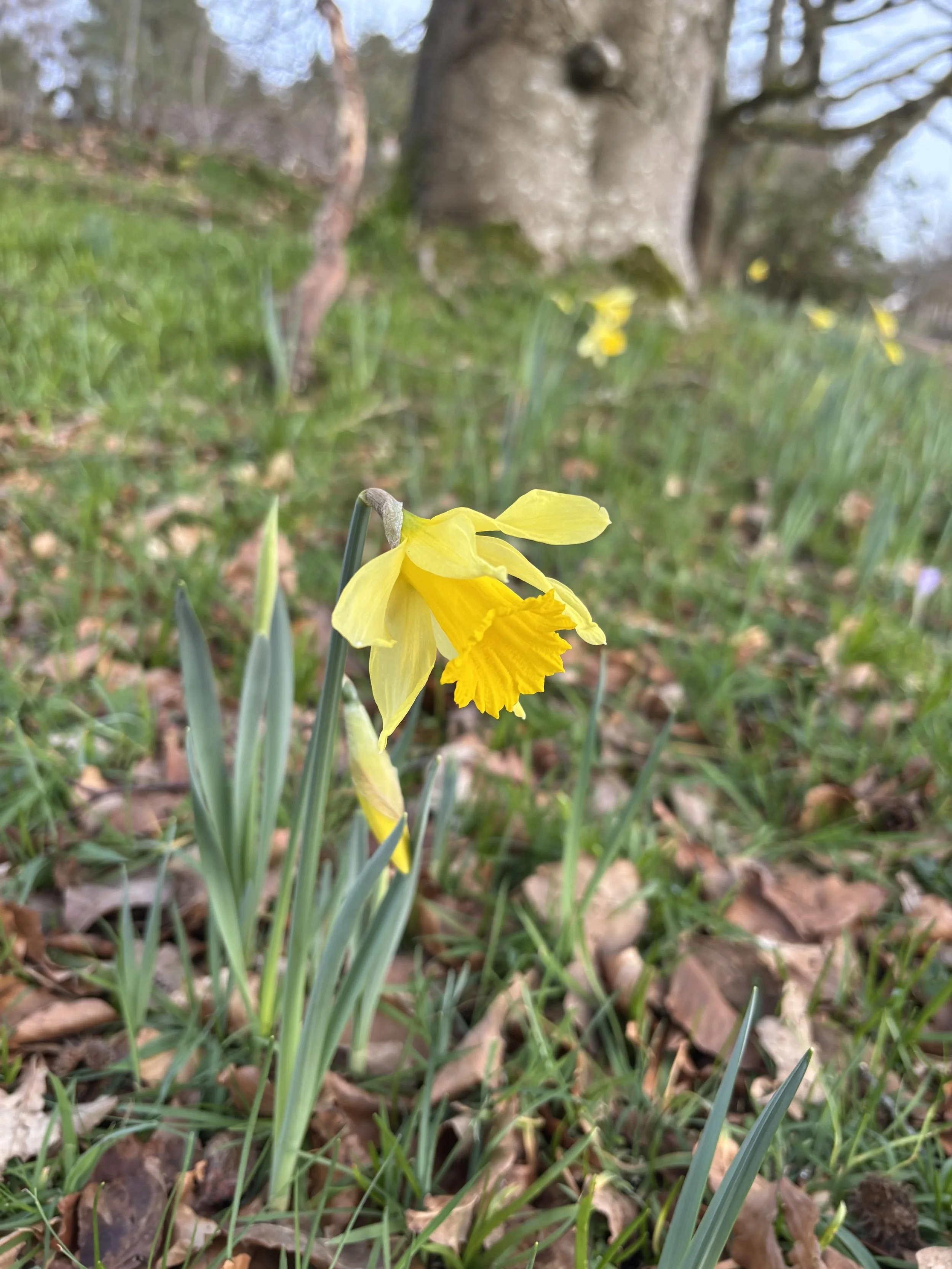
For the last few years the appearance of the first Narcissus pseudonarcissus in my garden has set my mind to thinking about the role of social media in my life. The stories of Narcissus and Echo seems a relevant modern parable. For those unfamiliar with the story, Narcissus is a young, handsome, arrogant boy who spurns the affections of everyone around him. Discovering his own reflection in a pool of water he is transfixed. Love struck and unable to tear himself away he wastes and pales slowly into a hanging drooping daffodil. Narcissus pseudonarcissus in particular brings this story to mind with its pale, slightly melancholy flowers hanging down. Meanwhile, Echo is madly in love with Narcissus (who rejects her) and follows him around forlornly, gazing at him secretly from afar. Consumed by love sickness she fades, incorporeal, and is left as a disembodied voice, without agency or originality, only able to repeat (or retweet) what he says.
Since getting onto ‘the gram’ in earnest, I’ve been struck each spring by how fittingly these two figures align with elements of our relationship with social media. In both cases, these young people were taken out of the corporeal, vital, creative reality of life and drawn instead into a fantasy that cannot be realised. I suspect that many of us end up channelling a little of both of these characters when we gaze into the bottomless waters of our phones. I certainly do.

Inevitably there is a part of me that takes validation from seeing my work reflected back at me in kind comments, interactions and questions from followers. I don’t mean that I, like Narcissus, think this is a reflection of perfection: my garden is painfully flawed, and I get anxious sharing it at times. Where Narcissus sought his reflection out of arrogance, I think many influencers do so out of insecurity. Having left a job in which public validation was taken to an extreme it is perhaps inevitable that for a few years I will instinctively look to others when trying to work out if I’m doing something right. I regularly scrutinise my motivations for sharing my garden, and in the end, I have good, practical and worthwhile reasons to do so. I learn from other, much better gardeners, it is useful for understanding what problems people face at home and ask me about, and I feel strongly about people’s relationship with plants and have set myself the challenge of improving it in some small way. If occasionally I find my head leaning over the pool, my heart sinking at a post flopping or swelling as a post does well, I try to catch myself and come back to reality. I’m not sure all influencers are as aware of these dangers, and in more successful accounts I feel I can see the wasting, fading, as they lean closer and closer in, mesmerised by their own virality.
I resonate far more with Echo. It is possible to while away hours, pouring over the creations of others. Gazing longingly at mature gardens, or gardens in different climates, on different soils. Gardens without small children and ground elder and exhaustion. Gardens without me and my mistakes and failings but made with confidence, experience (and often a much larger budget). I try at least to be open in my appreciation, always liking and commenting rather than admiring furtively from the bushes as Echo did. Still I wonder if one could waste away, longing for what one cannot have, echoing the brilliance of others rather than thinking, trying, failing, learning and gardening for oneself.
In both these cases, the irony is that time spent on social media (either sharing our own beautiful gardens to see them reflected back, or ogling the beauty of others) drags us further away from the doing of the thing itself. Instead of creating for their own pleasure, regardless of what people might think of it, so many gardeners (I think particularly those starting out) reframe the experience around either emulating other gardens they’ve admired or creating a garden that will be approved of and reflected back positively. Of course I’m overstating it, and there are those that keep their even keel, garden for themselves, sharing their creation without caring how it is received. Instagram is also an incredible force for good: a source of inspiration and of connection, putting me in touch with kindred spirits I wouldn’t otherwise have met. It can be rather lonely being the only person that sees or cares about what one is creating and whilst my daughter enjoys picking what I plant, beyond that I find Instagram the best way to share what I love with people that are interested.
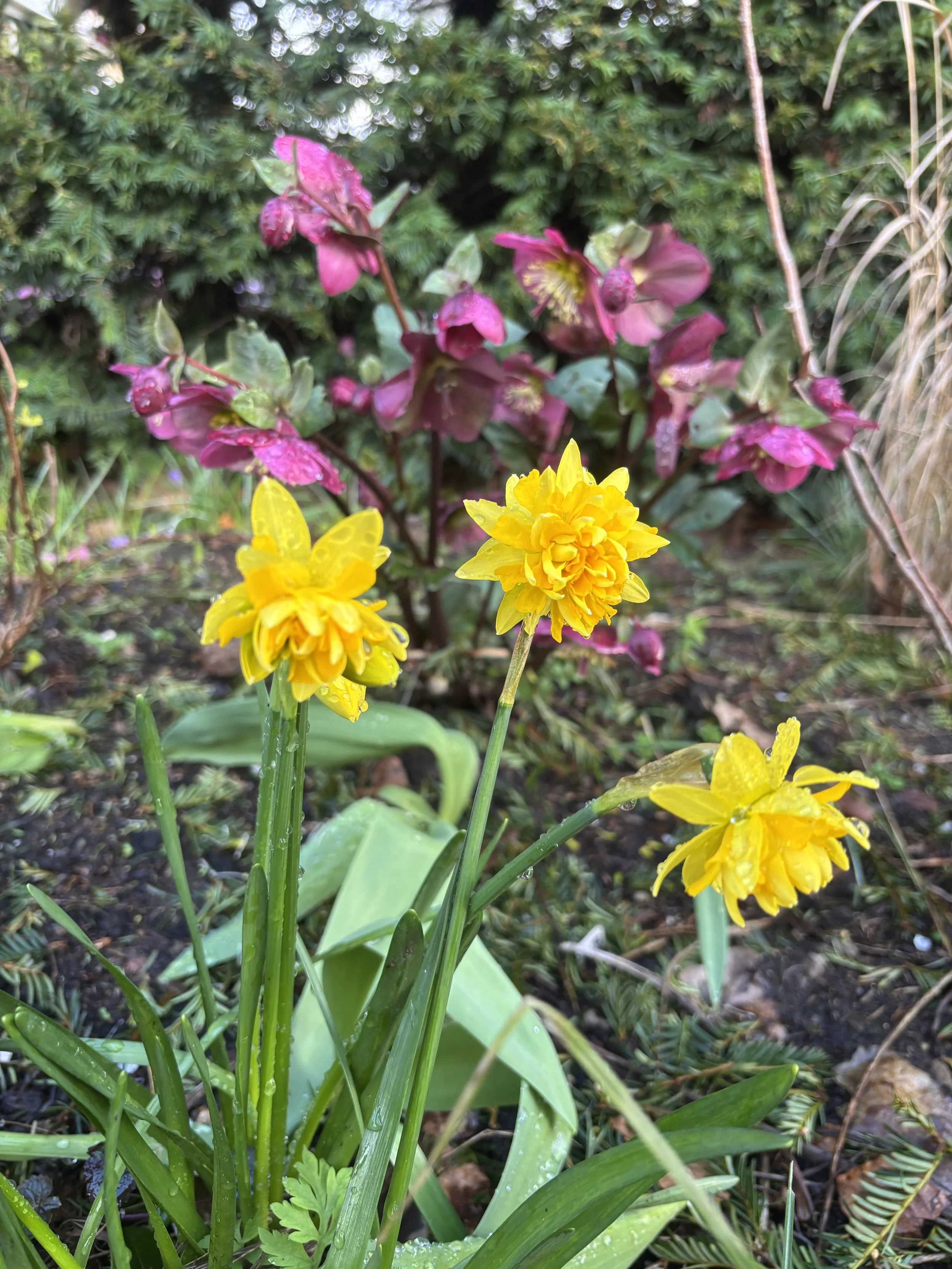
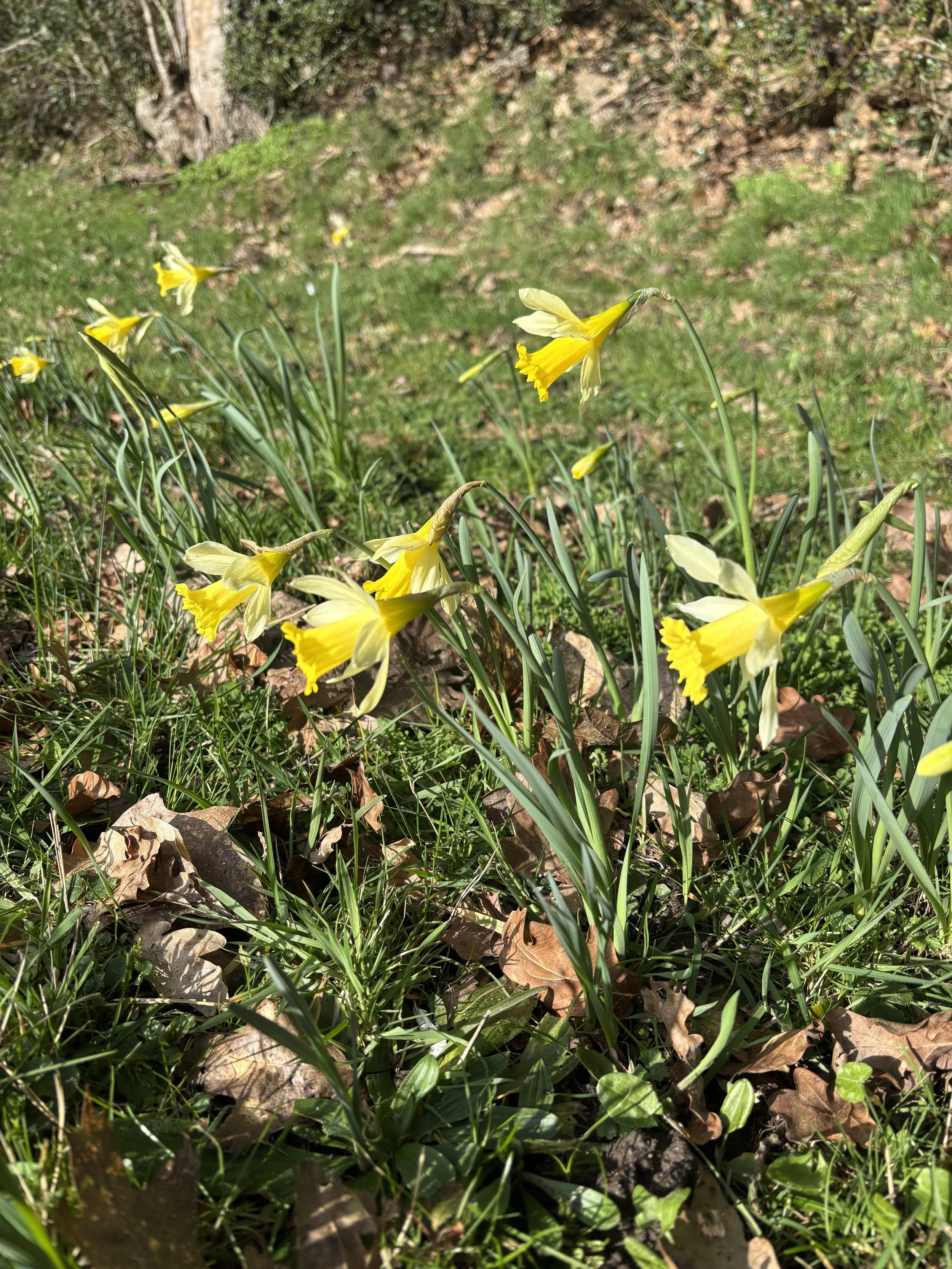
Last year I resolved to keep the Narcissus close to my heart as a reminder of the importance of action over introspection, creation over admiration. Whilst daffodils were in bloom in my garden I managed to keep my phone in my pocket and out of my hand in daylight hours. I will try my best to do the same this year. Luckily there is a long window of Narcissi ahead of me so I should get a lot done. After the first Narcissus pseudonarcissus the next to follow here are the cheap and cheerfuls which I have planted, ‘Tete a Tete’ and ‘Tete Bouclee’. Both of these are just breaking open now. Someone visiting recently looked at ‘Tete Bouclee’ and described them as ‘utterly ghastly’ which I was rather pleased with.
The previous owner here planted daffodils with abandon in the most joyous, rambunctious chaos, and the daffodils’ own promiscuous tendencies have filled out and blurred the boundaries between them all. It’s a merry riot that will take me from this week right through into April. I don’t have a clue what they all are but I enjoy them for the smile they put on my children’s faces.
For me it is the wan, down turned faces that draw me in. I’ve planted large numbers of ‘Snipe’ which I hope to see bloom for the first time in March, alongside the pale ‘Thalia’ which are now in their third year. When the last Pheasant’s Eye daffodils fade, weeks and weeks from now, I will have less of a visual reminder of the perils of validation seeking and wanting what one cannot have, but I will try to keep my head up, away from the black mirror, and to enjoy the muddy reality of living.
November
Surviving Frost and Keeping Faith
So often gardeners talk about January and February as the hardest, grimmest months of the year. Not so for me. Prone as I am to perpetually turning over new leaves, I face these two months full of energy and the fresh optimism of resolutions made on New Year’s Day and revised and renewed on my birthday (Feb 1st). The crisp cold resonates with the sense of as clean slate and I set about my roses and apples with a fresh gusto as I feel the pull of the lengthening days and the sap beginning to flow beneath my feet.
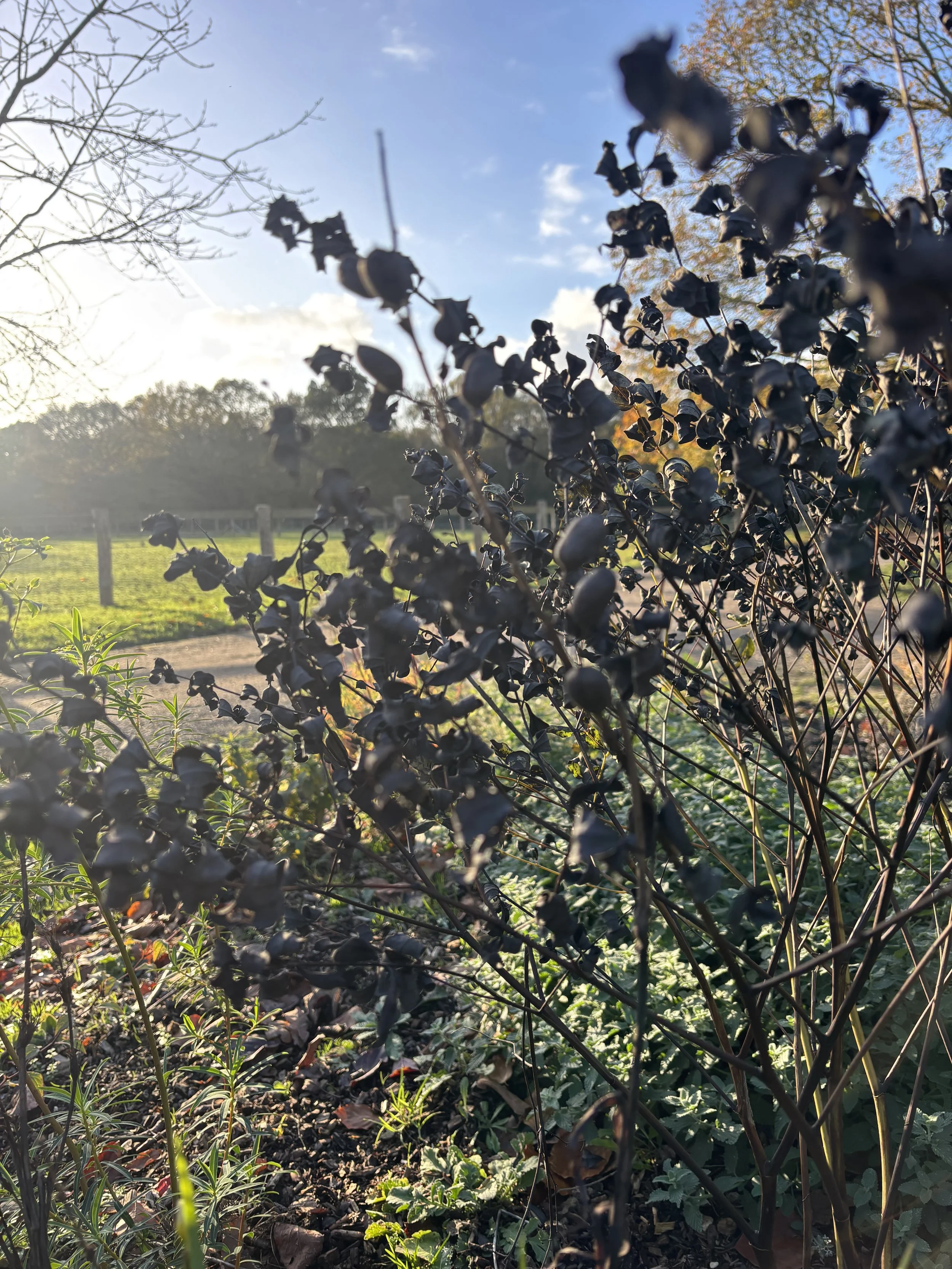
Baptisia foliage
November is my bleakest month. Even with such a warm November as this, I watch the plants around me fade and blacken and I feel a huge part of who I am slipping through my fingers. Having spent much of September and October with a clear sense of vision and excitement, dividing and rotating plants into a new iteration of the kaleidoscope for next year, suddenly the beds look chaotic and dishevelled, and weaknesses in my planting are laid bare. As the days shorten towards December I lose my thread and the sense of mission which has sustained me through Autumn collapses around me.
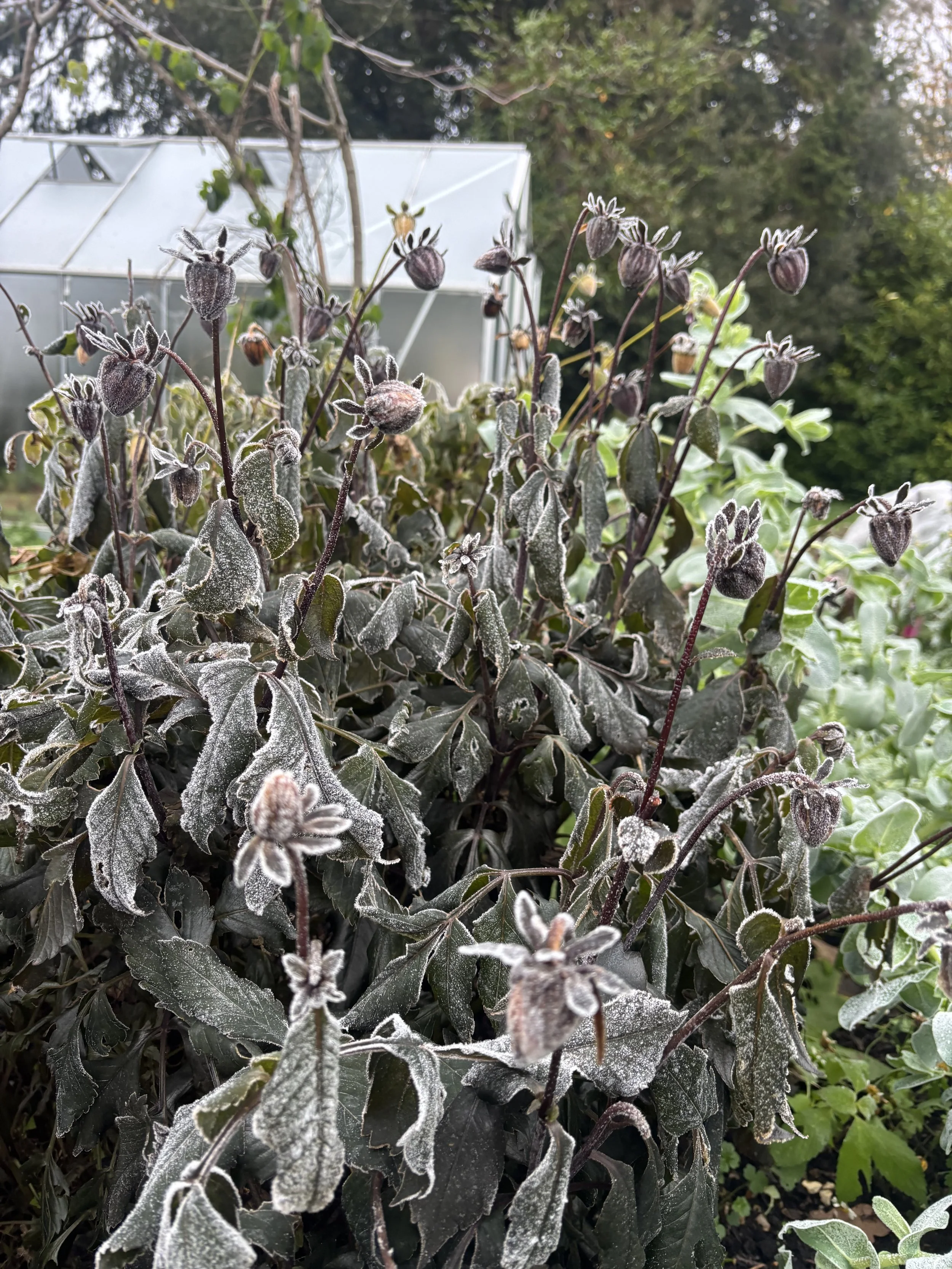
Frosted dahlias
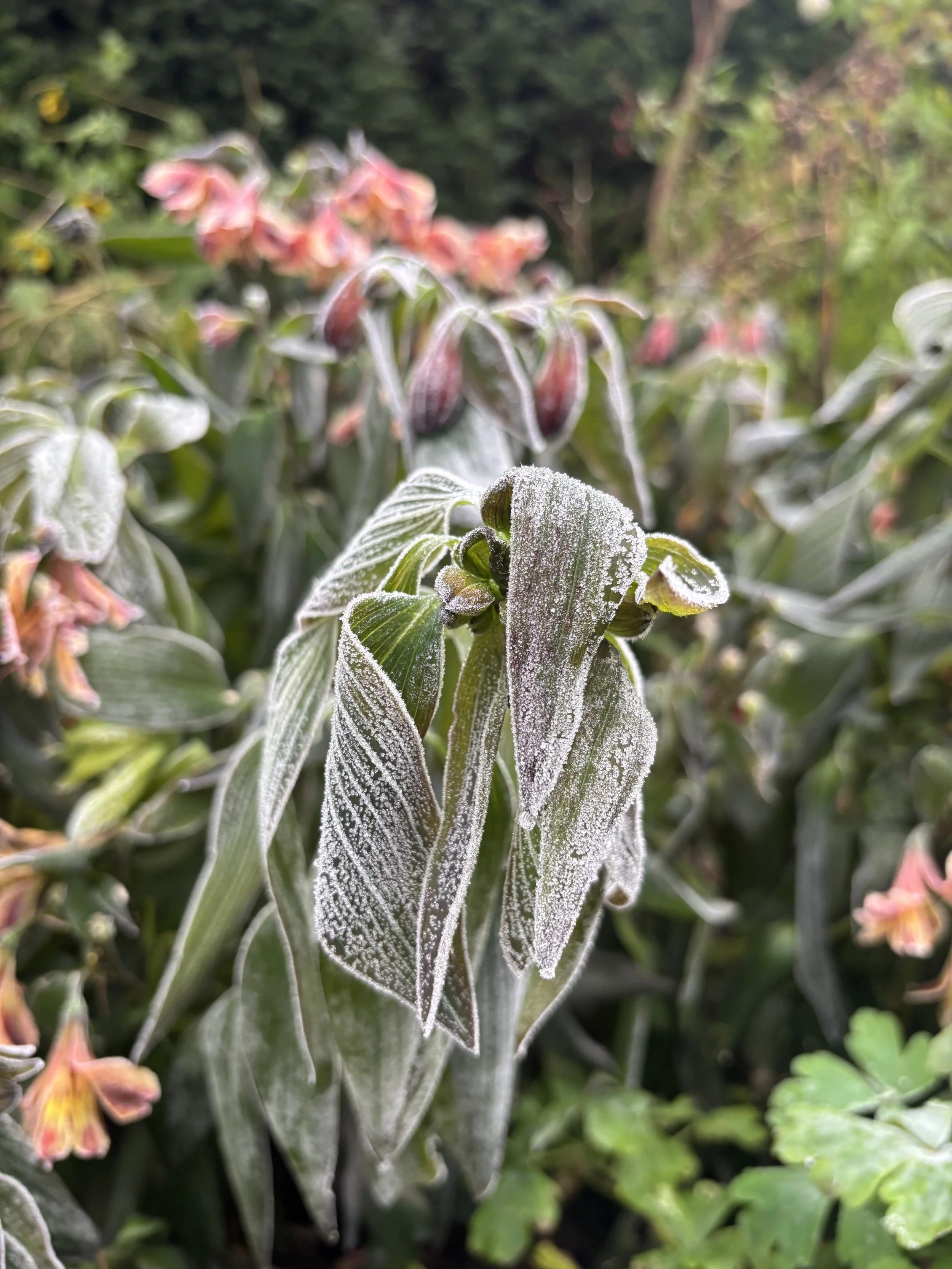
This last week I have felt like I’ve been cut down at the knees, doubled over and crumpled up by the frost like the soggy blackened remains of my un-lifted dahlias. I pride myself on being a relatively hardy person, but I suspect that like plants, people benefit from a gradual period of hardening off and ripening, acclimatising to the gently falling temperatures. This year’s swing from low teens to sub-zero within days has felt particularly brutal. The impact on the garden was instant. After a few beautiful hours in which my tender plants were perfectly suspended, crystallized, they all collapsed into great scars of blackening sludge in the borders.
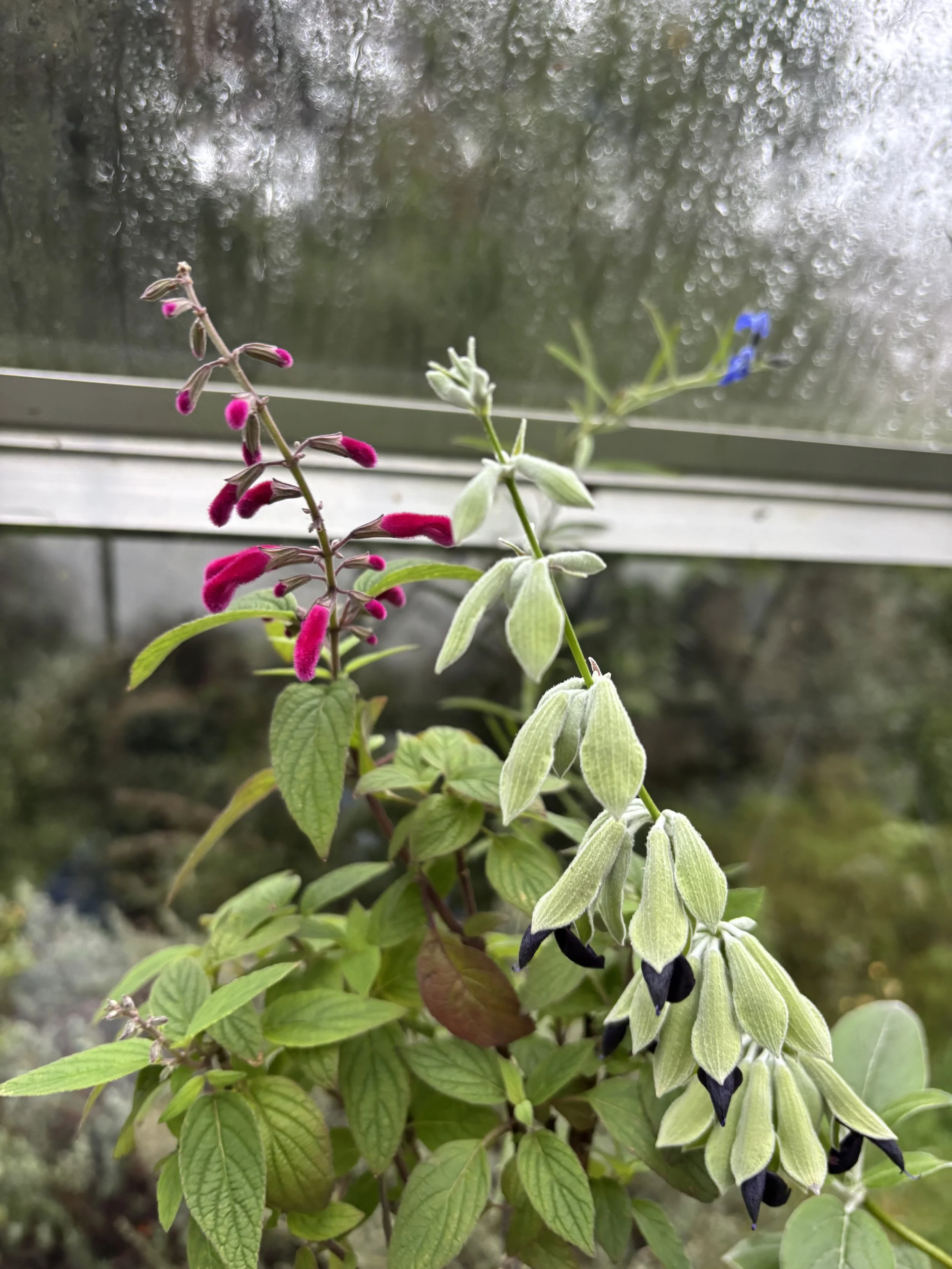
Huddled salvias
As I pulled on another jumper against the cold I considered how to insulate and protect my more delicate plants. I’ve started collecting various interesting salvias but am not yet at a stage where I can tell how hardy a new salvia will be based on its lineage or characteristics. Perhaps this is unsurprising given that a salvia’s ability to survive winter is based as much on the condition of its roots as the nature of its top growth. To be safe I brought all my new salvias into my unheated greenhouse at the start of November. Even then, when the frost hit, I came out to find some like Salvia ‘Discolor’ scorched and blackened. Not a problem (as I say it is largely their roots that count) but to be safe I have huddled them together for security and I tuck them beneath a layer of fleece at night before I go to tuck in my own children. On the coldest nights I have taken to co-sleeping with my 2yo daughter whose room is Baltic, and as my 5 year old dived in to join us for warmth at 3am I couldn’t help but think of my family of young salvias huddled beneath their duvet outside.
Other delicate plants I collect in beds around the walls of the house where, from my experience, the frost never settles. Our house is woefully poorly insulated and after an initial shock at the heating bills when we arrived, I have resigned myself to putting that heat to good use. I keep my favourite tulbaghia in one of these beds and they survive happily although I am now gradually moving them further and further out into the garden to see how well they cope. As back-up I lifted one of each of my treasured plants to keep under cover and propagate from in spring. I have other quite tender delights planted against the house walls which I’m too embarrassed to name until I’ve seen if my theory holds. Time will tell.
I’m sorry to say that with my more readily available plants I am rather lazy about leaving them through the winter. I’m yet to fall in love with dahlias and those few that I have are cut down and mulched unceremoniously with a haphazard bucket of woodchip or compost. So far, a successful strategy but they are in a raised bed and the last 2 winters haven’t been too cold. Salvia ‘Amistad’ which grew with great gusto this year I leave in situ, its great ugly mop of blackened foliage left in place as a sort of tatty blanket to protect the crown below. Not a big asset to the aesthetic winter garden but low effort. I have 2 lifted plants as back up in the greenhouse, but my outdoor plants have done well for 2 winters outdoors.
November the hardest month for keeping faith in the cycle and renewal of gardening. Hopefully when I have been a concerted gardener for 20 years, I will finally trust that next year mother nature and I will somehow pull it all off again. For now, green as I am, I find within weeks of the garden’s decline I lose all faith in its ability to return and my own ability to create. It seems impossible that my new beds which were lawn in Spring were a confection of delicate silvers and sugar pinks by summer. Impossible that it will do the same next summer, let alone that it might be better, the plants stronger, and that I might improve it.
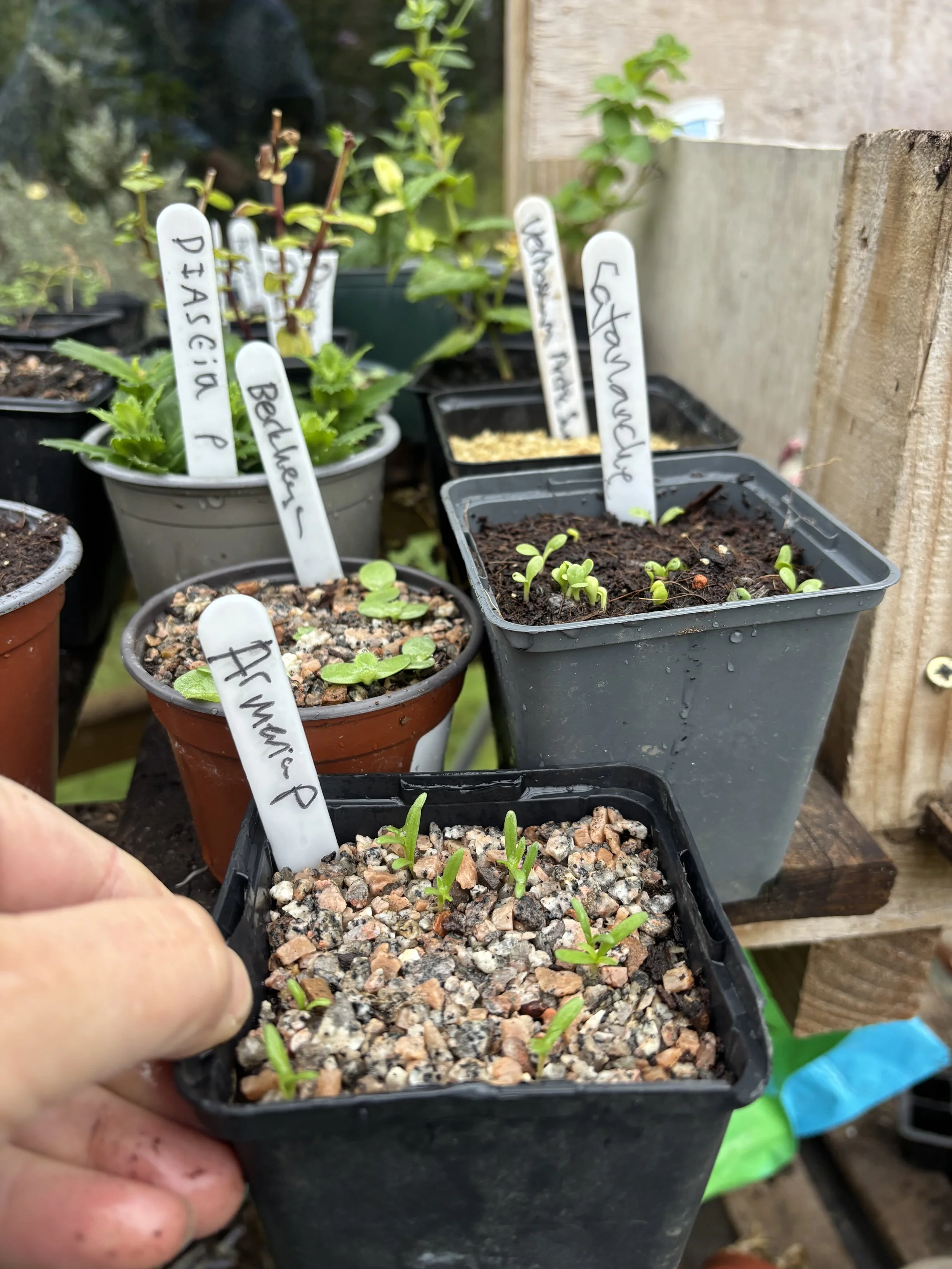
Seedling ready for pricking out
I find that small propagative acts help a lot with this, and in quiet moments I have been delicately pricking out seedlings of perennials and hardy annuals for next year. Tucked in tight but unheated against the cold, these tiny acts of faith won’t do much for now, but if they can survive the coming months they will grow away early next year. In the cold and dark their tiny frames look hopelessly fragile, but I find this sowing and overwintering ends up being the thread of hope and creativity that pulls me through to the new year.
Finally, in November I feel exhausted. September and October have been incredibly busy, working against the clock to take formative action for others in their gardens as well as in my own. The thought of the effort required to whip the whole circus back into shape next year feels crippling. For now, I am slowing my pace. Having output so much through spring and summer it is a luxury to spend the winter focussing on input: reading, listening, studying, researching. Hard as it is to have the year come abruptly to an end, I have faith that from this inputting of knowledge, this intellectual horticultural nourishment, a new gardening season of inspiration and experimentation will grow.

That Old Feeling
Autumnal Stirrings
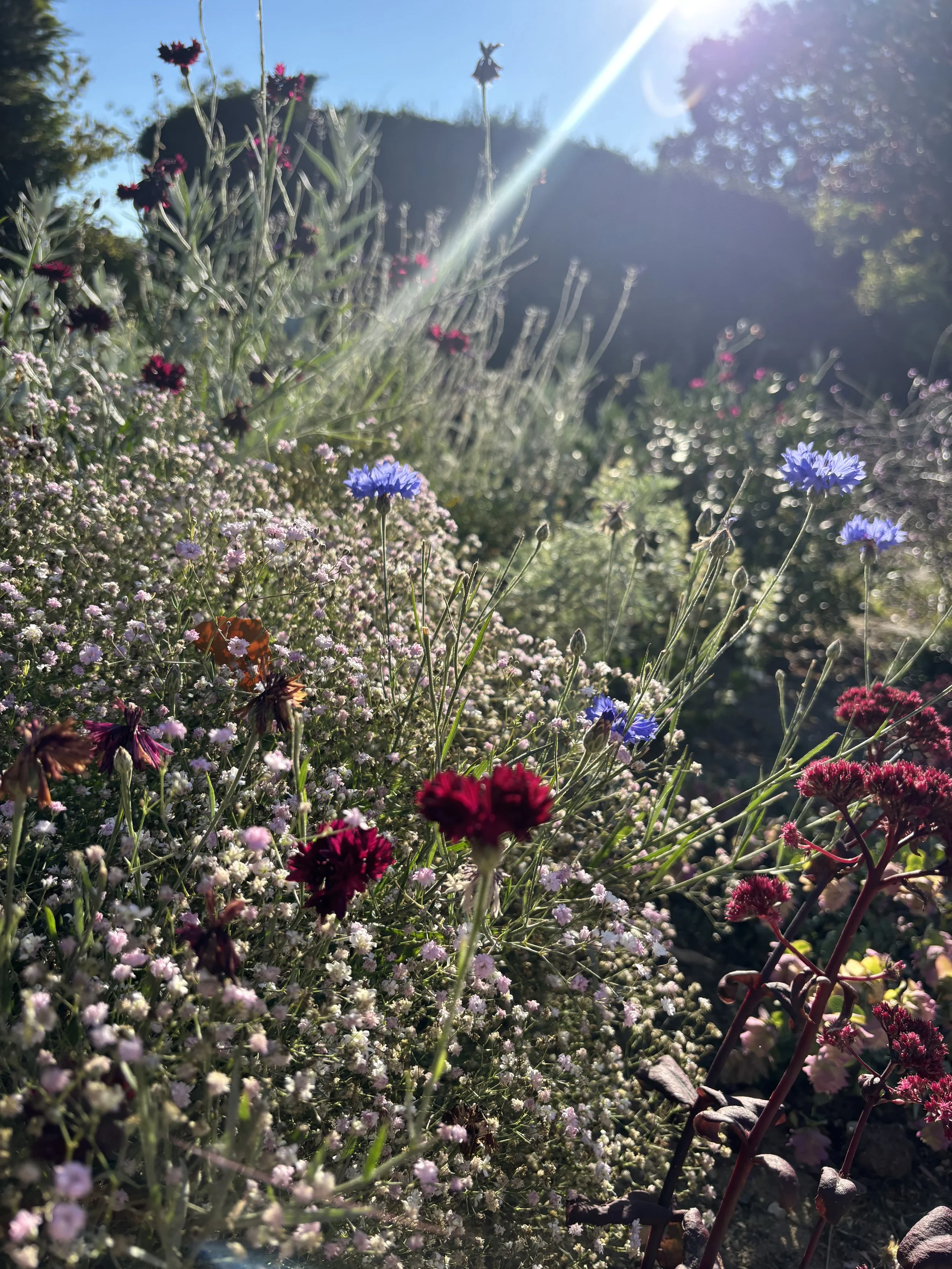
Drought tolerant Gypsophile ‘Rosenschleier’ and Hylotelephium
This has been a tough summer with the stress of drought hanging over the garden. Pleasingly my new ‘dry garden’ planting has shrugged off the heat remarkably well, remaining fresh and sprightly around me whilst, in the middle of it all, I have wilted. Despite being a great lover of resilient, heat loving plants, I have always felt more aligned with the woodlanders – dragging through the summer, semi dormant, waiting for autumn rain to refresh me, a period of gentle growth through winter and then revelling through early spring. A pulmonaria of a person.
Autumn is an electric season. A time for planning and doing and digging and planting, before the inevitable disappointments that come with the following summer, and the endless slew of palliative care, watering and deadheading, cutting back and propping up. The joy for me is in growth and potential, not in postponing the inevitable, dragging out the garden’s demise. The arrival of September is the golden, pivotal moment in which the world tips back into action.
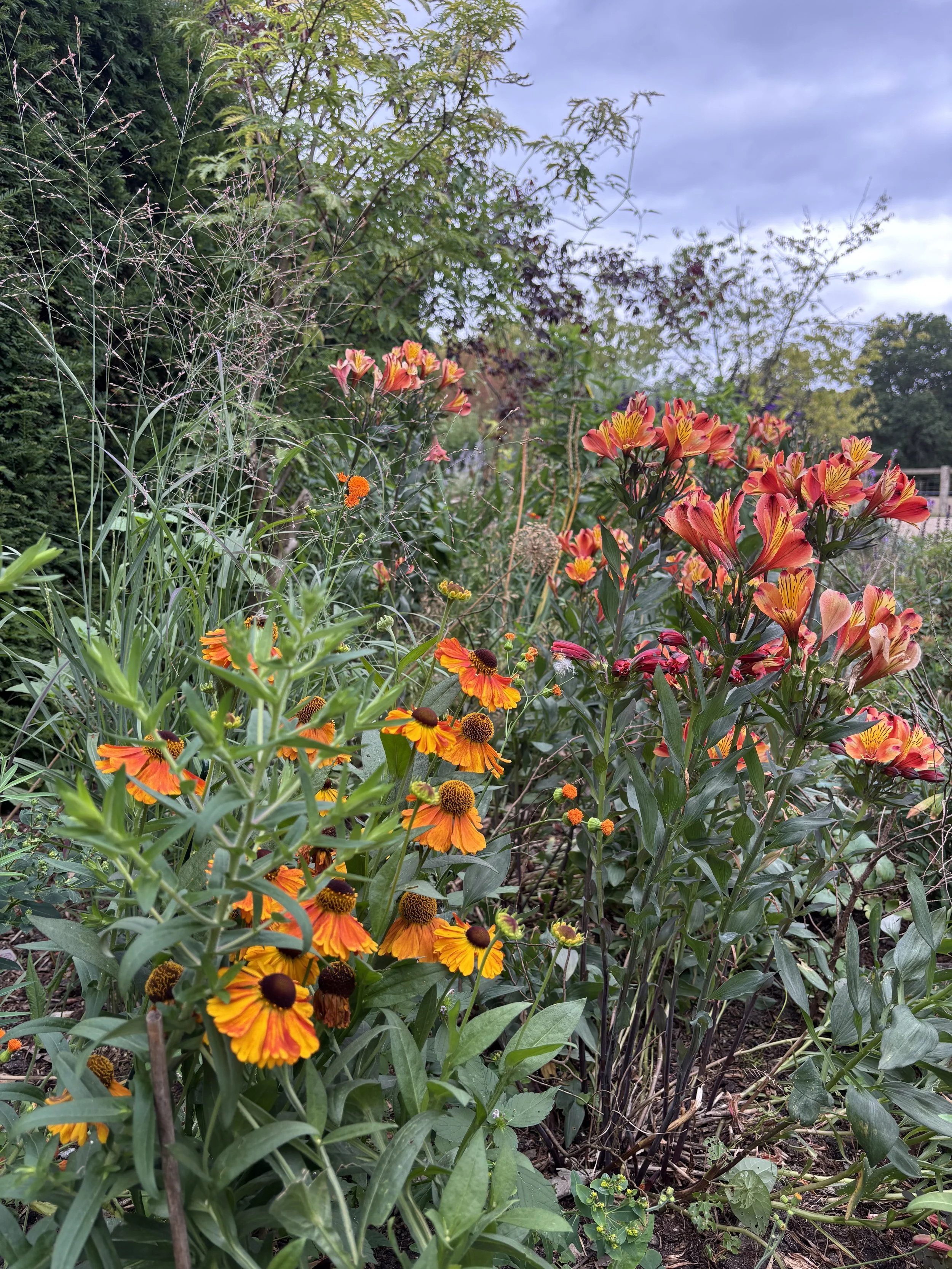
Late summer helenium and alstroemeria
In the last weeks of August Autumn can feel a long way off as the garden sags beneath the heat, but I always feel the first stirrings of anticipation at this time of year, like the first hint of a cool breeze finally on my face. Having had a strong sense of creative vision through the spring, I find that by May I lose the plot, too tired and lacking confidence in my own plans. All summer I worry – ‘What am I even doing? How can I maintain such a big space? What am I trying to achieve?’. I walk around the garden seeing problems and, no matter how hard I try, it is hard to muster confidence in my ability to fix them.
But last week, right on cue, as I was making dinner for the kids, I felt that first breeze of enthusiasm against the cheek, and ideas for the year ahead began to pop into my head. Wisps of a plan. Plants began to step forward and, when I thought they’d fit the job I paused to write them down. Now that the nights are too dark to garden, I will start to spend my evenings researching plants, trawling through the lists of good nurseries and further researching those that might serve well here. It’s a process I love a little too much and I force myself to save such ‘work’ for dark evenings at the end of the year rather than wasting good summer gardening time longingly chasing the mirage of what could be.
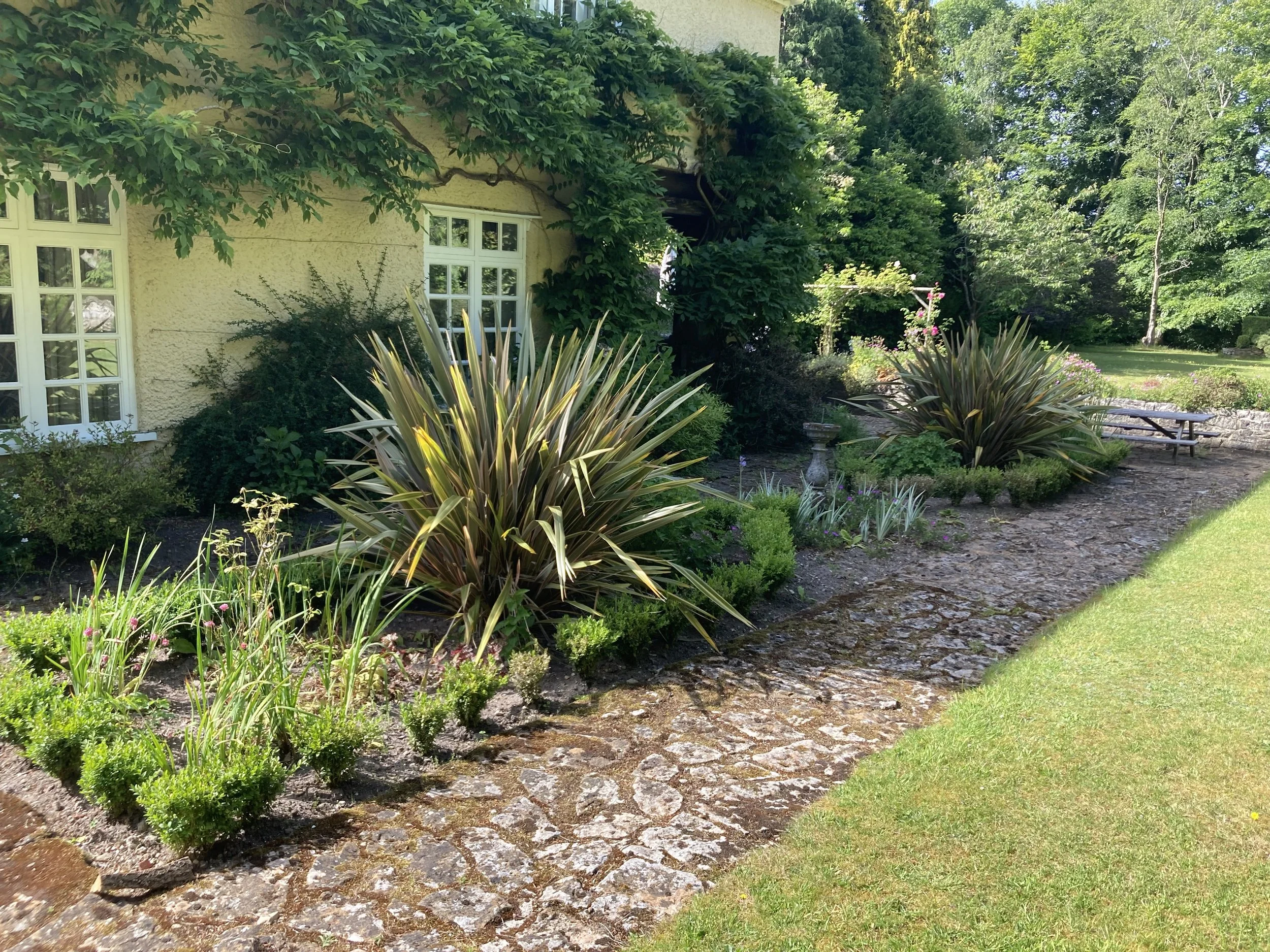
Narrow bed before we moved in
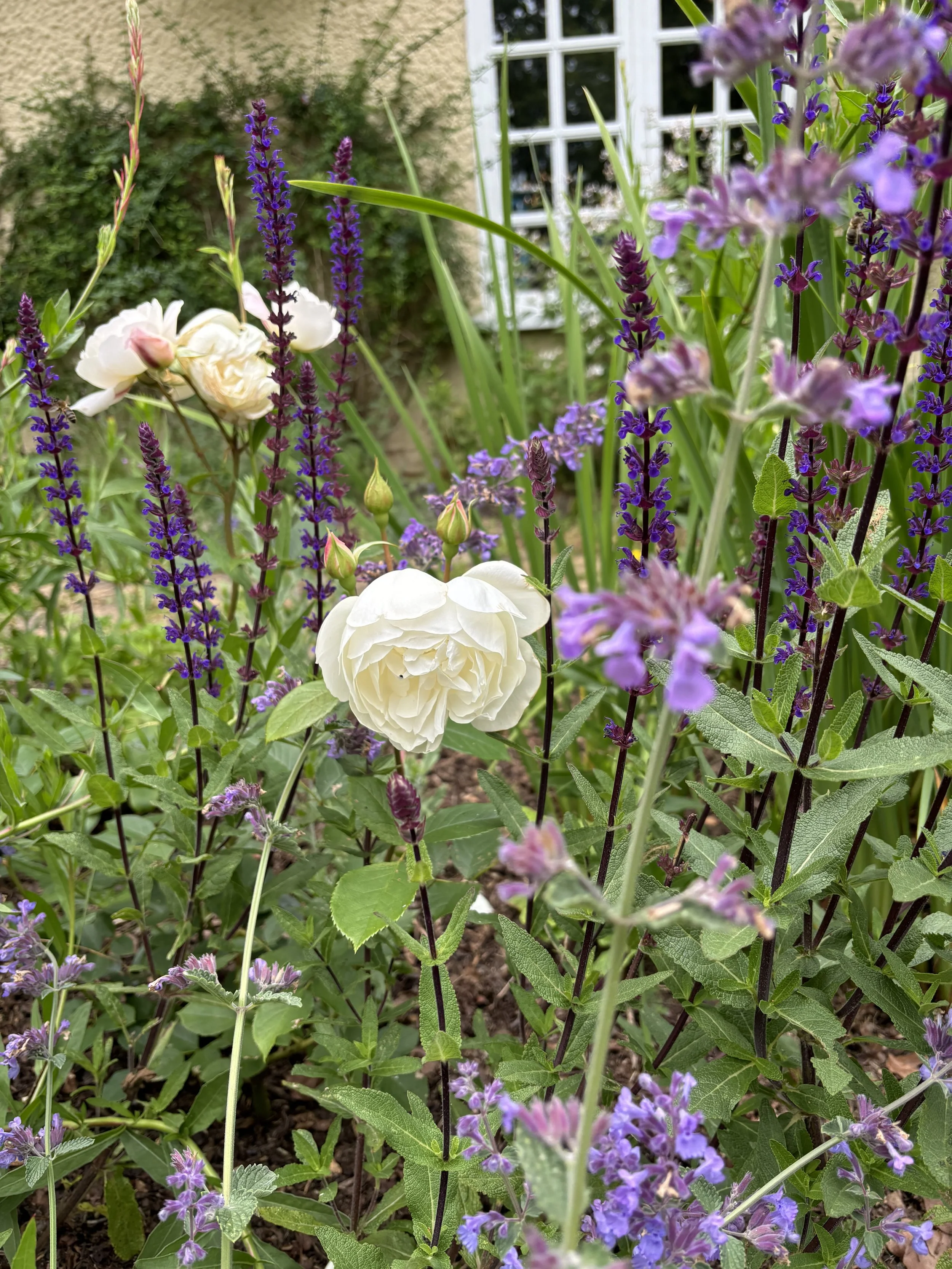
Current planting - lovely but a bit serious
Since moving here the week of Christmas 2022 I have tried to create one big chunk of garden and planting each winter and spring, so three big waves in total (I dug the first bed in our first winter, just after moving in and waddling 9months pregnant). For the first time this year I am expanding and reworking areas which I’ve already planted. The biggest chunk of work is on a longish, narrow but double bed running beside the house which I planted in our first spring here, with baby Iris only weeks old. At the time I removed a lot of sickly box hedge and then tried to largely fill the bed with what I could cobble together for free.
Divided Iris sibirica, Salvia ‘Caradonna’ and Geranium ‘Rozanne’ already in the garden, Alchemilla mollis and nepeta from a friend, two Rosa ‘Desdemona’ and some new perennials and shrubs I bought for the purpose. Since then, the planting has ticked along but without much to excite or raise a smile – altogether too subdued a palette for me. The main job this winter is to expand the border (lifting 100 or so old paving stones) and breathe a bit of humour into the planting.
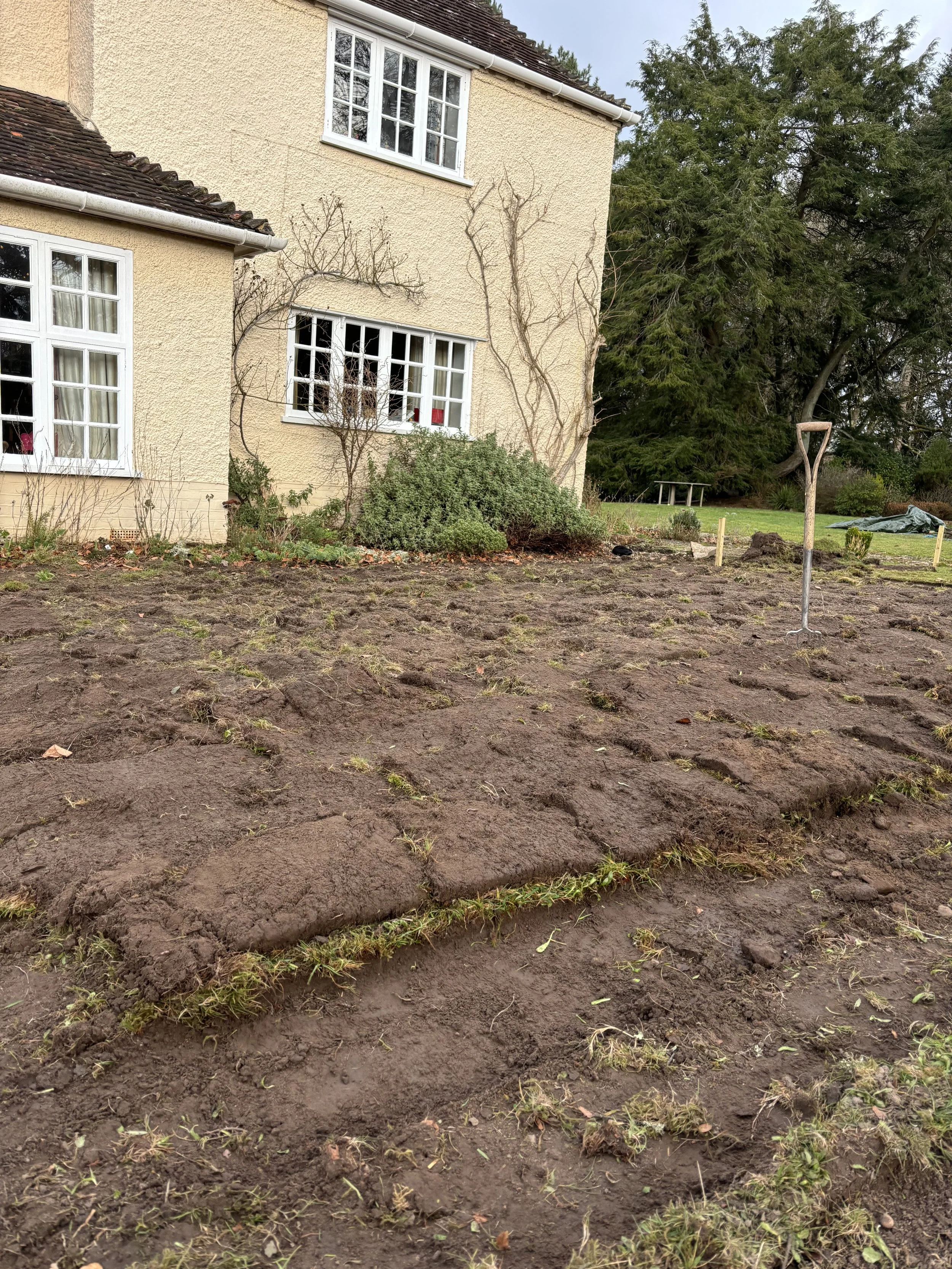
New beds March this year!
Then the 4 new silvery beds need filling as I conked out of steam and plants dramatically in mid-May this year leaving the back of the beds empty. Some good shrubs are destined for them as well as cardoons and further splits of perennials I’ve been nurturing. The two front banks need some rejigging, useful self- seeders of Corsican hellebore and scabious redistributed and the enormous Achillea ‘Cloth of Gold’ split and shuffled backwards where it’s ugly legs will be covered. My supposedly exuberant orange border needs a full overhaul as it is now over heavy on certain things (mainly Geum ‘Totally Tangerine’) and light on others. There’s a lot to do, and for all these areas the game is to introduce fresh excitement on as little budget as possible. New perennials are grown from seed or ruthlessly divided from overcrowded 2L pots I have pounced on.
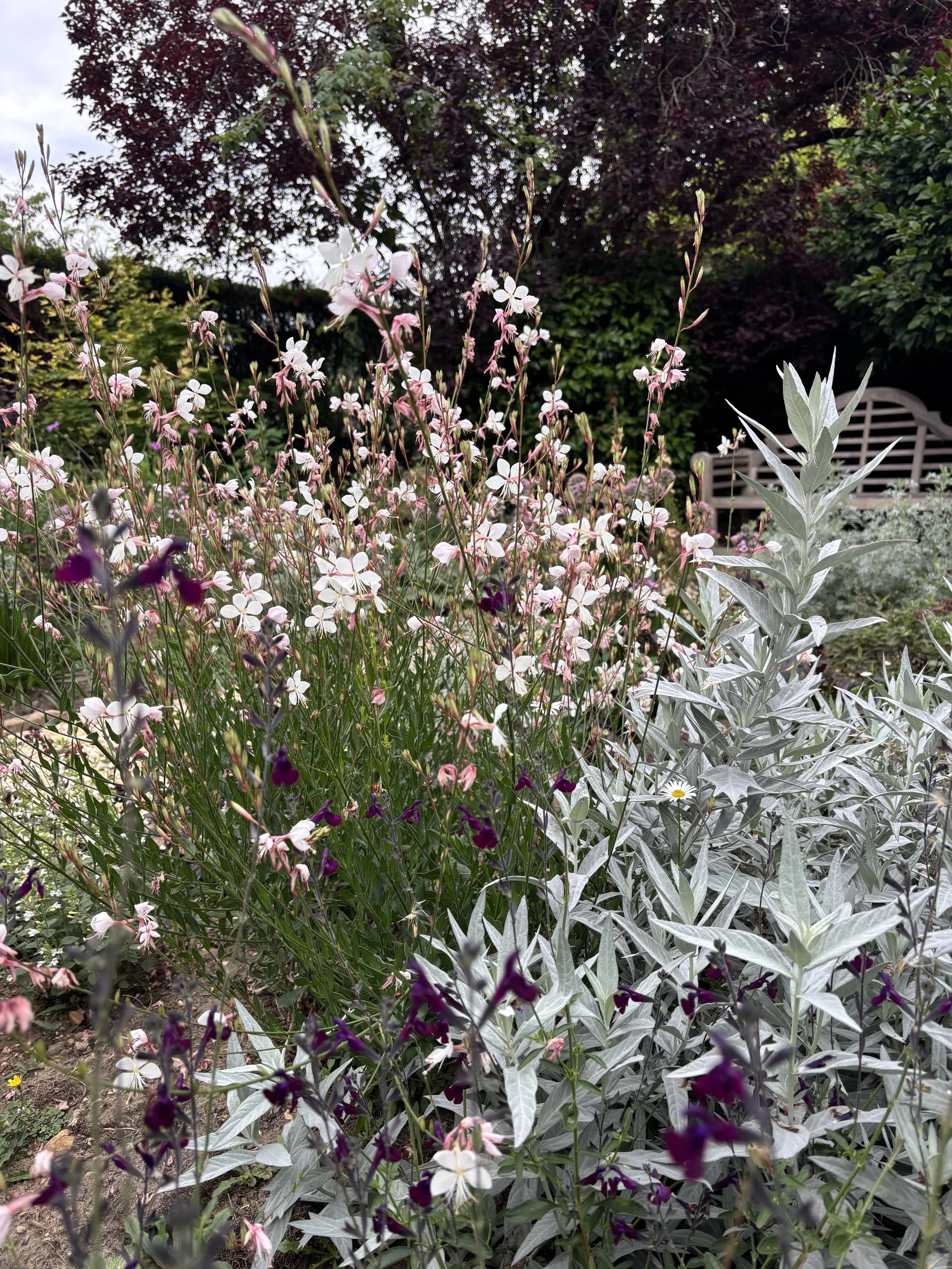
New silver beds have thrived but have big gaps that need working on
The August wait has been excruciating. Given the drought this year, I feel I’d like to see plants have a good spell of rain before any rough handling. We’ve just had two blessed days of rain but any real reworking must be a good few rainy weeks away. I couldn’t resist making some practical progress and as well as taking cuttings I’ve done a bit of light division. Several weeks ago, in a moment of fervour, I ripped a gorgeous red Astrantia into 15 pieces ready for a new bed I’m planning. Already their roots are showing in their pots and they will be perfect for planting out by the end of September.
I am itching to get going: to dive in, rip out everything I’ve done so far and rework it. As with every winter, I will work feverishly with a clear, bright vision driving me on. By next June, as with every summer, I will look at what I’ve done and roll my eyes and wonder how I could have been so foolish. This endless spiralling seems to me to be the sweetest part of creating a garden. The constant tantalising vision before you and the impossibility of achieving it. I have no doubt that I will never make a garden I’m really happy with, but give me 20 more winters here, and I hope I’ll be close.

Drawing a Blank
The pressure of pinning down planting
I remember the joy of my first taste of ‘planting design’ so clearly. In the depths of motherhood in lockdown I enrolled in an online course as a way of making some small and achievable progress towards a future I was impatient for. I was set a series of simple beds to design, each with various constraints, and received (extremely helpful) feedback on my work. On one hand there was a childish playfulness to arranging plants, and on the other the absorbing puzzle of visualising them season by season, around and about, over under and through each other. Finally, a brain teaser I enjoyed. In fact, it became something of an escape through the highs and lows of motherhood. Creating fictitious spaces and escaping to them whilst rocking crying children. I would set out a puzzle for myself, a corner of an imagined garden, and begin to furnish it season by season. As I was in labour with my daughter, I clearly remember dreaming up the sea of blue that I would plant around the feet of a stachyurus (a favourite of mine and in bloom when she was born).

Tasteful but a little too subdued for me
So, it’s a strange feeling to be sat, pencil in hand, struggling to put down on paper and link together the many scraps of ideas I’ve had in the last year for planting up my own garden. When other people have asked me to design beds for them, they’ve usually come armed with an array of pictures of what they like and often with a request for easy and minimal maintenance. Helping people navigate that process still gives me the enjoyment of those first exercises in design. But somehow creating my own garden feels impossibly hard. It’s my own space and I can grow whatever the hell I like, especially as I have no real desire to create a polished or perfect space. But I love so many things and could combine them in so many ways that trying to pin my thoughts down feels impossible. Since my goal in my own garden is to have a space to experiment and learn, try things different ways and get to know for sure how I would do things for other people, there isn’t the usual requirement for simplicity. I have one bed here which I planted up with the elegant classics which seem to be so much used and asked for these days: Nepeta to line the path, Salvia ‘Caradonna’, Rosa ‘Desdemona’, Iris sibirica and Gaura and so on. It looked lovely but is so far from my own style that I immediately want to change it all again.
I try to remind myself that, since that first taste of planting design, I have come to realise that gardens are never perfect, finished or static things, and that that would defeat the joy of them anyway. A garden is a constant, complicated process. A drawn plan is a good kicking off point, but no more than that. Even the best planned garden would have to shift and change every few years as plants expand, compete or succumb. No doubt mine will be unrecognisable in a few years’ time as I realise my mistakes and try to rectify them. Very few planting decisions are a one-way ticket (I’m holding back on the wonderful but woeful ‘forever perennials’ like Acanthus or Anemone x hybrida until things settle a little having spent far too much time digging them out of other people’s gardens). In fact, in the new area I’m planning, the vast majority of shrubby plants are fairly short-lived cistus and the like. Within the decade I will be replacing them from cuttings and the whole space will shift again.

Collecting plants in temporary beds last year in order to begin propagating them
Then there is the knowledge at the back of my mind that even if I drew up a ‘finished’ plan, I would never be able to plant it immediately. The area I’m working on is 4 beds of 5m by 7m with a long bed beside. A huge space to fill. I’ve been busily trying to create plants to fill it out: a sea of cuttings and seedlings in my greenhouse. Inevitably I’ve ended up with modest numbers of those I prize most and buckets of those I’m ambivalent about. But even with these I know there will be a period where I’m coxing and boxing to cover the ground. I plan to buy the main backbone of shrubs, and I tend to dice up and grow on my perennials when I first buy them, but realistically spaces will be held by those things I have more readily available (100 Lychnis coronaria seedlings from my parents’ garden to become 1,000 self seeders next year) whilst I try to build up stock of the things I want (Rhaponticum centaureoides, Serrulata tinctoria, Tulbaghia and so on). A satisfying process, saving some money and connecting me with every plant in the garden but it means that the garden will be a shifting, very imperfect thing from the start.
For me, the joy of gardening is in the process and the detail. The practicalities of planting and tending, and the small corners of interesting combinations which shift season by season. In the age of Instagram, it’s very easy to think of a garden as a picture, an end goal, and to feel the pressure to get something ‘right’ immediately. I keep seeing gardens planted with ever closer packed plants as we all try to attain the immediately full and finished ‘look’ we see on-line. There is a constant pull to see a garden as a finished product when in reality it is a process and an evolving relationship. I think this is particularly true in our own domestic back gardens. As in life, if we focus entirely on achieving some fixed ideal and forget to enjoy the journey, we will have missed the real magic of a garden.

Euphorbia myrsinites snaking over the first newly laid stones
As I put pencil to paper at last, I try to shrug off the sense that someone is watching and judging me over my shoulder or that my ideas need to be inspired and spot on first time. Building imaginary gardens is substantially easier than creating real ones, though much less meaningful. If I forget practicalities for a few minutes, I can recapture that sweetshop feeling I loved when my gardens were imagined, and start to pin down wisps of ideas: carpets of pale cyclamen revealed in winter beside silvery foliage; big cardoons shining against a backdrop of Cotinus, Euphorbia myrsinites snaking its way up and over stones. Fundamentally I am creating a horticultural playground for myself and planting out the starting point of what I know will be a long and fulfilling journey.

Planting my escape
A horticultural staycation
The Easter holiday arrived with some disagreement and a little resentment on my part. Faced with 3 weeks of daily sprogging and endless downpours I was keen to book a family trip, and I’ve been longing to return to Greece at Easter for years. It was selfishly motivated to be sure. I have incredibly vivid and formative childhood memories of spring wildflowers on mainland Greece and happen to be in the middle of planting up two enormous, dry banks with Greek hillsides as my inspiration. So yes, I would have dragged the kids off to do some botanising at every opportunity, but I’m sure they would have loved it.
Toby, thinking practically, pointed out that flying 3 ½ hours with 2 sprogs and a baby for a few days would be a lot of effort; that it was a bit last minute; that Iris insists on napping in cot twice a day so we would be wedded to our rooms. Eventually I agreed that we should leave it for another year. And so, the Easter holiday arrived, an unstructured morass of rainy, muddy days.

The plus side of staying put was that, in the first few days while my parents in law were visiting, I had time to start work on my own miniature Mediterranean hillside. Step one was laying out the 80 or so plants I had assembled. And so, rather than roaming amidst sun drenched banks of euphorbia, I stood in drizzle, clutching a soggy piece of tracing paper and pacing out the small, sad looking green tufts of my own potted Euphorbia wulfenii. The first bank is 13m by 8 with a fairly complex planting plan, so I trudged around arranging the blues of lavender, spreading rosemary and ceanothus, nepeta, perovskia and 60 sky blue iris, interwoven with the airy yellow wands of Cytisis praecox, Baptisia, Phlomis fruticosa and Sisyrinchium. After several hours in the mud, the plants were laid out, but the rain had begun to set in, so I downed tools for the day and headed inside where the sprogs were merrily bouncing off the walls.
That night Iris woke crying at 2am and, as I fed her, I listened to the sound of 40mph winds ripping around the house. In my stupor I didn’t register the full implications of this, but when I came out, spade in hand, the following morning, all 80 pots had blown off their bank and into our drive. I began again, this time working on small sections and then planting to secure them.

Yellow flowered broom, Cytisus praecox ‘All Gold’
As I worked, the names of the plants transported me to the Mediterranean: Verbascum olympicum, Genista aetnensis and Helleborus corsicus. In went the ferny leaves of Ferula communis which grow in their thousands on Greek mountainsides, and the stem of which was used by Prometheus as a vessel for that first spark of fire he gifted to mankind. I planted banks of the wild Iris pallida, sacred to the goddess of rainbows, and clumps of sulphur yellow Helichrysum from which Apollo wove his crown.
There was a painful irony to planting these drought tolerant beauties in the rain, but in the end, it was probably no bad thing. This part of the garden is designed to be low maintenance and to go without water but to achieve this it helps to give plants a good head start. I plunged each pot into a bucket of water for good measure, and slooped water around them after planting to help them settle in. Good luck to them.

Euphorbia characias ssp. wulfenii
Miraculously Easter Sunday arrived with blue skies and, as if in answer, the yellow Cytisus praecox came into bloom. I may not have made it to Greece this year, but in a quiet moment when the sprogs are busy finding worms, I can take my coffee out to our drive and plonk myself between nepeta and cistus. If the sun comes out and I bring my head low enough to the ground, gazing between lime euphorbias and the apple green flowers of the hellebore, I am transported back to the Attican hillsides I visited as a child.

Violets
Divine and deviant, tiny but tough
Homer describes Persephone as collecting bunches of roses, crocus, wild violet, iris, narcissus and hyacinths before Hades drags her down to the underworld. This seems to me an unlikely and lumpy bouquet and it is disappointing that out of season roses (no doubt imported) have been an inescapable feature of floristry since ancient times. I suppose that, as the goddess of spring, Persephone excelled in getting flowers to grow, not necessarily in arranging them.
The Ancient Greek violets must have grown an awful lot taller than the Viola odorata in my garden which, reaching about 10cm, wouldn’t add much to a mixed bouquet. They have come to symbolise modesty because of the way their flowers are often tucked away, hidden amongst the leaves, but their diminutive size and humble habit do not diminish my respect for this little plant which fills all sorts of nooks and crannies in the garden and is extremely useful.
They may not be showy but they are as tough as old boots. They tolerate mowing, moving, poor soil, sun or shade and dry or moist conditions (though a damp and shady spot will prolong their flowering). Several times I have lifted a clump and forgotten about them, found them with bare roots on the garden path the next day, bunged them in a dingy corner and hey presto. They’re a great option for spaces that get a lot of rough use. They sit comfortably around the compost heap and whilst most plants take umbrage at being trampled and wheeled over, the little violets carpet the ground with foliage throughout the year and provide deep purple flowers in the earliest days of spring when even the tiniest bloom can hold the stage.
Violets take their name circuitously from Io, mistress of Zeus, whom he transformed into a cow, hiding her from Hera’s wrath. Accustomed to the delicacies of palace life, Io wept on tasting the bitter grass which was now her breakfast, lunch and supper until, as a parting gift, Zeus transformed her tears into sweet violets on which she could graze. The story of Io has always left me with the image of a rather pampered heifer with a terrible sweet tooth. An appropriately fragrant diet for a divine mistress, violets are edible to mere mortals too. Their sugary scent has long been prized and more recently abused in confection, from the rather lurid ‘creme de violette’ liqueur to the sickening Parma Violet sweets named after the wild violet’s rather frou-frou and heavily scented frilly French cousin. There are classier ways to use violets in the kitchen. Their leaves, apparently packed with vitamin C, can be added to salads, and their flowers can be preserved in sugar, crystallised to decorate cakes, or turned into a home made subtle ‘Creme de violette’ equivalent by being steeped in Vodka. Bear in mind that the famous odour of Viola odorata can vary considerably and in many cases has been lost, so homemade liqueur or sweets are likely to be only subtle in fragrance but a very decorative colour.

Cleistogamous violet flowers
For a plant representing modesty, the Viola has a remarkably deviant sex life and wantonly reproduces twice a year. In spring its flowers open and it interbreeds with abandon, the seed heads rising up before popping open and flinging seeds widely. By contrast in autumn the viola produces small closed flower buds and, hidden beneath the covers of its rosette of leaves, furtively self pollinates. This autumnal reproduction is a-sexual and the flowers cleistogamous (from the Greek kleistos meaning closed). These flower heads grow beneath the soil, blanched and blind, looking like alien body parts. The upshot of this double reproduction is that the rather seedy violet tends to spread, but the young plants are easily dug out and are no threat if monitored. I tend to just plant them in the bare corners where they can self pollinate or fling their seed freely without causing offence.

Poor Ophelia floats down steam, a chain of violets around her neck, plucked before their time, destined never to set seed.
Reproducing twice a year might all seem a bit weird for a plant that plays such a fragrant and innocent role in myth and literature, but given that the violet’s poor spring flowers have been plucked by almost every literary maiden since Persephone herself, it makes sense to have a back up should spring pollination fail.
At this time of year one sees violets everywhere, so if you’re not too fussy perhaps the easiest option is to find a patch you like the look/smell of in a neighbour’s garden somewhere and ask if you can have some. For the purist there are heritage varieties available such as ‘Queen Charlotte’ that have kept their scent. Seeds will need stratifying, or else will need to be sown in Autumn and left out to the seasons, but once they get going they should self seed or spread by stolons, giving you plenty of future plants. I inherited my violets when I moved in and for some reason they always grow in the one part of the garden where I definitely don’t want them: I dig them up and shuffle them all down to the shady end only to find more doggedly growing where I had removed them the year before. This is no great problem as they are easy to move and, so far, I can always use more of them. Popping up in inhospitable corners, putting on a brave face after a close encounter with a wheelbarrow and blooming with spangles of purple in the coldest months of the year, it is this dogged determination that I love most about them.

Primulas
Human tinkering with what was already perfect
My earliest memory of being involved in gardening is of my grandmother. When I was still very little she gave me some low white metal ‘fencing’, about 15 cm high, to edge my own plot of garden and took me to a garden centre to buy bedding primulas. I remember being completely entranced by the variety of bright colours available, like pick and mix sweets, and I came home full of excitement to plant them. My grandma was genuinely very fond of primulas, but looking back they were also the perfect plant for a first garden experience: offering wide variety of colour with instant effect, and for very little money.

The perfect Primula vulgaris

… and man’s creation: the bedding primula
Since then I have struggled a bit with hybrid primulas. Their bright colours and compact form mean that, plonked in the ground, they can look a lot like something from a teletubby’s back garden, and they can’t seem to escape connotations of tutti frutti bedding schemes. With the current fashion for pollinator friendly, natural planting we are moving away from hybridised forms and double flowers, but still our selection and breeding of these forms is a huge part of our horticultural heritage and has its’ roots in the history of plants like the primula and polyanthus. Oddly other highly bred plants seem to be coming back into fashion, like the many weird and (sometimes) wonderful dahlias which have made a remarkable comeback in the last 10 years. They don’t seem to be judged so harshly. I have a suspicion that this is due to the innocence and purity of the much beloved native primrose, Primula vulgaris. Somehow we don’t mind seeing a frilly hot pink dahlia, but we look at what mankind has done with what was originally the fragile beauty of our wild primrose or oxslip and feel uncomfortable.

A tuft of cowslips painted by Albrech Durer in 1526
This is ironic, since it is the primula’s natural tendency towards interbreeding which made it such a perfect candidate for hybridisation. The first ‘polyanthus’ form (several flowers on one long stem) is the result of a naturally occurring cross between Primula vulgaris and the cowslip, Primula veris giving us the oxlip or Primula x polyantha, whilst both the first pink and double forms were introduced from natural occurrences
We have taken this ball and run with it, and the history of the primulas, from auriculas to polyanthus, has provided enough material for whole books on the subject.

Portrait of Martha Rodes with the highly sought after green edged auricula
It is a history of the overlap between nature and human creativity, fashion and obsession. It is also a history that encompasses a wide range of human experience and social background. Auriculas, along with other “Florist flowers” were a collector’s item and craze of the very wealthy in the 17th and 18th century, but by the 19th were hugely popular among the working class people of the industrial north and midlands who would compete to show perfect blooms (alongside other flowers like carnations and tulips). The steps along the road towards the hybrids available today read like episodes in a novel with no small degree of romance to them. It was a little girl, Julia Mlokossjewicz, who discovered Primula juliae in 1900 on an expedition with her father in the Caucasus, bringing its’ bright magenta flowers and hardiness into the breeding mix and giving rise to the popular Primula ‘Wanda’. Florence Bellis, a trained concert pianist, found herself bankrupt and with deteriorating health in the 1930s. She moved into the hayloft of a friend’s barn, spent her last $5 (so the story goes) on a packet of polyanthus seeds and from these humble beginnings went on to breed many of the flowers much loved today.
I am left divided: loving primulas for their history and the memories they bring me, but struggling to find a role for them in a small London garden. I can quite imagine that one day I will become a nut for auriculas, but that time hasn’t come yet, and whilst the shady end of my garden is full of ‘wild’ primroses and oxlips, they seem to me to fall under a different bracket from the showier polyanthus that result from 400 years of tinkering.

Shades of Primula ‘Zebra Blue’
I now grow the showier flowers in pots, and you’d be surprised how many of the cheap ‘bedding primulas’, when planted individually rather than in garish mass, take on the old-world charm of a prized specimen plant. The Elizabethan craze used to be for double flowers, flowers with a ruff and what was called ‘Hose in hose’, where one flower sits on top of another, and many of these old varieties can still be found on-line. But I would challenge gardeners to stop and look closely at the beauty of even those plants found at 6 for £3 in the garden centre.

‘Victoriana Gold Lace’
I currently have a soft spot for ‘Zebra Blue’ which has the most amazing striped delft colouring in shades of blue and white, ‘Francesca’ which has slightly alien looking green petals and ‘Victoriana Gold Lace’ which (to an untrained eye - often the most important eye of all) could hold its own amongst the most prised auriculas.

The dainty ‘Lady Greer’
For planting in beds and borders, simpler forms and colours look more relaxed and naturalise well, whilst less hyrbidised varieties are more tolerant of variable conditions (drought, wet and cold) and have much higher survival rates. For a gentle pink twist on the original, Primula vulgaris var. sibthorpii is a variant of P. vulgaris brought back from the Balkans, with pale pink flowers. Varieties of Primula juliae flower well and are resilient: P. juliae ‘Wanda Alba’ or ‘White Wanda’ keeps all of Wanda’s resilience but with pure white flowers whilst ‘Lady Greer’ is a polyanthus form with all the delicate colouring of a native Oxlip. I also love the purple foliage of many Irish bred primulas, the most famous and beautiful of all being ‘Guinevere’ with gentle pink flowers and deep purple stems and leaves.
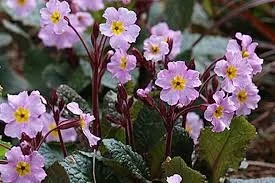
The purple stemmed, Irish ‘Guinevere’
Their tendency to hyrbridise means that named varieties can’t be propagated by seed but clumps can be divided every 3 to 4 years after flowering. Primroses do best moist humus-rich soil, and in partial shade under deciduous trees or shrubs where they will receive light in spring but protection from the full summer sun. This means they do brilliantly tucked into borders amongst summer flowering plants. Completely forgotten for the warmer months their evergreen rosettes are revealed as everything dies back and they provide welcome, delicate colour while the rest of the garden sleeps.
We all look to repeat the memories that mean most to us and last week I took my little Arthur, just under 2, to buy primulas for our garden. He was delighted at having free choice and inevitably picked all the colours I would have avoided, but his joy in selecting and planting them was a delight to watch and hopefully the first step in a passion that will stay with him for life. I will always be grateful to my grandmother for encouraging me in the garden and think of her whenever I see a primula in bloom.

Arthur in our garden busy planting

Betrothal
I will be tying the knot with a new garden…
I’m betrothed. The contract was signed in the summer, the ink is dry, there is no going back. On the 12th of December this year I will be tying the knot with a new garden (and house) and a project which, with a following wind, will occupy my dreams and energy for decades to come. Luckily, I am also completely in love with the garden to which I am bound. At least I think I am: it can be hard to stay sanguine amongst all the frenzy of the matchmaking process. Like some 17th century prince, I chose my bride (my future garden) on the back of a brief and heavily chaperoned encounter. A second, similar visit served to confirm my ardour although, in truth, we hardly had time to get to know one another. On both visits the garden glowed in the late spring sun, which reached through the doors of the immaculate front hall and open bedroom windows. Like a veiled and bedecked maiden, her eyes lowered, this impression can hardly be the full picture of what a future of living with her will hold.
Still, the instant we were informed we had a rival for her hand our intentions solidified. We threw our hat in the ring and within the month the house was ours. Giddy and exhilarated, I was left clutching a 4-page brochure and a handful of my own hurried photographs: the real estate equivalent to one of those stunning miniature portraits presented to a king awaiting his bride. With a 6-month enforced wait before we can move in, my impatient, unconsummated love has gradually intensified to a height of passion I can hardly stand. I am truly lovesick.

Perhaps concerningly this impatience has led me down the path of obsessive stalking. With the aid of google maps I spend my evenings retracing her boundaries, her contours and eccentricities. We are temporarily staying in a bungalow 15 minutes’ walk away, close enough to allow for endless self-torture. On my first free morning after the move, I yomped the footpath that links our road with the meadow behind the house. Forced to stop some distance away across a field, I paused, panting, to gaze at the huge old conifers which mark out the voluptuous curve of the back garden. On my walk back I scared a deer which bounded off. A verse of the Song of Solomon came to my mind:
‘My beloved is like a gazelle or a young stag. He stands behind our wall, gazing through the windows, peering through the lattice. My beloved calls to me ‘Arise my darling. Come away with me, my beautiful one…’
As I became bolder, I took to driving circuitously past the front gate on my way to the shops; the post office; the school run; the GP. I pause to gaze at the entrance: a long, sunny, south facing bank beneath oak trees. In my mind I have already studded it a hundred times with crocus and narcissi, scilla and little creamy species tulips. I’ve lovingly filled the back of the bank with great candelabras of foxgloves. Dreaming of these things is always so much easier than the reality of planting them.
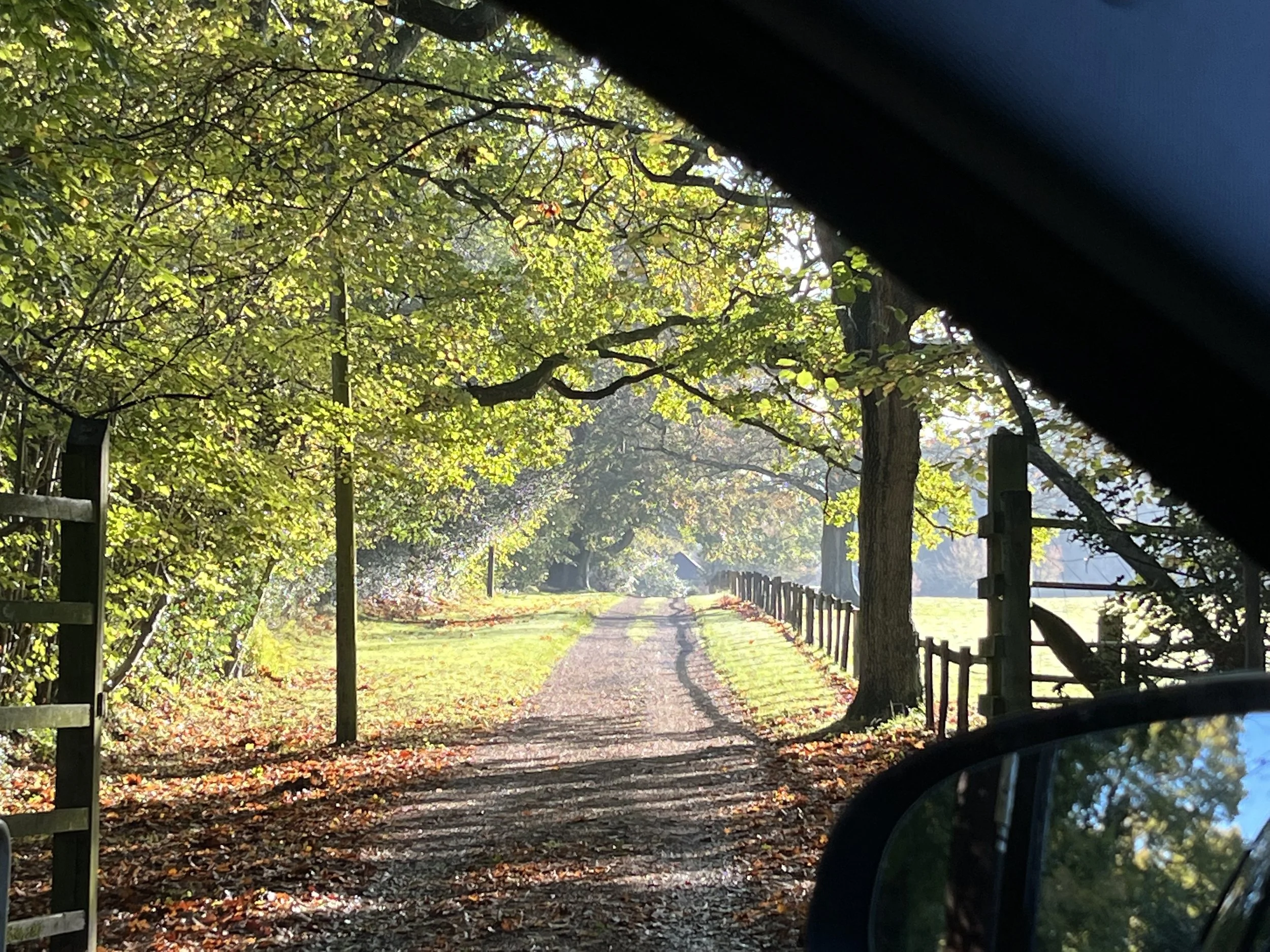
As far as I can see there are two great problems with this sort of enforced, long distance courtship. First and foremost, I have built the garden up in my mind to the extent that when we arrive there is a high risk of disappointment as reality bites. Having visited in early summer, I will finally step through the gates a week before the December solstice, that darkest day of the year. In the cold and dark I will look at the endless tangles of rhododendrons (which I loathe) and vast tracts of bamboo (why were they ever planted?!) and I’m quite sure I will panic.
Couples still in the first throws of romance have an irritating habit of making disparaging remarks about each other, as if to prove that, despite appearances, their love is pragmatic, and they see the other clearly. ‘Of course, Johnny couldn’t boil an egg if you paid him. I don’t think you even know where the kettle lives, do you darling?’ with that teasing, ribbing smile. Little does she realise that in 10 years’ time the fact that John can’t cook will drive her to distraction. She’ll be slopping out bolognaise for ungrateful children whilst cursing through her teeth.
I find myself using a similar tone when describing my future garden to friends. ‘The soil is terribly poor – pure sand. And highly acidic too – for a gardener who can’t stand azaleas! I must be mad, but I do love a challenge!’. Perhaps I’m trying to persuade myself that I know what I am getting into, calming the growing fear that I have bitten off more than I can chew. Perhaps in 5 years I will throw in the towel in desperation and look for a garden on clay. Bamboo 1, Katy nil.
The other great risk is that in my impatience to break ground, to plunge a spade into the soil, I will awkwardly fumble my first spring in the garden and make all sorts of embarrassing mistakes, rather than taking the time to get to know her properly. Advice to all new gardeners (or old gardeners of new gardens) is to wait and watch for a year. Understand the sunlight, the seasons, the soil. Undertake a gentle wooing of the garden to ensure a harmonious, long-term relationship. I am sorely tempted to break all the rules. I have already mapped paths in my mind, removed beds and built new ones, installed a greenhouse. I have mentally carved and moulded every inch of her, imposing upon her my own horticultural fantasies. I take a deep breath and hope I find the patience to wait and watch as her own personality unfolds before me.
For now, I’m trying to focus myself on the practicalities of the move ahead and drag my dreams back indoors to the very pressing issues of where we will sleep, sit and eat. Being a gardener with no garden is frustrating, but the relationship which awaits me promises to be rich, fulfilling, and like all lovers on the eve of marriage, I am naively full of hope that it will be easy and trouble free. I will make mistakes, and she will exasperate me. I’m pregnant, due to have a baby in March, and after lavishing the garden with attention in our first honeymoon months, I will no doubt neglect her more than I should. But over the years we will find our way.
For now, I have contented myself with ordering tulips for the two empty planters by the front door: a token compromise to my eagerness, and a gift to the house on the day we are united.

Pickling walnuts
Nutty cuisine for the brave
There’s nothing quite like presenting a plate of home-made pickled walnuts to separate the lions from the lambs among your dinner guests. I served mine for the first-time last week and they did a wonderful job, first rendering the table silent and thoughtful for a considerable time and then as a potent and divisive talking point. Pickled walnuts are one of those weird delights that have somehow come to define our national cuisine without anyone in the UK having really eaten them. They are an eccentric tradition of the English kitchen and the pickling process isn’t for the faint of heart (taking several weeks and staining pretty much everything in your kitchen). To any experimental and courageous chef who thrives on a culinary challenge, I would highly recommend them! For a quick recipe summary scroll to the bottom, but I hope you will find my honest notes on the process useful. Forewarned is forearmed.
The concept of a walnut tree sounds poetic: a tree to dream beneath, fruitful and voluptuous. The reality (at least in a small garden) is very different. Our walnut squats at the end of the garden blighting the ground beneath it as the leaves and roots exude juglone, a chemical that kills off many plants and prevents seeds from germinating.
Still, the tree is festooned with green fruit in early summer and I told myself that a harvest of homegrown walnuts would be pleasure enough to mitigate its’ other qualities. How wrong I was. For starters, those nuts seem to disappear off the tree faster than a box of Quality Street on Christmas day, secretly snaffled by covert visitors. Secondly, what nuts are left make a disappointing harvest. There’s nothing like a home-grown tomato, warmed by the sun, and biting into a ripe garden apple can feel positively biblical. Do home-grown walnuts knock the bagged kind out of the park? Not really. After gathering up the remaining blackened, rotting fruit last year, I cracked them open to find a measly handful of walnuts which tasted like fairly average walnuts. That tree’s days were numbered.

Arthur and Toby help with the harvest
This year we decided to give it one last chance: what better way to get a bumper harvest than by pickling the whole fruit before the squirrels got to them. The first and most crucial step is to pick the walnuts in good time, before the shell within them has started to harden. I picked mine in the second week of July which I can tell you, with hindsight, was a bit too late. You want to be able to lance the fruit with a kitchen skewer, without hitting the resistance of the developing shell. It’s worth checking this on both axes (ie across the fruit’s fatter and indented sides) because I thought I checked this pretty well but in the end, had quite a few shells forming by the time my fruit were pickled (the shells continue to develop after the nuts are picked). Ideally, the second half of June would give you the perfect trade-off of ripened nuts without any shell.
Every fruit needs to be pierced a couple of times with a fork. It is worth pausing at this juncture to enjoy what will be the last pleasant moment in the entire process. Savour the delicious and surprisingly resinous, pine smell that they exude. Also, notice the small quantity of brown stain that appears on your fingers (or wear rubber gloves). This is a gentle sign of what is to come. Then you pop all the fruit into a stainless-steel pan or a big bucket, cover with brine. This heady mix is then left to fester for two week, after which they begin to turn a mottled brown.

Irresistible. Walnuts after their first week of brining
The nuts now need to be left out in the sun for a few days to blacken (in a chemical process started by the salt). It’s worth bearing in mind that anything you lay them on will be ruined. Plates will be stained with black dots, baking trays will rust from the salt. After two weeks of brilliant sunshine, it began to rain just as my walnuts were ready, so I left mine in the brine for a further few days and they then spent one heavily overcast day outside, but still they seemed to blacken pretty well. I suppose being a classic British recipe, the requirements of sun drying are very different to those for, say, tomatoes in Italy.

Sun blackened walnuts ready to pickle (the white is residue from the salt rather than anything more sinister)
Finally, the hard work is over and all that remains is the actual pickling. Boiling large quantities of malt vinegar is a formidable experience and it is worth choosing the longest handled spoon you can find to avoid choking when you get too close. I also wish I had worn some sort of protective mask and goggles and approached the pan looking like a desert traveller from Star Wars, but on the plus side the acerbic cooking process leaves you looking 10 years younger.
Having poured the liquor over the nuts all that remains is to wait a few weeks (or years), and they are ready to eat. My final note of advice would be to label well and as appealingly as possible. The murky jars look like some mad scientist’s sinister collection in formaldehyde, so it’s worth marking them clearly in case they remain at the back of the cupboard for some time and years down the line, someone panics. When you put lids on the jars, it helps to add a thin layer of clingfilm to stop the acid corroding the jar tops. Whilst they might not be a store cupboard essential, they’re certainly a king among condiments. After enjoying them as a talking point at your own table, you can generously gift your remaining jars at Christmas allowing friends and family to spread the word on its remarkable flavours. Far superior to a pickled onion, pickling walnuts was definitely a worthwhile endeavour. At least having pickled so many in one go, I won’t have to repeat the experience for a decade.
Recipe for 2kg of nuts
Preparation:
Prick the green nuts sever times with a fork
Cover with water and add 225g of salt, stirring well to dissolve. Leave these for a week, then pour away the liquid and replace it with fresh water and another 225g of salt for a second week.
Drain and leave to blacken in the sun (or realistically just daylight will do) for 3 days.
Pickling:
1 litre malt vinegar
500g brown sugar
1 tsp allspice
1 tsp cloves
½ tsp cinnamon
½ tsp black peppercorns
1 tbsp fresh grated ginger
Mix the ingredients in a pan and bring to the boil.
At this point either add the nuts and boil for 15 minutes, or place the nuts into jam jars and pour over the mixture (I did this because I had left the nuts in brine for a few extra days and they were very soft and close to disintegrating. It has worked perfectly well).
Seal the jars and leave in a cool dark place for at least three weeks and ideally a few months, potentially many years.
Enjoy! Traditionally served with cheese and cold meats.
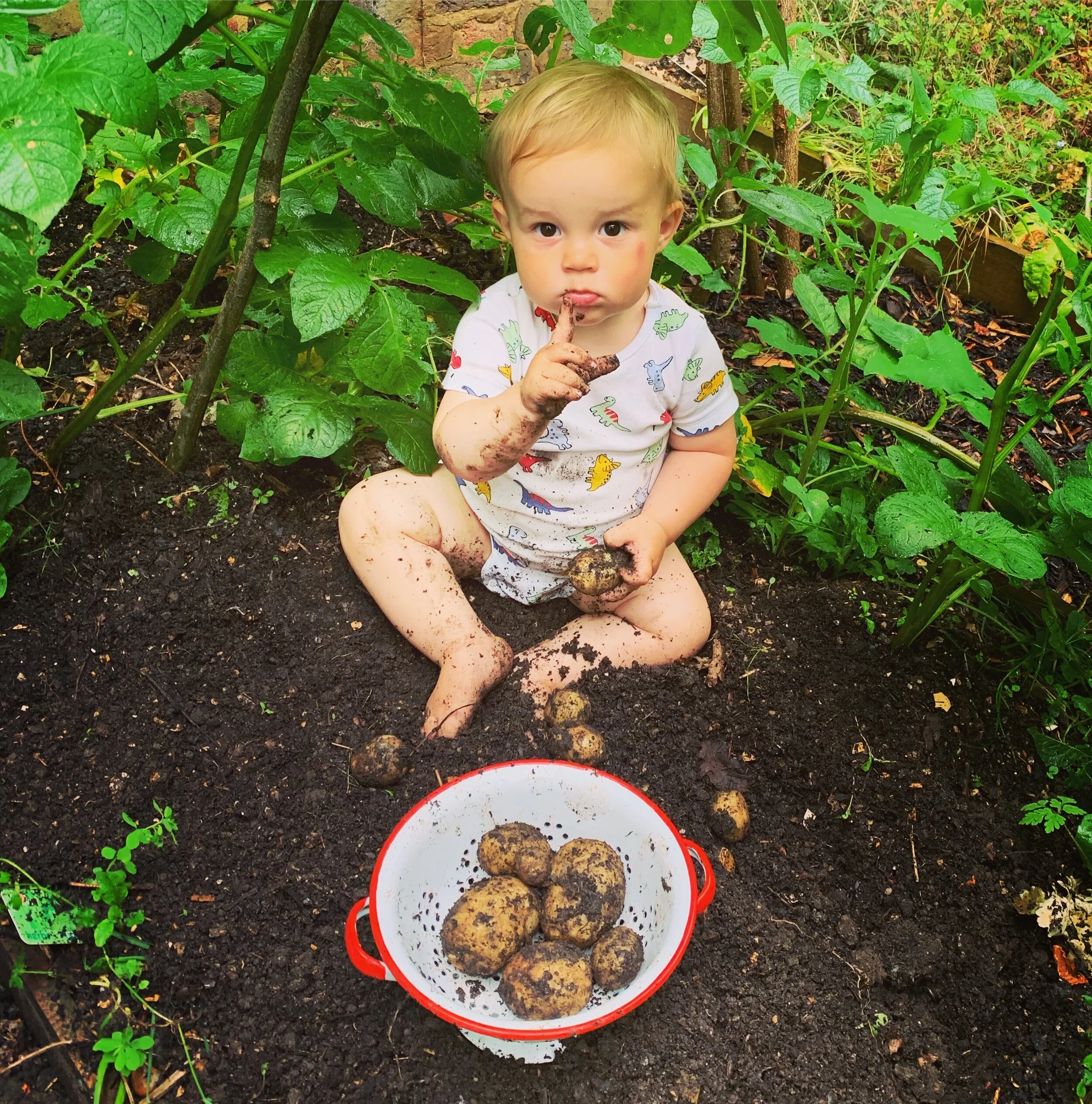
Gardening with a child. Gardening as a child.
Trying to let go of saying ‘NO!!’

Rosemary with lamb… a classic combination
This week is National Children’s Gardening Week, and to honour it I have been making a concerted effort to spend as much time gardening with my 2 year old son, Arthur, as possible. When I was pregnant with him I imagined hazy hours together exploring the wonders of nature as I tended a perfect garden in a new life as an earth mother in which I had great stretches of unscheduled time for gardening (HA!).
In reality, almost every activity we have tried in the garden has ended in chaos and a lot of the knee jerk ‘Arthur, NO!!’.

‘Look Mummy! CROCKS!!’
He loves the process of harvesting, and it’s a great way to get small kids to enjoy veg, but as soon as he could walk we found all our cherry tomato plants stripped of their fruit, ripe or otherwise. He runs in at dinner time calling ‘Look, I picked some radishes’, his hands full of tiny radish too small to eat. Then there are his efforts at what I call ‘live heading’ where he helpfully lops all the flowers off my plants for me, or discovers an exciting insect right in the middle of a flower bed and charges after it full of enthusiasm. I had no idea that I was sowing the seeds of disaster when, last autumn, I got him to help me pot up my spring bulbs, placing crocks in the bottoms of pots, scooping in compost and arranging the fat bulbs for me. This spring, months later, I wasn’t sure if I was more horrified or impressed when I found him proudly smashing flower pots calling ‘Look Mummy! CROCKS!’. He helped me sow all my seeds this spring, and then rearranged all the labels. This has done wonders for testing my horticultural knowledge but when it comes to distinguishing my ‘wok broc’ from my collard greens I am still stumped. Above all I find smatterings of certain plants growing in everything and can only assume a certain degree of compost mixing has taken place behind my back.

But maybe the problem lies with me as an adult rather than with him. A toddler’s curiosity and wonder in a garden is to be treasured and, as is so often the case in parenting, it is our adult preconceptions about what a garden ‘should’ be that causes friction. Perhaps we could all learn something by watching children in our gardens, and by thinking back to the magic of our own early experiences with gardening and nature.
I grew up with a garden big enough to have shrubs to hide in, a little pond and various other secret corners to inhabit. According to family mythology, one of my first words was mesembryanthemum (an interesting reflection of gardening trends in the 80s), and as soon as I could toddle I was off exploring the garden, terrifying my parents as I gorged myself on wild strawberries and returned stained red. I used to fish for newts in the pond with my brother and sister (my brother was brilliant at drawing them), and whilst other girls began to show an interest in mainstream cosmetics, I was trying to make garden perfume (notoriously giving my 5 year old sister a rash with my ‘day-lilly dreams’ concoction) and trying to wash my hair with horse-chestnut leaves. The old greenhouse was a place of secret magic and the discovery of a bucket of golden vermiculite was as thrilling to us as Tutankhamun’s tomb to Howard Carter. In all these memories, the garden was a place of mystery, of exploration, of experimentation and, above all, of freedom and independence.
Reflecting on these experiences, I realise I want to give Arthur freedom to explore and a sense of adventure alongside helping him discover the joys of nurturing that come with growing plants of your own. Nature can entertain and teach children in a way that indoor toys never can. It changes and develops, it’s unstructured, it’s dirty and immersive. But giving him these experiences is much harder than I had expected. We are lucky to have the garden we do, but it’s pretty small and there’s very little space for him to ‘run wild’. In the rush to perfect what little space we have and, maybe I have lost the childhood magic of chaos and dirt, mud pies, beetles, sticks and dens. Plants used to be precious regardless of how healthy they were looking or whether they were weeds or some coveted cultivar. I used to enjoy the garden without it having to ‘be’ anything other than itself.

Yesterday as Arthur abandoned sowing sunflower seeds with me and instead sat in the compost bucket and began to shovel it down his shorts I drew a long breath, smiled and continued with the seeds myself. I have sown enough seedlings that when he decided to try to feed our cat cosmos this morning I was able to remain philosophical as I scooped them into the bin. I am trying to set parameters that will keep him safe and me sane, but in the end I am just grateful that he takes an interest, grateful that we have a garden to share with him and time to enjoy it, and determined not to crush the spark of discovery.

Arthur and Toby picking Pak Choi

Edible flowers of Spring
I’m not sure what it is that draws me to edible flowers. I suppose I love flowers so much that bringing them into the kitchen was inevitable! As I nibble my way through all the edible flowers in the garden, I find that some are very definitely worth eating and others really don’t add much to the sum of human happiness.
Luckily a lot of spring flowers are a great addition to the kitchen, for their looks and many cases for their flavour. There are all sorts of ways to use edible flowers and in the coming weeks I’ll give you a round-up of how we use them, but with delicate spring blooms you can get started by just bunging them on the plate as a garnish. There is nothing simpler. They can be placed around a starter, laid out on a cake just before it’s served or sprinkled on top of a risotto or a salad, or anything you like. This is particularly useful with flowers that have a good savoury flavour, like those of bolting mustard plants or the mild, garlicky flowers of various wild garlics (see below).
Most of these are very common and easy to find, and are probably growing in your garden already, so I hope once you finish reading you will head out to the garden, gather a few, and be eating a beautiful spring supper tonight. None of these will last long out of water so pick them just before you use them or else keep them on their stems in a jug of water, ideally in the fridge until you need them.
Finally, I should add the obligatory note that you really shouldn’t eat anything unless you’re sure what it is. If in doubt leave it out. This list is of the flowers I have in the garden at the moment, but there are plenty of others in bloom elsewhere. I find this list on Thompson and Morgan to be very thorough as a resource for inspiration. I would add that my general rule is to find advice that you can eat a flower in at least three places online before you dive in. The internet is a wide and wild place and you never know what some nutters might write… A quick search online should yield results for even the rarest of edible options, so if you’re keen to diverge from this list and try other blooms, make sure a few people have tried them out and lived to tell the tale. Also, make sure you know your flowers are clean. If they’re in your garden and you’re generally organic and haven’t used pesticides or weed killers then you can nibble them as you pick them. If you’re gathering from elsewhere or the flowers are already on a plant you’ve just bought, give them a quick wash to be safe.
Tulips
I’m starting with these because they’re the most surprising flower on the list and because, as I write, your tulips are probably at their peak, so there isn’t much time left to use them. The first time I ate a tulip petal I held it, trembling, to my lips and took the smallest nibble I could manage. It just felt all wrong. But to my amazement they actually tasted lovely. The petals are quite thick and crisp and have a flavour half way between lemon and lettuce. They’re extremely handy as serving cups for savoury or sweet food (they’re great holding ice cream for example). A revelation and well worth trying. Either snap the petals off or, if you are stuffing the flowers whole, make sure you remove the central reproductive parts and all of the stem. These parts aren’t toxic per se, but aren’t great for the digestion. But don’t be put off! The petals are wonderful!
Primroses
Primroses are a classic edible flower and were traditionally used to decorate Simnel cakes, a fruit and marzipan cake eaten around Easter. Easter may be passed, but primroses will be good to eat for a while yet. They have a gentle, slightly lemony flavour and although they’re quite a big flower they’re nice and crisp on the tongue and not too papery. As with all flowers, they are lovely just used as a garnish, but the traditional way to use them is to crystallise them. Paint the front and back with whisked egg white with a teaspoon of water added, and then sprinkle sugar over both sides before laying them on baking parchment to dry. They can be stored this way for months and are great for decorating cakes and deserts.
Don’t feel limited to the traditional yellow primrose (Primula veris), all primroses are edible. Cowslips work just as well although I would slip them out of their calyx which is more pronounced. Most excitingly, all cultivars are edible no matter how jazzy they may look, so bedding primulas are a great addition to the dinner table. This opens up a world of brightly coloured blooms from pinks to red and even deep blue. I love primula ‘Zebra Blue’ which adds a bit of shock factor for dinner guests to boot.
Violas
Another classic for crystallising are violets, which I remember seeing in little bags at great expense in a very smart chocolate shop in Venice. Small, wild violets are quite hard to crystallise as their flowers have a lovely 3 dimensional quality that is lost and works against you in the sugaring process, so I would use wild violets as they are. Hybrid violas and pansies have much flatter flowers which makes them a real gift for sugaring and for decorating food in general. I much prefer small viola types which I use to top tulip pots over winter. The larger pansies are still edible but one thing I’ve learnt is that most edible flowers are best enjoyed in small bites. Chewing on a whole pansy stops being pleasurable and becomes thought provoking. Instead I would pull off the petals and scatter them on food and salads, or else use them in recipes like floral pasta (recipe to follow shortly!).
Alkanet
Alkanet is the most annoying weed I’ve had to battle with in this garden. 5 years I’m finally on top of it, but it has deep roots, the tips of which will regrow if they snap off when you dig them out. Its big, hairy leaves are ugly, but it has wonderful deep blue flowers, much like a forget-me-not. They’re a bit of a fiddle to remove from the plant: I gently pinch behind the petals to lift them free of the calyx. Once you have them they are brilliant to use in all sorts of ways. They crystallise better than forget-me-nots because they’re bigger, and they keep their deep blue as they dry. They’re also great in ice cubes for drinks in the summer.
Forget-me-nots
These are in the same family as alkanet, and as borage which I will include in a later list of edible flowers in summer. Their exquisite range of pinks and blues are set off by a bright yellow centre. On the downside, you face the same issue as that with alkanet in terms of pulling the petals free without damaging them. I often just use a full spray as a decoration, but the stems aren’t great to eat so I do this with the assumption that they’ll be left at the side of the plate. Once you liberate the petals they are a wonderful, delicate garnish or can be popped on the top of a cake or into ice cubes.
Honesty
I have loved honesty since I was a little girl for its flowers and fat ‘money purse’ pods, but I was surprised to discover recently that it’s edible. The leaves and pods actually have quite a strong mustard flavour, but the flowers are mild and very beautiful. You have to be quite careful not to crush the papery petals but they look lovely.
Wild garlics
Traditionally people seek out wild garlic (Allium ursinum) for its leaves, but its flowers are delicious too. This year I’ve been tackling the less well known three cornered leek, Allium triquetrum which is invasive and tough to eliminate and has unfortunately and mysteriously popped up all over the garden. It has very different leaves to the broad flat leaves of wild garlic, and they run the risk of looking like a white bluebell, which would be highly toxic, so snap the leaves and make sure they have a strong garlicky smell. It’s other defining feature is that the flower stems are triangular in cross section which bluebells are not. We use the stems and leaves as a sort of garlic chive, but the flowers have an amazingly mild garlic taste and look beautiful scattered on a salad. These aren’t flowers to use on a cake or desert given their strong garlic flavour.
They’re my absolute favourite edible flower at the moment because, unlike some of the others, they really add flavour as well as beauty.
Bolting brassicas
If you grow any brassicas or mustards at the moment you will be fighting a difficult battle against them bolting. All these plants are biennial and programmed to flower in spring, set seed and begin their two year life cycle again. It’s a bit of a law of diminishing returns trying to stop leafy greens from bolting, but cutting the flowers off can buy you a little time. All of their flowers are edible and whilst cabbage or kale flowers have a mild, savoury, broccoli taste, mustards, mizuna and rocket all have absolutely delicious fiery flowers. Again, I wouldn’t pop these on your pudding but they’re great as a garnish to add a bit of pep to savoury food.

Chaenomeles
Japonica Jelly

Chaenomeles on an Edo period scroll by KANŌ Sigekata (1657-1699)
On winter walks, there are a few plants that I always find grabbing my attention and one of the best of these is Chaenomeles. It’s small, pear blossom flowers sing out at you from stark, bare branches at a time of year when everything else is a bit dour. Chaenomeles spend the rest of the year looking utterly unremarkable if not downright twiggy and unpromising, and anyone passing them in June might wonder what on earth people thought was so “superb” about them when Chaenomeles x superba was named. But the winter and early spring is their time to shine and they take full advantage of it.
This is, of course, exactly what they are trying to do. With very little else in bloom, winter-flowering shrubs have their moment in the limelight, but with limited pollinators braving the chilly weather, they have to make the most of their opportunity. Appearing when there are few, if any, leaves to contend with, the flowers seem particularly luxuriant against their bleak, bare stems, and look like they belong in an Edo period Japanese print, or on Chinese lacquer work. In fact, they are depicted on both, and our common name for these plants as “Japonicas” is a reference to their oriental origins. Chaenomeles x superba is a hybrid cross between C. japonica from Japan and C. speciosa from China and both cultures celebrated its blossom.

Chinese lacquer work screen depicting birds on a Chaenomeles bush
All of them will happily grow into a big tangled shrub if left to their own devices: impressive whilst in flower but rather forbidding the rest of the year. Training them against a wall or railings seems to do more justice to their delicate exoticism, displaying their flowers for appreciation and, more importantly, their fruit for easy picking.
I remember encountering Chaenomeles on walks as a child, and back then it was their fruit which would catch my eye more than their flowers. Weird and knobbly yellow pomes, somewhere between a large crab apple and a miniature pear, their fruit are arguably the most ‘superb’ thing of all. The genus is named from the Greek chaeno “to split” and melon “apple” based on a description by botanist Thunberg of the fruit splitting. Since then, this has been criticised as something that rarely, if ever happens, so I have decided instead that the name must have been meant as a rapturous instruction: ‘just split the fruit open’!
The moment you do their fragrance is incredible: lemony and sweet with a hint of pineapple. They smell so intoxicating you’d almost think it was a good idea to take a nibble, but raw the fruit are bitter and pithy. Luckily adding a tonne of sugar mitigates their bitterness, and their pithiness makes them a brilliant source of pectin – they’re perfect for making jelly. Since the fruit are small, you end up needing quite a few to make a good, useful quantity, and I’ve always kept a sort of urban foragers map of the Japonica hedges of our Brixton neighbourhood. Most people don’t have a first clue what to do with them and are happy enough to part with the fruit, especially if you leave a little jar of jelly on their doorstep a few weeks later.

Arty and I rescuing Japonicas off the ground in the park
Last weekend we went to a London park (which I will keep top secret) for a run-around and after we stopped for an outdoor coffee I suddenly noticed a Japonica covered in bright red blossom and last season’s fruit. Urban foraging is a noble art, and I would never pick the lumpy fruit off the branches in a public park in case some little child should wander past, see them at eye level (adults never look down and rarely look closely) and fall in love as I did. But fruit hidden on the ground I consider fair game. Twenty minutes later we were driving home with a bag of muddy fruit in the boot and the car smelling like a sweet shop.
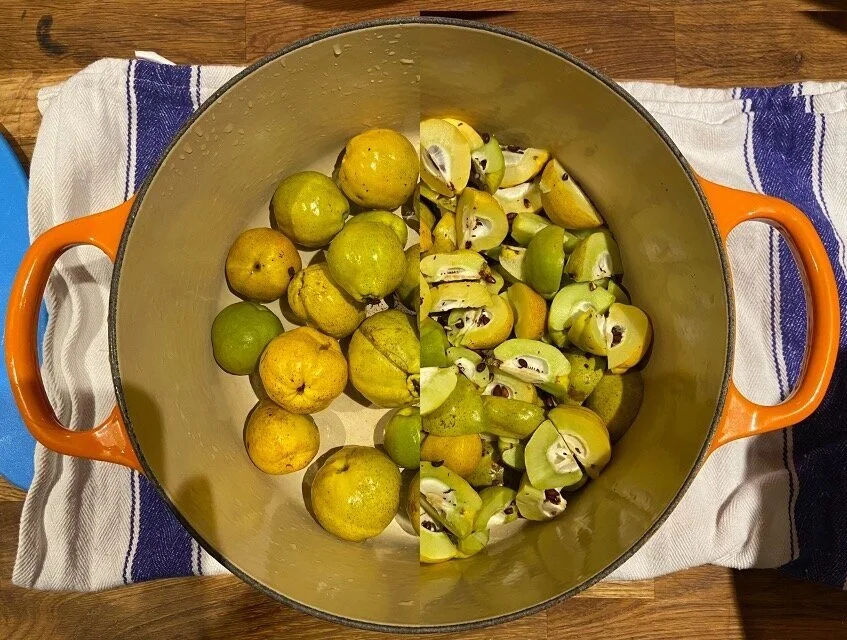
Credit to Toby for the unsolicited photoshoppery
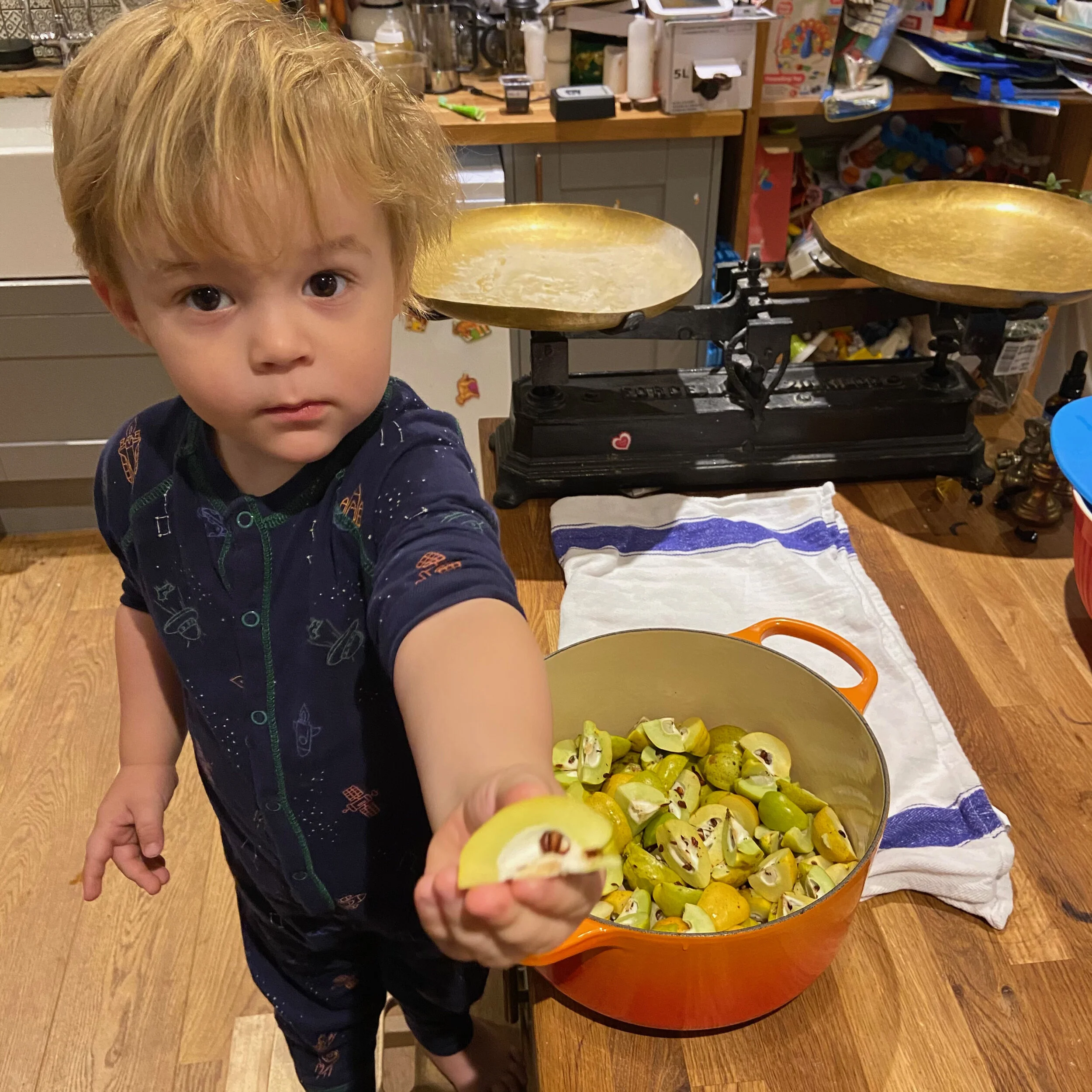
We chopped them up, covered them with water and stewed them until they were soft and pulpy. The whole mix was then suspended in a cheesecloth (or baby muslin) over a large mixing bowl overnight. Drip by drip, the resulting liquid was a rich and brilliant yellow. We measured it out into a heavy bottomed pan, adding one pound of sugar for every pint of liquid and then boiled its socks off for about 15 minutes, regularly dripping small quantities onto refrigerated plates and ho-humming about its consistency (when it starts to form a skin and hold together on the plate it’s ready).
The resulting amber jelly has a lovely lemony taste. So often food writers describe jam-making as capturing the very essence of summer; we have captured the subtle and exotic flavour of Japonicas in winter.


Inspiration from Italy
Cooking and growing Italian winter greens

Exploring the towns in the Italian riviera
After 18 months within the UK, in September we were lucky enough to go down to Nice to visit my parents in law. While were there, Toby and I escaped across the Italian border to the very Western corner of Liguria, the Italian Riviera. We primarily went for the market shopping. Ventimiglia, a little town near the border, has the most brilliant market, stalls overflowing with cheese, fresh pasta, sundried tomatoes and above all, vegetables. The real allure of an Italian market is that of the weird and wonderful veg I’ve never tried before. Serpentine tromboncini (long elongated courgettes) and weird and wonderful tomatoes, jewel like beans and marbled aubergines. Above all, this year I really fell for the Italian bitter winter greens, admittedly not the showiest of vegetables but exotic and exciting in their own right.

Rossa di Treviso
Best known in the UK are the wonderful burgundy leaved radicchio such as ‘Rosso di Chioggia’ and ‘Rosso di Treviso’, both of which can be found in more upmarket greengrocers. But within the chicory family there are other varieties with very different characteristics. In the market at Ventimiglia, the most abundant chicory sold looks a lot like a giant dandelion with wonderful big, serrated leaves. This is Cicoria catalogna, very close to the wild form of Chicorium intybus and is indeed closely related to the dandelion which can be cooked up in a similar way.
These green leaves have a strong, bitter taste and are either soaked in ice cold salt water before rinsing and adding to salads or are boiled for a few minutes to reduce the bitterness before being sauteed with some olive oil and a bit of lemon juice. A similar variety, often referred to as ‘Asparagus chicory’ or ‘cicoria puntarelle’ contains fat buds which look much like asparagus and lie hidden within the outer crown of leaves. These buds are sweet enough to be chopped up in a salad or cooked very lightly.

Dandelion like leaves of Cicoria Catalogna
Dandelions not only look similar but taste similar too. I’m too late to sow chicory this year, but as a quick alternative you can gather up dandelions from around the garden. The very bitter leaves can be cooked and eaten like cicoria catalogna, or they can be forced much like an endive (again from the same family) to produce tender pale shoots.
All chicory can be sown from late spring or early summer (lengthening days trigger bolting so you need to let days lengthen a bit first), and they are at the top of my list for growing next year. I’m interested to see how it goes.

Spring rapini or cime di rapa
The other ‘bitter’ green that covered every stall in Italy this autumn was what the Italians call Cime di rapa. These look much like bunches of very weedy sprouting broccoli but are in fact a form of turnip or mustard. As with chicory, their bitterness is reduced by boiling them for a little while and they make a brilliant traditional pasta sauce chopped up and again sauteed with oil and lemon zest. Unlike chicory the plants grow fast and there isn’t much mystery to growing them. They are so quick to grow that the varieties are often named after the number of days to a first harvest, Quarantina, Sessantina and Novantina (40, 60 and 90) as well as some slower growers in the early hundreds. I’ve had problems with them bolting in the past, so they do best direct sown and are perfect in the cooler months of the year, either in early spring or late summer. They throw up tonnes of small flowering shoots which you chop down and eat leaves and all.
Oddly these vegetables don’t seem to have made it across to Britain and information on preparing, let alone growing them is surprisingly scarce. Beyond Patience Gray (who describes how various chicories, radiccio and cime di rapa are cooked), the only cookbook I can find that references them is Antonio Carluccio’s brilliant book Vegetables which has a good first chapter on Italian greens and a few recipes. Beyond that I’ve spent many hours trawling the web and trying to decipher the back of Franchi seed packets to better understand the variety of bitter greens available and how to grow and cook them.
I love the idea of growing things that are a bit harder to find in the shops here so I can’t wait to sow them. Luckily Seeds of Italy has a huge range both of chicories and of cime di rapa, and the packets are so generous, I’ll be sowing a few as baby salad leaves along the way. I can’t wait till spring!
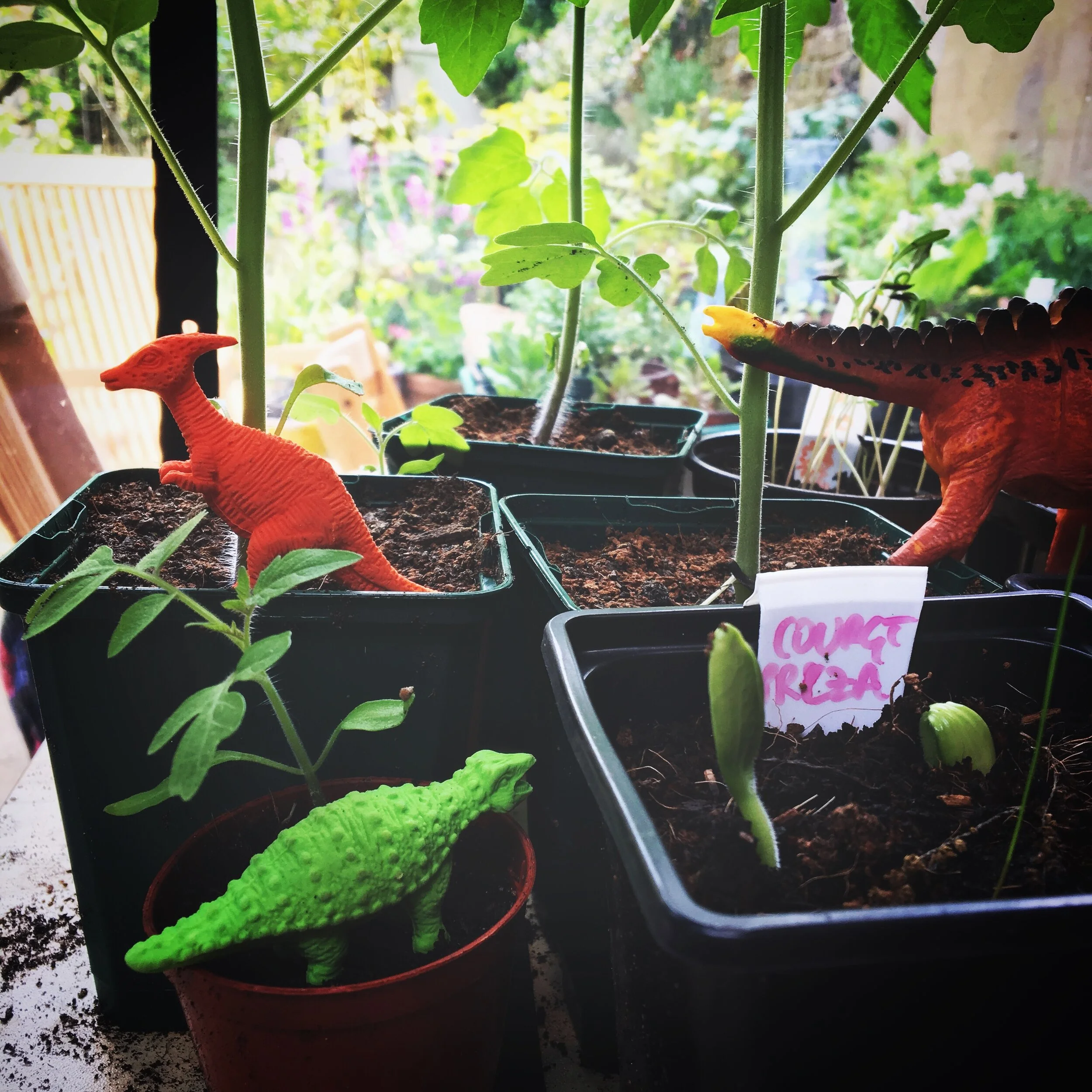
Parenting and Potting on
The trials of raising healthy, independent young plants
I can be a horribly inconsistent gardener. Each spring I am dillgent and spend all hours that my son sleeps busily getting on with things. But as the garden matures, my own commitment to its upkeep starts to slip. After years of feeling guilty about this, I’ve realised that it’s not because I’m fickle and lose interest or energy, it’s that the gardening jobs in early spring kindle hope and capture my imagination in a way that primping a garden in full bloom never will.
Of all the spring jobs I love, pricking out and potting on seedlings has to be my favourite. Yes, true, it helps that I can do it in the evening at the kitchen table accompanied by a good scotch or a crisp glass of wine. I also find it a very meditative task: repetitive enough to allow the mind free range but still requiring attention and care. Above all, it is a task that connects me to the garden, as I take the time to engage with and care for each of the plants that will go on to serve me so well for the rest of the year.

Pricking out seedlings with a glass of wine and an episode of House - the perfect way to spend a spring evening
This early care for a plant is not unlike early care for a child: providing an opportunity to bond but also the great responsibility of giving them the best possible start in life. The development and nurture of plants in their earliest stages goes on to have a huge impact on their final growth and, as with parenting, this can lead to no end of anxiety over getting it right. Consistent moisture early on allows seedlings to plump and fill out, setting the framework and structure for their form as they grow, while feeding them the right diet is just as important, although I’m finding this is at least much easier with passive seedlings than with a rebellious toddler.
I have already had several parenting fails this year. Struggling to find seed compost under lockdown and too impatient to wait for a better alternative, I sowed a number of seeds into quite a chunky multipurpose compost. They germinated well but have since struggled forward, their lower leaves showing signs of malnutrition and were rapidly overtaken by seed I sowed two weeks later in a good seed mix.
As plants head into their teenage the house begins to feel crowded with their gangly forms, but the responsibility of care is in no way diminished even if I try to give them the space to do their own thing. An over fussy parent, I quite like to sow things in trays where possible and them prick them out and pot them on several times, particularly with plants like cosmos and tomatoes which respond to being transplanted deeply by putting out new roots. In their early days, I cluck as my cosmos become increasingly stretched and thin (gardening is the only example of where being ‘leggy’ is not a compliment), and I try to fatten them up as I bury them deeper and deeper. In truth, there is always a period in April where many of my seedlings are a bit lanky and, like a kid wedded to their x-box, I can’t help but feel they need some time outside.
Finally they are ready to leave home, and the parent’s task becomes one of fostering independence, toughening them up for life on their own. I don’t have a cold frame, but small plants are moved onto our patio during day times and gradually hardened off to face the realities of the outside world. When they do finally move into the garden and put down roots I will still be there watching from a distance, trying to give them their independence but desperately worried about slugs or a sharp frost.

Young plants on our patio table, approaching graduation
Like parents, we can never get it 100% right no matter how hard we try, and will always blame ourselves for their failings and be uncertain how much credit we can take for their triumphs. But there is great consolation in the knowledge that, like children, young plants show remarkable resilience and, once we have nurtured them through these earliest days, they will go on to thrive without us, shaped subtly by our support and care, but brilliant adults in their own right.

Finding Time to Garden
A past-time with no cheating and no shortcuts
I’ve had a baby! Little Laurie (Laurence) arrived 4 weeks ago and is thriving! The last month has flown by and every moment has been filled with the joy and exhaustion of being a family of 4. It’s been a good few weeks since I last wrote here but life has finally settled down so I’m back!
Yesterday Toby took Arthur to football, Laurie fell asleep in his crib, I poured my coffee and just like that, I was alone in the garden for the first time in weeks. I’ve been in and out in the last few months, mainly to help Arty strip the veg patch of nearly 900 cherry tomatoes one handful at a time, and to hoof buckets of veg scraps to the compost heap, but between ‘pregxhaustion’ and clutching a newborn, I hadn’t touched the ground in nearly 2 months. Yesterday, coffee in hand, the world stopped spinning for a moment and it was bliss. Taking stock in the warm September sun; tackling some woefully overdue weeding. Best of all, having my hands in the soil again after 9 months of wearing gardening gloves.
10 minutes later, Laurie woke up and the spell was broken.
At the moment, it feels like there is never enough time to do anything, let alone enough time for the garden. But the garden shows no sympathy for the stress of early maternity and refuses to wait for me, galloping wildly ahead without me. Every time I step outside the list of what needs to be done grows longer. Rather like my tummy I find my ‘post-partum garden’ looks nothing like it used to and falls far short of any societal ideals. But none the less I’m still super proud of what we’ve managed this year. We’ve grown an awful lot of veg and even if some corners of the garden are looking neglected, when I look out of the kitchen window I can still see flowers.
One of the greatest charms of gardening is that our creations exist independently of us. Unlike a ‘finished’ piece of art, our relationship to our garden is a continuously developing one: the art we create in a garden is open-ended and our medium has a life and opinions of its’ own. This enriches the art of gardening but makes it an exhausting and exacting hobby at times. Unlike so many past times, there’s no quick fix, no cheating, and very little control over the time frame for getting things done. Much of gardening consists of critical day to day jobs which, when skipped, can have disastrous consequences (RIP to the trays of seedlings I left un-watered earlier this spring). You can’t really take a break: If you decide to leave the garden to itself for 6 months and then return, you pay for it and at the back of our flower beds I’m now facing mountains of well-established weeds as penance for months where I couldn’t bend down!
The pay-off is the huge satisfaction of knowing that what beauty there is in your garden is the result of hard labour. When I flick through images of people’s private gardens and allotments on social media I find myself quite moved by the sheer scale of collective human effort that has gone into them. No one can grow vegetables or arrange bunches of cut flowers from the garden without showing up week after week, digging, weeding and watering for months beforehand. I’m full of respect for all those gardeners who squeeze in time for their gardens between work hours or kids or whatever else life throws at them.
I’ve just started to volunteer at Brockwell Park again which feels fantastic, and so far Laurie sleeps contentedly in his pram while I get busy gardening, but how long that will last, who can say. I look forward to a time when I have long, uninterrupted spells in the garden, but for now, it looks like my relationship with the garden will continue to be one of snatched moments of freedom to get on with things. Perhaps gardening will still feel this way long after all my children have flown the nest. Perhaps it is this that makes gardening feel like such a luxury and a pleasure: making time in the garden has come to represent making time for myself.
And on that note, Laurie has drifted off and I have some foxglove seedlings in urgent need of potting on, so I shall wish you a pleasant day, close my laptop and dive outside before it starts to rain.

Digging into toxoplasmosis
Advice for any pregnant gardeners
I am currently 34 weeks pregnant and gardening is getting complicated. I can garden standing up, or I can garden sitting down, but switching between the two regularly is now completely impossible. At Brockwell Park where I volunteer, I think the team are genuinely concerned I’m doing more damage than good to the garden as they see me lumbering into the middle of the borders, plants parting before me as before an elephant through the thicket.
Once you’re pregnant you are presented with a whole list of things you can’t do and mustn’t eat (coffee, alcohol, sushi, soft cheese). I was therefore thrilled when a friend recommended a brilliant book called ‘Expecting Better’ which debunks many of the myths around maternity and is incredibly permissive (perhaps why it’s so successful). Having read that I could drink the odd glass of wine and enjoy a coffee a day, I turned to pages about dangerous activities (hot tubs, flying, tattoos, cats) and on the last page I read:
‘The Bottom Line: Changing the cat litter is fine… but gardening is associated with an increased risk of toxoplasmosis. It should be avoided.’
I couldn’t believe it. At the time I was in my second trimester, sitting drinking a cup of tea with garden mud under my fingernails from a morning on the veg patch. I’d researched what I could and couldn’t do quite thoroughly, but no one had told me not to garden.
Toxoplasmosis is a disease caused by one of the world’s most common parasites, toxoplasma gondii which is found in infected meat, in cat faeces and, most frustratingly for gardeners, in the soil (thanks to the cats). For most adults, toxoplasmosis is completely harmless and symptomless. Unfortunately, whilst some risks are flagged in pregnancy to avoid discomfort to the mother rather than any risk to the baby (eg salmonella or lifting heavy bags), toxoplasmosis is not one of them. Catching it in pregnancy really is often disastrous, causing miscarriage and still birth, and for those babies that do survive, leading to ongoing complications, some of which only manifest themselves in a child’s teens. Reading about it as a pregnant gardener it is easy to get pretty scared.
Reassuringly, the transmission of toxoplasmosis is actually extremely rare and the most common way people catch it is through rare or cured meat. It can live in the soil for up to 18 months but would only get there if an infected animal had died there OR if an infected cat had defecated. Luckily, cats who are infected are only infectious for about 2-3 weeks, and most adult cats have already had it, so the chances are still fairly low. But because it poses such a huge problem if you do catch it, it is still definitely worth protecting yourself during pregnancy.
The first bit of good news is that once you’ve had it you’re immune for life and it is possible to be tested for it. In my first pregnancy, I wasn’t tested and didn’t even know you could be, but it turns out you can ask your midwife or GP to run a test for you if you garden a lot and you’re concerned. The test can tell you if you actively have it, but also if you have had it in the past and are now immune. If that result comes back, congratulations!! You can garden happily, safe in the comforting knowledge that cysts full of the little worms are snug and dormant, buried within your muscle and organs, protecting you for life.
I was convinced I had had it because:
I spent most of my time singing in France eating rare steak and vast quantities of salami
I have had cats and gardened since childhood
My London garden is a latrine for every cat in the neighbourhood
I never wore gardening gloves
I ate veg fresh from the garden
I was, therefore, a bit disappointed to discover that I haven’t had it, but I suppose that goes to show how rare it really is.
If you haven’t had it, gardening with good gloves and then washing your hands when you finish is the best thing you can do to protect yourself. Wash all your garden vegetables thoroughly (and shop-bought veg for the same reason). Some people suggest wearing a mask while gardening and perhaps in very dry weather if the soil is dusty that might be worth it…. I suspect in a British summer this isn’t really necessary.
So I am ploughing on through my last few weeks of pregnancy, and to be honest I can barely touch the ground anyway. I love gloves a lot of the time (e.g. slug collection) but there are moments where trying to protect myself from my own soil feels sad and disconnecting. Whilst other expectant mothers look forward to a martini, a rare steak and some opinionated cheese to follow, I am just looking forward to taking off my gardening gloves and putting my hands in the soil for the first time in 9 months.
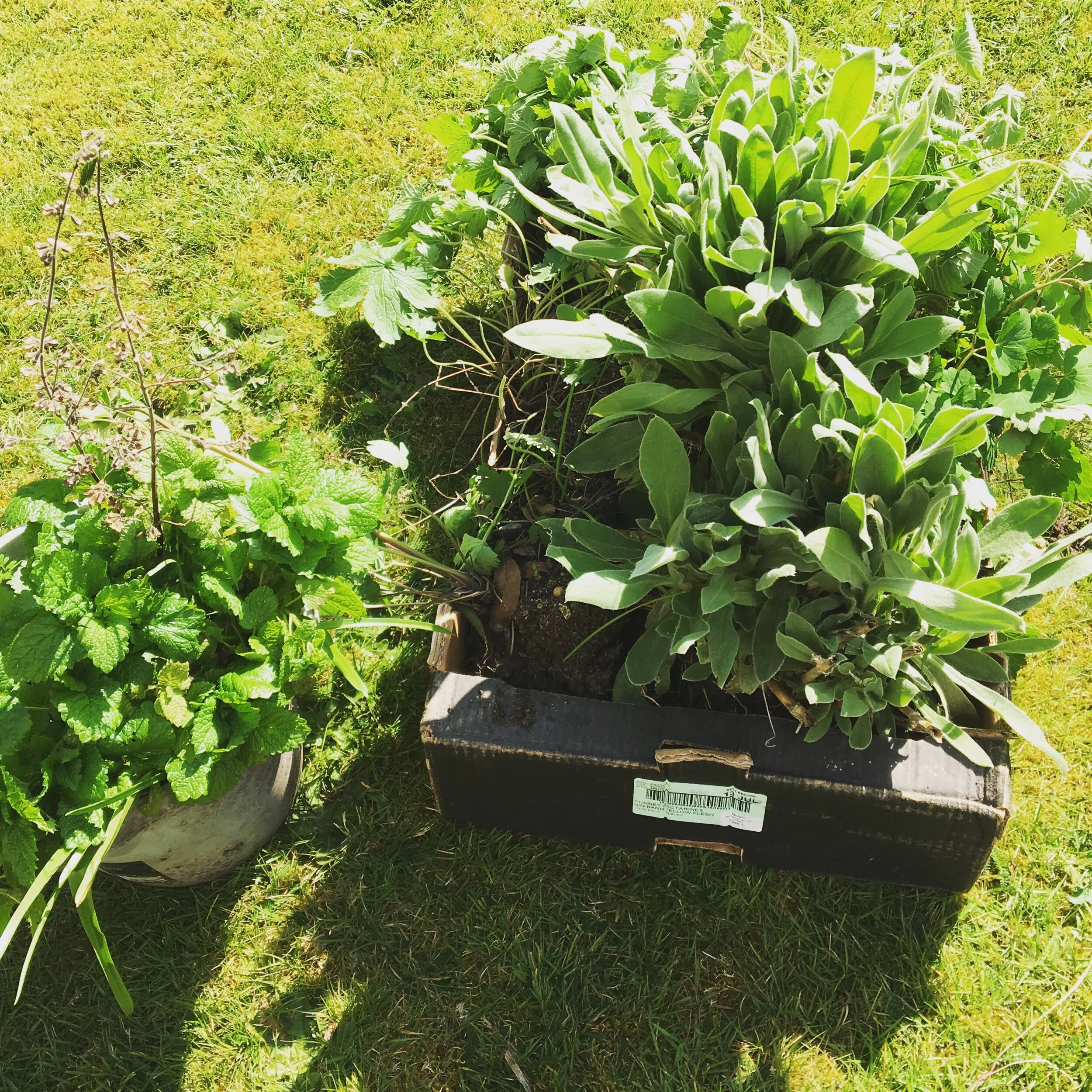
Lockdown 2020 - Divide and Conquer
Getting hold of free plants while nurseries are closed
The week before ‘Lockdown 2020’ began, where other people were stocking up on loo paper I was filling my car with horse manure and wildly grabbing trays of summer bedding plants from the local nursery. And I wasn’t alone. I found myself queuing for the usually quiet car park and diving for the last pack of kale seeds, pipped to the post by a wild-eyed man in moccasins and a gilet. It was clear that all the good burghers of Wandsworth and Clapham were planning ahead for a summer of social isolation in the garden with a gin and tonic. Once garden centres closed down, online sellers were inundated with orders and many have either run out of stock or are suspending ordering as they struggle to fulfil a massive surge in demand whilst maintaining social distancing for staff. Those of us lucky enough to have gardens all suddenly have time to spend in them, but seemingly no way to get hold of plants to put in them. It’s still worth trying to find plants online as some suppliers are delivering, but given long delivery lag times there are other ways to fill up the garden and best of all they are pretty much free and hugely satisfying.
We can make a virtue of necessity and view this summer as a brilliant opportunity to revive the tradition of the cottage garden. Cottagers had very little space and no money, relying on the exchange of free plants to fill their gardens. There was a strong culture of passing on seedlings, cuttings and divisions to allow people to fill their gardens and expand their collections for free, with the added benefit that the plants that you grew would be tried and tested varieties that you knew flourished in the garden next door.
For beginner gardeners, the idea of dividing a plant might seem daunting, but it’s actually pretty easy, and arguably you will have better success with something that has been thriving in your neighbour’s garden than you will with a delicate plant from a garden centre. The plants we buy have often lead a pampered life of exotic celebrity. Forced into bloom early and dolled up to entice us, we knock them out of their pots without any effort to understand or get to know them. They find themselves plonked in the cold ground and promptly sulk at best or give up completely.
Dividing plants is also completely free. Planting only one of each plant in a garden looks pretty awful, but repeat planting (with the same plant throughout a border) is very expensive to achieve when each pot costs £9. Divide an existing clump and you can easily have 5 or so plants to fill a garden. The other great benefit of not spending a fortune on your plants is that a beginner can hack away like a mad scientist with the wild abandon that comes from knowing you have nothing lose. So, with hearts emboldened, I suggest we all go bravely into the garden and have a look for plants we can increase in this way.

After half and hour of hacking
The first place to have a look is your own garden. More experienced gardeners will probably already have an idea of what is well established and ready to divide, but beginner gardeners may be pleasantly surprised. Remember that year you moved in, spent £200 on plants from the garden centre, had a fabulous looking garden for 3 months and then never touched it again? Hack your way through the weeds and you may just find them still there, 3 years bigger and just beginning to put on their spring growth.
Anemone japonica often ends up spreading everywhere
The next place to look is over the fence. Friends and neighbours with well-established gardens will probably have big clumps of certain things that they are more than happy to give away. The Japanese anemone in the front garden that keeps on spreading. Too much Phlox. I should add at this point that you obviously need to follow social distancing rules doing this at the moment so let them dig plants up for you or ask them to mark your victims (a length of ribbon adds a sense of poetry and drama) before they watch through the window as you make your approach with a spade.
In general the plants you are looking for are herbaceous perennials (i.e. not a shrub, tree or a seedling) with a good crown (i.e. several vigorous shoots or a mass of green in a clump rather than one single stem). If in doubt, leave it until you know what it is this summer and then dig it up and divide it in the autumn. As a rule it always pays to err on the side of caution and have fewer divisions of a healthy size until you are confident in what you are up to.
There are 2 methods of dividing, both well documented online but here is a brief summary:
1. Sudden death with a spade
This is often the preferred method of experienced gardeners, especially with woodier crowns like a hosta. On a ‘how to’ video you see someone calmly place a sharpened spade effectively between the eyes of their trembling victim and then stamp, splitting the plant cleanly in two. I have been keenly practicing this technique for some time, but personally I struggle with it. For one, there seems to be an art to stamping with surgical precision and I haven’t mastered it. Also, I tend to panic just before the blade comes down and this has the disastrous effect of bluntly shaving much of the plant off. Don’t panic! It is almost impossible to end up with fewer plants than you started with. At worst, you end up with a slightly smaller plant and a richer understanding of the process for next time.
2. Butchery with a bread knife
My preferred method, this has the precision of the spade but you can take things at your own pace and stop halfway for a shot of Dutch courage. After you have dug up your plant, take a moment to have a look at the way it grows. If it is quite leafy or floppy it might help to give it a haircut so you can see what’s going on. If you feel about you will probably find a couple of obvious places where the plant falls into sections with a bit of bare soil between. At this point, either use your thumbs and fingers to gently tease the roots and crown apart or, if you meet with resistance, use the bread knife to cut through the roots and crown until you have two pieces. Repeat this where necessary and where obvious divisions present themselves.

Lychnis coronaria clump before divison…

… and after
Replant your divisions quickly when you have finished as they won’t like being left to dry out. Some plants with more top-growth will also benefit from a good haircut (to about 10cm) so that roots have time to establish without the pressure of sustaining foliage. This looks brutal and feels like you are adding insult to injury, but it will honestly do them good. Finally, give them a really good water which will wash soil back in around the roots and prevent them from drying out. With a following wind, many perennials will have a new lease of life from this treatment and set off into the year with renewed vigour.
At a point where we are forced to stay at home and public parks are threatening to close, those of us with gardens have never been so aware of the great privilege and luxury that they afford us. If we don’t get out into the garden now, when will we? The closure of garden centres is a real loss (and a great tragedy for the industry), but it is no excuse for staying indoors!
Taming Medusa
One woman, a bread knife and a gorgon dahlia
In the 4 years since we moved in here I have never divided my Dahlias. I realised my mistake when, last Autumn, I lifted a writhing Medusa’s head from the soil. I neglect my dahlias terribly and popped them, sparsely covered with compost, in a cardboard box in my outdoor tool shed. Not frost-free, but out of the wet of winter which is enough to protect them from rotting. Most importantly they were out of sight and mind, and I adopted the standard British approach to a tricky problem of pretending it didn’t exist.
But by the first week of March, I found my mind straying to the monsters I had unearthed that lay in wait at the end of the garden and I knew I could put off surgery no longer. Step one was easy enough. I took all my dahlias to the sink and gave them a good rinse under the tap to see what was going on. This took rather a long time as the tubers were so large they had grown into each other in a knotted mess, providing habitat for large numbers of overwintering insects and retaining soil despite my best efforts. Our sink will never be the same again.
Much to my disappointment, Medusa was undiminished by a good hair-wash, her locks even more tangled than I had initially realised. In any guide to dividing dahlias you are shown a central stem or two with a ring of neatly arrayed tubers radiating from it. You then divide them up ensuring that each division has a little node or bud at the top and enough tuber to give it a kick start. The whole process looks encouragingly simple, and so it should be… if you do it regularly.
The gorgon had 7 stems many of which, confusingly, were growing from the bottom and sides of the mass, pushing their way up through the tubers. This made locating any kind of growth bud extremely difficult and gave the whole exercise much more of an intellectual ‘logic puzzle’ feel than I had anticipated. I set to with a bread knife, damaged two small tubers beyond repair and gave up for the afternoon.
That evening, with the help of some Dutch courage, I returned to the task and practiced on my tamer candidates fist. Once I had got into the swing, I tackled the gorgon with reckless abandon and I think we were both quite pleased with the results.
For anyone dividing Dahlias for the first time, here is what I have learned:
If you can’t see the nodes and that worries you, wait a little longer. The growth buds sit at the top of the tubers where they join and in general if you are keeping your divisions quite large (eg dividing a plant in half) then you will always have some nodes there. But if you want to see them to be sure, pop your tubers in some compost, water them a little and wait for a few weeks. As they prepare to burst into growth the buds become visible and you will still have time to divide them up.
If plants divide easily into 2 or 3 then you’re away.
If your dahlia is a mess like mine and you’re nervous about losing the patient, you’re better off being cautious and making sure that your central plant is strong and healthy. With Medusa in the end I found it easier to remove a few ‘babies’ here and there, each with one or two bits of tuber and a bud, and to leave the densest part of her untouched. This means I have one mother plant and several offspring, but dahlia plants bulk up really quickly and by next year they will all be a good size.
Don’t chuck your casualties. With a messy plant to divide, it’s quite hard to avoid the occasional tuber falling off by mistake. Even if you can’t see a node, it’s always worth potting it up in a small pot and seeing what happens. Of 7 casualties I had this year, 5 have started to sprout and are looking promising.
Don’t put it off till next year. I’ve been amazed at how quickly relatively small looking sets of tubers grow into really healthy flowering dahlia plants. They are a species with a lot of energy and vigour. You’re better off increasing your stock every year or so and lifting dahlias to check on their condition, remove rotten tubers, and tame them before they grow wild. You’ll have lots of plants in no time, and your hairdressing will be much simpler in future.

The Itinerant Gardener
Maintaining a healthy long distance relationship
International travel is an unavoidable ‘perk’ of my job. As I completed my most recent tax return it dawned on me that the year I got married I spent over 230 days abroad with work. On quizzing musicians today about how they survive the travel they all say the same thing: thank heavens for the modern technology that makes this lifestyle workable, connecting us from afar with those closest to our hearts. How did people manage before FaceTime? I can only agree. Toby has spent many hours patiently directing the video camera around the garden in the falling light as I profess that I am deeply homesick and can hardly bear to hang up. ‘Just one last look at the dahlias and then I promise I’m done’ I sigh before we make arrangements for the same time tomorrow.
The other great necessity, all my colleagues would say, is an understanding partner. In this I am extremely lucky. Toby was put to the test in the first months of our relationship when 90 perennial plug plants arrived at his doorstep needing potting on and tending until my return. I was abroad for 2 months and decided his were the safest hands for such a precious charge. Most of them are still happily blooming in our garden today, a living testament to his patience, although I suspect this is the kind of stunt one can only pull once and in the early, giddy days of a relationship. I spent the 3 months before our wedding in Berlin, during which time I was supposedly growing our wedding flowers. In effect this translated to many hours of Toby diligently watering our garden and deadheading cosmos while I gave close instruction over FaceTime. They turned out beautifully but I felt rather shamefaced when I was congratulated on the day for having grown them all myself.
Gardening might seem a passion incompatible with such an itinerant career but in fact the more I have travelled the more the garden has been my anchor. It is a wonderful thing to put a small plant in the ground, to know that it is busily growing in your absence as you knit and watch endless Netflix in a drab Aparthotel room, and to find it awaiting you with open arms, burgeoning and in bloom on your return. Whenever I get home I drop my suitcase at the front door and run straight to the garden to check on its progress. It is a great comfort at the back of my mind wherever I am to know that the garden is a constant, ticking along with its own steady rhythm regardless of how chaotic life gets.
This is not to say that our long distance relationship is easy. I find myself pining as the weeks pass, dreaming of its beds and borders with a frustrated longing which can only be expiated through hours online ordering seeds which I know will be waiting for me on the doormat. I lie awake at night with plans and plant lists for our future together drifting through my mind. Absence makes the heart grow fonder and I return with redoubled passion, full of good intentions, and find even the most mundane jobs a joy.
The most important thing to remember when leaving a garden is to part on good terms. The smallest of unresolved issues, if left, can rankle and take root even in just a few weeks. Before any trip away from home it is a good idea to put things in order. Green alcanet and dandelions plague our patch and a few weeks is enough time for them to take off and seed all over the place. An hour digging them out before you leave will save a lot of backbreaking work later on. The other two big issues I face with extended absences are snails and drought. Like Scylla and Charybdis, if one doesn’t get you the other will and navigating between them seems an impossibility. A few weeks of dry weather keeps the gastropods at bay but I return to a garden of dead plants and withered opportunity. Invariably if the heavens deign to water the garden for me in my absence the slugs and snails greedily consume everything the rain has nurtured.
You can get around the water problem for larger plants by focussing on things that tolerate or even thrive in dry conditions. Two years ago I returned to a garden that was 80% dead with small pockets of flourishing fennel, verbena and carpets of my beloved Erigeron. These have become the backbone of my beds which now include globe thistles, Eryngium, and the seemingly trendy Knautia massedonica. Oddly I have found my dahlias cope with neglect as well as their juicy tubers seem to be able to keep them going without watering for quite some time. Spring bulbs will generally sit happily through a dry summer and bigger more established shrubs and roses are mature enough to cope on their own. The rest of the garden consists of a lot of plants that are tough as old boots and will withstand rough treatment like Achillea ptarmica and Hesperis matronalis. Generally if it’s hard to get rid of it from the garden then it will do fine without you.
Pots present much more of a problem, so before travelling a good rule would be “if in doubt stick it in the ground”. My inner aesthete can’t quite bear to bung empty lemonade bottles in all my pots as a water supply (as some people suggest) and somehow splashing out on a timed watering system hasn’t been feasible yet. At a nursery I was once advised to fill the bottom of my plant pots with the stuffing of Arthur’s nappies which will apparently store water and then slowly release it. This seems a bit weird but might be worth a shot. For now I just collect my pots into a small area and try to inveigle friends and neighbours into watering them. A good soak once a week should suffice and is more useful than daily sprinkling so if you can find someone to do that for 20 minutes you should be fine. The exception to this is seed starting and small seedlings or cuttings which need pampering with conditions as constant as you can give them. Trips abroad in April are always the source of much heartbreak. As with bringing up children, experiences in the earliest days of a plant’s life go on to shape much of its character later on and in general you are better off planting seeds a bit late after a trip than putting them in before you go and leaving them to drought or being eaten. After such early trauma plants are often stunted for life (water supply in the juvenile growth stage permanently determines the shape, structure and habit of a plant as it matures).
After the heart break of anxious weeks apart one always wants to look one’s best on being reunited and the final job before I go is to give the garden a thorough haircut. With many perennials you can tweak and delay their flowering with a good trim and with pots of bedding this is even more important. Cut back and feed any plants in pots and before you leave and a fresh flush of growth and flowers will await you with a smile when you return.
All of the above may make the separation anxiety more bearable and the reuniting sweeter but parting is still painfully hard. Best of all would be to only travel in winter, in the cold months when the garden is sleeping anyway, and to tiptoe back in the spring to greet it as it wakes with hands full of seed packets and a head full of plans for the year to come.