
Pickling walnuts
Nutty cuisine for the brave
There’s nothing quite like presenting a plate of home-made pickled walnuts to separate the lions from the lambs among your dinner guests. I served mine for the first-time last week and they did a wonderful job, first rendering the table silent and thoughtful for a considerable time and then as a potent and divisive talking point. Pickled walnuts are one of those weird delights that have somehow come to define our national cuisine without anyone in the UK having really eaten them. They are an eccentric tradition of the English kitchen and the pickling process isn’t for the faint of heart (taking several weeks and staining pretty much everything in your kitchen). To any experimental and courageous chef who thrives on a culinary challenge, I would highly recommend them! For a quick recipe summary scroll to the bottom, but I hope you will find my honest notes on the process useful. Forewarned is forearmed.
The concept of a walnut tree sounds poetic: a tree to dream beneath, fruitful and voluptuous. The reality (at least in a small garden) is very different. Our walnut squats at the end of the garden blighting the ground beneath it as the leaves and roots exude juglone, a chemical that kills off many plants and prevents seeds from germinating.
Still, the tree is festooned with green fruit in early summer and I told myself that a harvest of homegrown walnuts would be pleasure enough to mitigate its’ other qualities. How wrong I was. For starters, those nuts seem to disappear off the tree faster than a box of Quality Street on Christmas day, secretly snaffled by covert visitors. Secondly, what nuts are left make a disappointing harvest. There’s nothing like a home-grown tomato, warmed by the sun, and biting into a ripe garden apple can feel positively biblical. Do home-grown walnuts knock the bagged kind out of the park? Not really. After gathering up the remaining blackened, rotting fruit last year, I cracked them open to find a measly handful of walnuts which tasted like fairly average walnuts. That tree’s days were numbered.

Arthur and Toby help with the harvest
This year we decided to give it one last chance: what better way to get a bumper harvest than by pickling the whole fruit before the squirrels got to them. The first and most crucial step is to pick the walnuts in good time, before the shell within them has started to harden. I picked mine in the second week of July which I can tell you, with hindsight, was a bit too late. You want to be able to lance the fruit with a kitchen skewer, without hitting the resistance of the developing shell. It’s worth checking this on both axes (ie across the fruit’s fatter and indented sides) because I thought I checked this pretty well but in the end, had quite a few shells forming by the time my fruit were pickled (the shells continue to develop after the nuts are picked). Ideally, the second half of June would give you the perfect trade-off of ripened nuts without any shell.
Every fruit needs to be pierced a couple of times with a fork. It is worth pausing at this juncture to enjoy what will be the last pleasant moment in the entire process. Savour the delicious and surprisingly resinous, pine smell that they exude. Also, notice the small quantity of brown stain that appears on your fingers (or wear rubber gloves). This is a gentle sign of what is to come. Then you pop all the fruit into a stainless-steel pan or a big bucket, cover with brine. This heady mix is then left to fester for two week, after which they begin to turn a mottled brown.

Irresistible. Walnuts after their first week of brining
The nuts now need to be left out in the sun for a few days to blacken (in a chemical process started by the salt). It’s worth bearing in mind that anything you lay them on will be ruined. Plates will be stained with black dots, baking trays will rust from the salt. After two weeks of brilliant sunshine, it began to rain just as my walnuts were ready, so I left mine in the brine for a further few days and they then spent one heavily overcast day outside, but still they seemed to blacken pretty well. I suppose being a classic British recipe, the requirements of sun drying are very different to those for, say, tomatoes in Italy.

Sun blackened walnuts ready to pickle (the white is residue from the salt rather than anything more sinister)
Finally, the hard work is over and all that remains is the actual pickling. Boiling large quantities of malt vinegar is a formidable experience and it is worth choosing the longest handled spoon you can find to avoid choking when you get too close. I also wish I had worn some sort of protective mask and goggles and approached the pan looking like a desert traveller from Star Wars, but on the plus side the acerbic cooking process leaves you looking 10 years younger.
Having poured the liquor over the nuts all that remains is to wait a few weeks (or years), and they are ready to eat. My final note of advice would be to label well and as appealingly as possible. The murky jars look like some mad scientist’s sinister collection in formaldehyde, so it’s worth marking them clearly in case they remain at the back of the cupboard for some time and years down the line, someone panics. When you put lids on the jars, it helps to add a thin layer of clingfilm to stop the acid corroding the jar tops. Whilst they might not be a store cupboard essential, they’re certainly a king among condiments. After enjoying them as a talking point at your own table, you can generously gift your remaining jars at Christmas allowing friends and family to spread the word on its remarkable flavours. Far superior to a pickled onion, pickling walnuts was definitely a worthwhile endeavour. At least having pickled so many in one go, I won’t have to repeat the experience for a decade.
Recipe for 2kg of nuts
Preparation:
Prick the green nuts sever times with a fork
Cover with water and add 225g of salt, stirring well to dissolve. Leave these for a week, then pour away the liquid and replace it with fresh water and another 225g of salt for a second week.
Drain and leave to blacken in the sun (or realistically just daylight will do) for 3 days.
Pickling:
1 litre malt vinegar
500g brown sugar
1 tsp allspice
1 tsp cloves
½ tsp cinnamon
½ tsp black peppercorns
1 tbsp fresh grated ginger
Mix the ingredients in a pan and bring to the boil.
At this point either add the nuts and boil for 15 minutes, or place the nuts into jam jars and pour over the mixture (I did this because I had left the nuts in brine for a few extra days and they were very soft and close to disintegrating. It has worked perfectly well).
Seal the jars and leave in a cool dark place for at least three weeks and ideally a few months, potentially many years.
Enjoy! Traditionally served with cheese and cold meats.
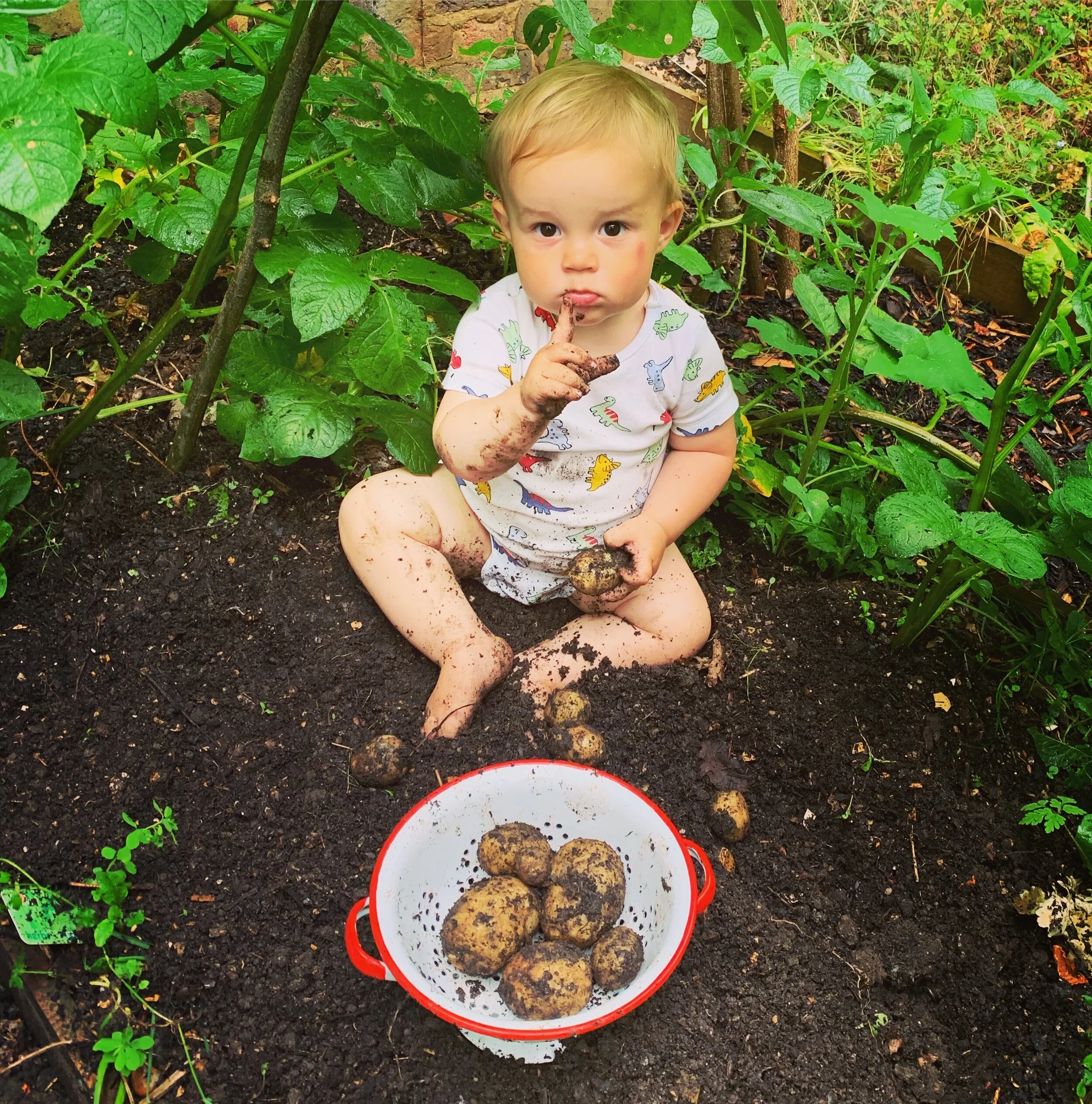
Gardening with a child. Gardening as a child.
Trying to let go of saying ‘NO!!’

Rosemary with lamb… a classic combination
This week is National Children’s Gardening Week, and to honour it I have been making a concerted effort to spend as much time gardening with my 2 year old son, Arthur, as possible. When I was pregnant with him I imagined hazy hours together exploring the wonders of nature as I tended a perfect garden in a new life as an earth mother in which I had great stretches of unscheduled time for gardening (HA!).
In reality, almost every activity we have tried in the garden has ended in chaos and a lot of the knee jerk ‘Arthur, NO!!’.

‘Look Mummy! CROCKS!!’
He loves the process of harvesting, and it’s a great way to get small kids to enjoy veg, but as soon as he could walk we found all our cherry tomato plants stripped of their fruit, ripe or otherwise. He runs in at dinner time calling ‘Look, I picked some radishes’, his hands full of tiny radish too small to eat. Then there are his efforts at what I call ‘live heading’ where he helpfully lops all the flowers off my plants for me, or discovers an exciting insect right in the middle of a flower bed and charges after it full of enthusiasm. I had no idea that I was sowing the seeds of disaster when, last autumn, I got him to help me pot up my spring bulbs, placing crocks in the bottoms of pots, scooping in compost and arranging the fat bulbs for me. This spring, months later, I wasn’t sure if I was more horrified or impressed when I found him proudly smashing flower pots calling ‘Look Mummy! CROCKS!’. He helped me sow all my seeds this spring, and then rearranged all the labels. This has done wonders for testing my horticultural knowledge but when it comes to distinguishing my ‘wok broc’ from my collard greens I am still stumped. Above all I find smatterings of certain plants growing in everything and can only assume a certain degree of compost mixing has taken place behind my back.

But maybe the problem lies with me as an adult rather than with him. A toddler’s curiosity and wonder in a garden is to be treasured and, as is so often the case in parenting, it is our adult preconceptions about what a garden ‘should’ be that causes friction. Perhaps we could all learn something by watching children in our gardens, and by thinking back to the magic of our own early experiences with gardening and nature.
I grew up with a garden big enough to have shrubs to hide in, a little pond and various other secret corners to inhabit. According to family mythology, one of my first words was mesembryanthemum (an interesting reflection of gardening trends in the 80s), and as soon as I could toddle I was off exploring the garden, terrifying my parents as I gorged myself on wild strawberries and returned stained red. I used to fish for newts in the pond with my brother and sister (my brother was brilliant at drawing them), and whilst other girls began to show an interest in mainstream cosmetics, I was trying to make garden perfume (notoriously giving my 5 year old sister a rash with my ‘day-lilly dreams’ concoction) and trying to wash my hair with horse-chestnut leaves. The old greenhouse was a place of secret magic and the discovery of a bucket of golden vermiculite was as thrilling to us as Tutankhamun’s tomb to Howard Carter. In all these memories, the garden was a place of mystery, of exploration, of experimentation and, above all, of freedom and independence.
Reflecting on these experiences, I realise I want to give Arthur freedom to explore and a sense of adventure alongside helping him discover the joys of nurturing that come with growing plants of your own. Nature can entertain and teach children in a way that indoor toys never can. It changes and develops, it’s unstructured, it’s dirty and immersive. But giving him these experiences is much harder than I had expected. We are lucky to have the garden we do, but it’s pretty small and there’s very little space for him to ‘run wild’. In the rush to perfect what little space we have and, maybe I have lost the childhood magic of chaos and dirt, mud pies, beetles, sticks and dens. Plants used to be precious regardless of how healthy they were looking or whether they were weeds or some coveted cultivar. I used to enjoy the garden without it having to ‘be’ anything other than itself.

Yesterday as Arthur abandoned sowing sunflower seeds with me and instead sat in the compost bucket and began to shovel it down his shorts I drew a long breath, smiled and continued with the seeds myself. I have sown enough seedlings that when he decided to try to feed our cat cosmos this morning I was able to remain philosophical as I scooped them into the bin. I am trying to set parameters that will keep him safe and me sane, but in the end I am just grateful that he takes an interest, grateful that we have a garden to share with him and time to enjoy it, and determined not to crush the spark of discovery.

Arthur and Toby picking Pak Choi

Chaenomeles
Japonica Jelly

Chaenomeles on an Edo period scroll by KANŌ Sigekata (1657-1699)
On winter walks, there are a few plants that I always find grabbing my attention and one of the best of these is Chaenomeles. It’s small, pear blossom flowers sing out at you from stark, bare branches at a time of year when everything else is a bit dour. Chaenomeles spend the rest of the year looking utterly unremarkable if not downright twiggy and unpromising, and anyone passing them in June might wonder what on earth people thought was so “superb” about them when Chaenomeles x superba was named. But the winter and early spring is their time to shine and they take full advantage of it.
This is, of course, exactly what they are trying to do. With very little else in bloom, winter-flowering shrubs have their moment in the limelight, but with limited pollinators braving the chilly weather, they have to make the most of their opportunity. Appearing when there are few, if any, leaves to contend with, the flowers seem particularly luxuriant against their bleak, bare stems, and look like they belong in an Edo period Japanese print, or on Chinese lacquer work. In fact, they are depicted on both, and our common name for these plants as “Japonicas” is a reference to their oriental origins. Chaenomeles x superba is a hybrid cross between C. japonica from Japan and C. speciosa from China and both cultures celebrated its blossom.

Chinese lacquer work screen depicting birds on a Chaenomeles bush
All of them will happily grow into a big tangled shrub if left to their own devices: impressive whilst in flower but rather forbidding the rest of the year. Training them against a wall or railings seems to do more justice to their delicate exoticism, displaying their flowers for appreciation and, more importantly, their fruit for easy picking.
I remember encountering Chaenomeles on walks as a child, and back then it was their fruit which would catch my eye more than their flowers. Weird and knobbly yellow pomes, somewhere between a large crab apple and a miniature pear, their fruit are arguably the most ‘superb’ thing of all. The genus is named from the Greek chaeno “to split” and melon “apple” based on a description by botanist Thunberg of the fruit splitting. Since then, this has been criticised as something that rarely, if ever happens, so I have decided instead that the name must have been meant as a rapturous instruction: ‘just split the fruit open’!
The moment you do their fragrance is incredible: lemony and sweet with a hint of pineapple. They smell so intoxicating you’d almost think it was a good idea to take a nibble, but raw the fruit are bitter and pithy. Luckily adding a tonne of sugar mitigates their bitterness, and their pithiness makes them a brilliant source of pectin – they’re perfect for making jelly. Since the fruit are small, you end up needing quite a few to make a good, useful quantity, and I’ve always kept a sort of urban foragers map of the Japonica hedges of our Brixton neighbourhood. Most people don’t have a first clue what to do with them and are happy enough to part with the fruit, especially if you leave a little jar of jelly on their doorstep a few weeks later.

Arty and I rescuing Japonicas off the ground in the park
Last weekend we went to a London park (which I will keep top secret) for a run-around and after we stopped for an outdoor coffee I suddenly noticed a Japonica covered in bright red blossom and last season’s fruit. Urban foraging is a noble art, and I would never pick the lumpy fruit off the branches in a public park in case some little child should wander past, see them at eye level (adults never look down and rarely look closely) and fall in love as I did. But fruit hidden on the ground I consider fair game. Twenty minutes later we were driving home with a bag of muddy fruit in the boot and the car smelling like a sweet shop.
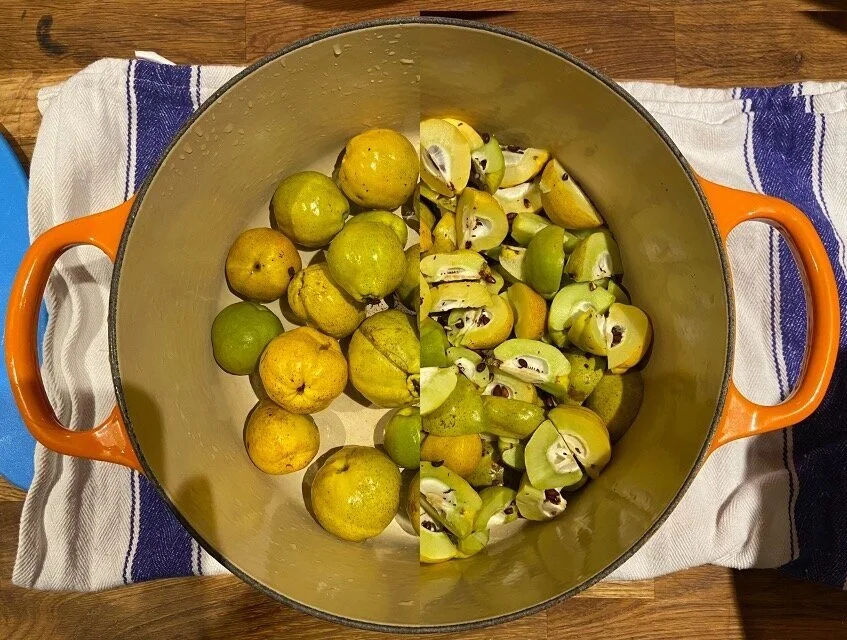
Credit to Toby for the unsolicited photoshoppery
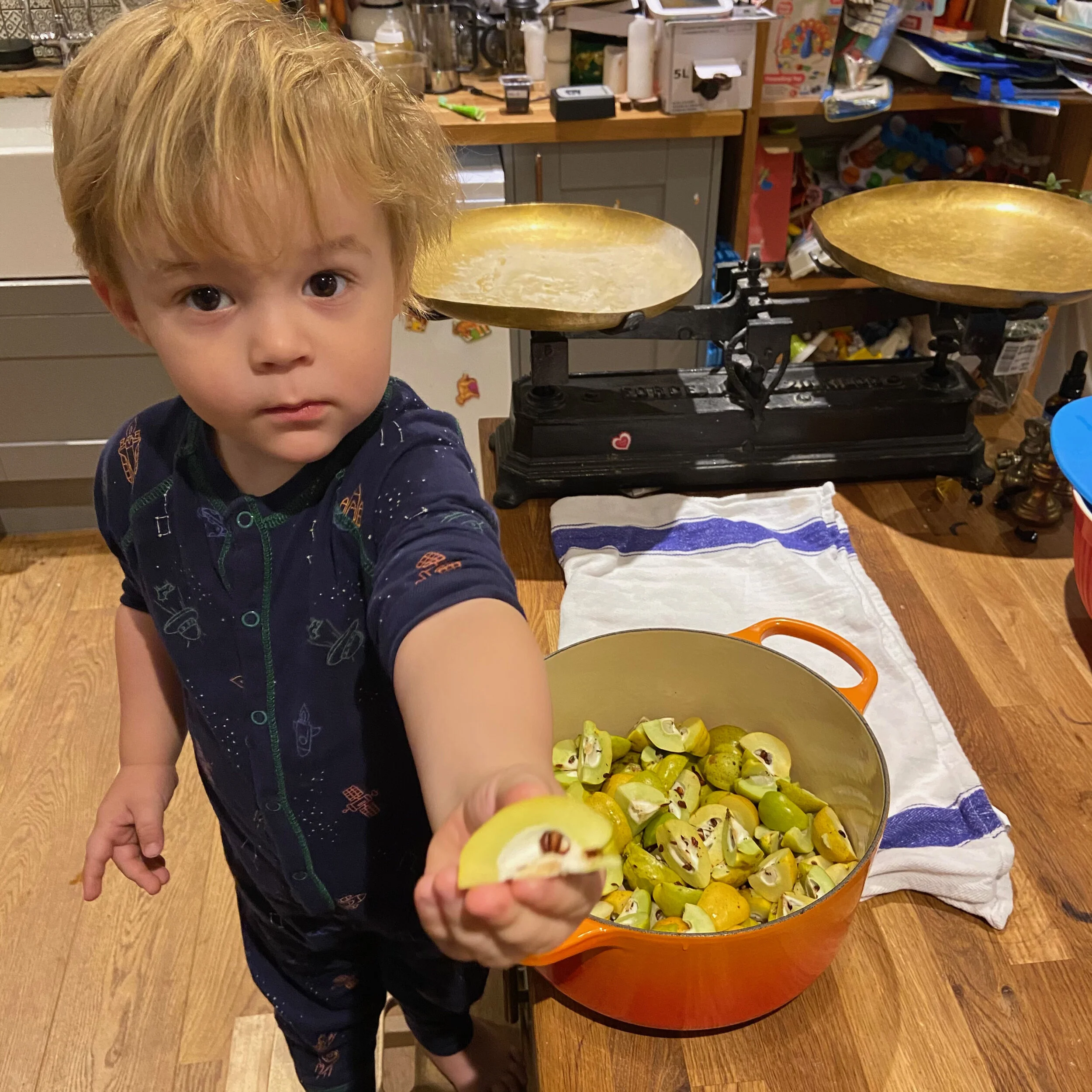
We chopped them up, covered them with water and stewed them until they were soft and pulpy. The whole mix was then suspended in a cheesecloth (or baby muslin) over a large mixing bowl overnight. Drip by drip, the resulting liquid was a rich and brilliant yellow. We measured it out into a heavy bottomed pan, adding one pound of sugar for every pint of liquid and then boiled its socks off for about 15 minutes, regularly dripping small quantities onto refrigerated plates and ho-humming about its consistency (when it starts to form a skin and hold together on the plate it’s ready).
The resulting amber jelly has a lovely lemony taste. So often food writers describe jam-making as capturing the very essence of summer; we have captured the subtle and exotic flavour of Japonicas in winter.

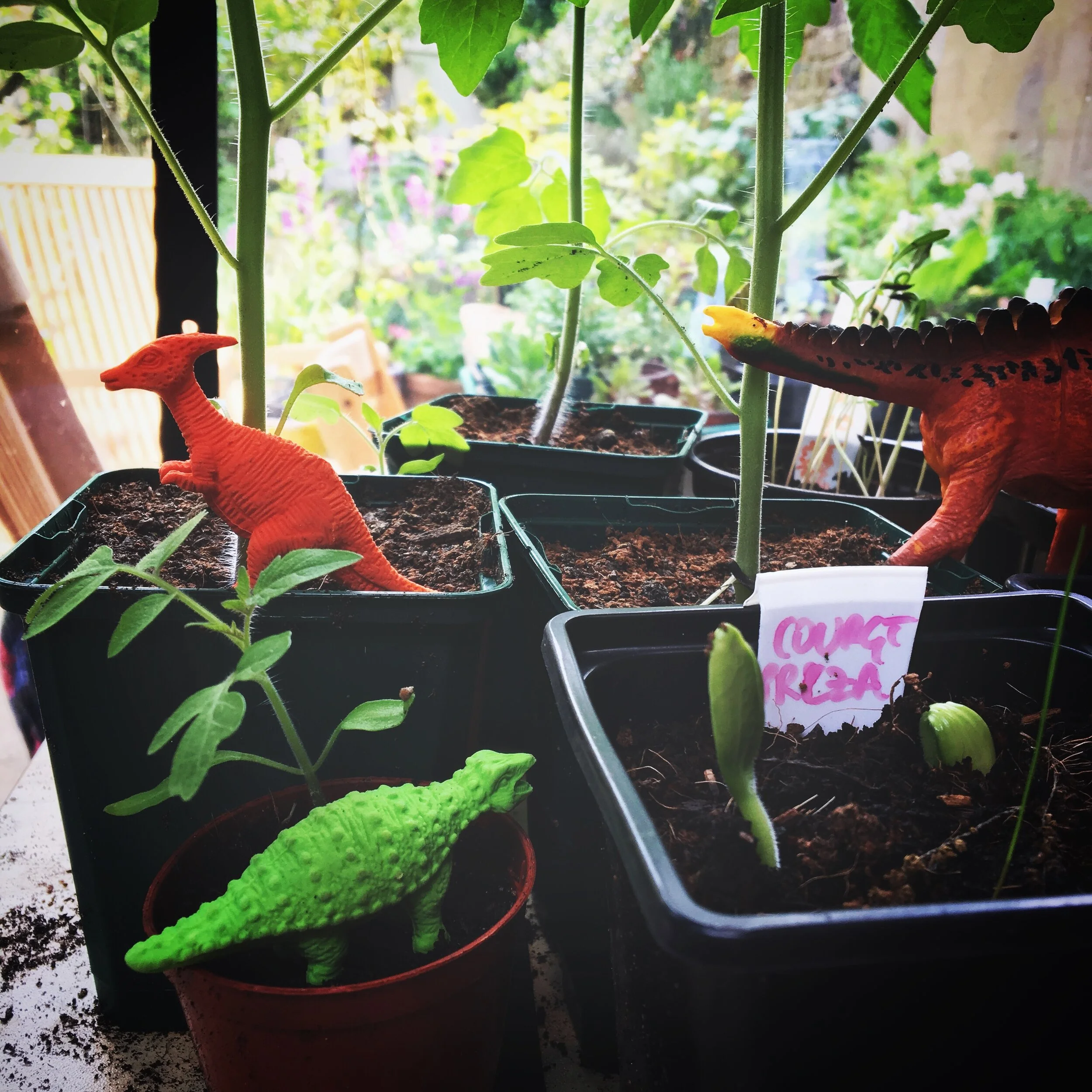
Parenting and Potting on
The trials of raising healthy, independent young plants
I can be a horribly inconsistent gardener. Each spring I am dillgent and spend all hours that my son sleeps busily getting on with things. But as the garden matures, my own commitment to its upkeep starts to slip. After years of feeling guilty about this, I’ve realised that it’s not because I’m fickle and lose interest or energy, it’s that the gardening jobs in early spring kindle hope and capture my imagination in a way that primping a garden in full bloom never will.
Of all the spring jobs I love, pricking out and potting on seedlings has to be my favourite. Yes, true, it helps that I can do it in the evening at the kitchen table accompanied by a good scotch or a crisp glass of wine. I also find it a very meditative task: repetitive enough to allow the mind free range but still requiring attention and care. Above all, it is a task that connects me to the garden, as I take the time to engage with and care for each of the plants that will go on to serve me so well for the rest of the year.

Pricking out seedlings with a glass of wine and an episode of House - the perfect way to spend a spring evening
This early care for a plant is not unlike early care for a child: providing an opportunity to bond but also the great responsibility of giving them the best possible start in life. The development and nurture of plants in their earliest stages goes on to have a huge impact on their final growth and, as with parenting, this can lead to no end of anxiety over getting it right. Consistent moisture early on allows seedlings to plump and fill out, setting the framework and structure for their form as they grow, while feeding them the right diet is just as important, although I’m finding this is at least much easier with passive seedlings than with a rebellious toddler.
I have already had several parenting fails this year. Struggling to find seed compost under lockdown and too impatient to wait for a better alternative, I sowed a number of seeds into quite a chunky multipurpose compost. They germinated well but have since struggled forward, their lower leaves showing signs of malnutrition and were rapidly overtaken by seed I sowed two weeks later in a good seed mix.
As plants head into their teenage the house begins to feel crowded with their gangly forms, but the responsibility of care is in no way diminished even if I try to give them the space to do their own thing. An over fussy parent, I quite like to sow things in trays where possible and them prick them out and pot them on several times, particularly with plants like cosmos and tomatoes which respond to being transplanted deeply by putting out new roots. In their early days, I cluck as my cosmos become increasingly stretched and thin (gardening is the only example of where being ‘leggy’ is not a compliment), and I try to fatten them up as I bury them deeper and deeper. In truth, there is always a period in April where many of my seedlings are a bit lanky and, like a kid wedded to their x-box, I can’t help but feel they need some time outside.
Finally they are ready to leave home, and the parent’s task becomes one of fostering independence, toughening them up for life on their own. I don’t have a cold frame, but small plants are moved onto our patio during day times and gradually hardened off to face the realities of the outside world. When they do finally move into the garden and put down roots I will still be there watching from a distance, trying to give them their independence but desperately worried about slugs or a sharp frost.

Young plants on our patio table, approaching graduation
Like parents, we can never get it 100% right no matter how hard we try, and will always blame ourselves for their failings and be uncertain how much credit we can take for their triumphs. But there is great consolation in the knowledge that, like children, young plants show remarkable resilience and, once we have nurtured them through these earliest days, they will go on to thrive without us, shaped subtly by our support and care, but brilliant adults in their own right.

Finding Time to Garden
A past-time with no cheating and no shortcuts
I’ve had a baby! Little Laurie (Laurence) arrived 4 weeks ago and is thriving! The last month has flown by and every moment has been filled with the joy and exhaustion of being a family of 4. It’s been a good few weeks since I last wrote here but life has finally settled down so I’m back!
Yesterday Toby took Arthur to football, Laurie fell asleep in his crib, I poured my coffee and just like that, I was alone in the garden for the first time in weeks. I’ve been in and out in the last few months, mainly to help Arty strip the veg patch of nearly 900 cherry tomatoes one handful at a time, and to hoof buckets of veg scraps to the compost heap, but between ‘pregxhaustion’ and clutching a newborn, I hadn’t touched the ground in nearly 2 months. Yesterday, coffee in hand, the world stopped spinning for a moment and it was bliss. Taking stock in the warm September sun; tackling some woefully overdue weeding. Best of all, having my hands in the soil again after 9 months of wearing gardening gloves.
10 minutes later, Laurie woke up and the spell was broken.
At the moment, it feels like there is never enough time to do anything, let alone enough time for the garden. But the garden shows no sympathy for the stress of early maternity and refuses to wait for me, galloping wildly ahead without me. Every time I step outside the list of what needs to be done grows longer. Rather like my tummy I find my ‘post-partum garden’ looks nothing like it used to and falls far short of any societal ideals. But none the less I’m still super proud of what we’ve managed this year. We’ve grown an awful lot of veg and even if some corners of the garden are looking neglected, when I look out of the kitchen window I can still see flowers.
One of the greatest charms of gardening is that our creations exist independently of us. Unlike a ‘finished’ piece of art, our relationship to our garden is a continuously developing one: the art we create in a garden is open-ended and our medium has a life and opinions of its’ own. This enriches the art of gardening but makes it an exhausting and exacting hobby at times. Unlike so many past times, there’s no quick fix, no cheating, and very little control over the time frame for getting things done. Much of gardening consists of critical day to day jobs which, when skipped, can have disastrous consequences (RIP to the trays of seedlings I left un-watered earlier this spring). You can’t really take a break: If you decide to leave the garden to itself for 6 months and then return, you pay for it and at the back of our flower beds I’m now facing mountains of well-established weeds as penance for months where I couldn’t bend down!
The pay-off is the huge satisfaction of knowing that what beauty there is in your garden is the result of hard labour. When I flick through images of people’s private gardens and allotments on social media I find myself quite moved by the sheer scale of collective human effort that has gone into them. No one can grow vegetables or arrange bunches of cut flowers from the garden without showing up week after week, digging, weeding and watering for months beforehand. I’m full of respect for all those gardeners who squeeze in time for their gardens between work hours or kids or whatever else life throws at them.
I’ve just started to volunteer at Brockwell Park again which feels fantastic, and so far Laurie sleeps contentedly in his pram while I get busy gardening, but how long that will last, who can say. I look forward to a time when I have long, uninterrupted spells in the garden, but for now, it looks like my relationship with the garden will continue to be one of snatched moments of freedom to get on with things. Perhaps gardening will still feel this way long after all my children have flown the nest. Perhaps it is this that makes gardening feel like such a luxury and a pleasure: making time in the garden has come to represent making time for myself.
And on that note, Laurie has drifted off and I have some foxglove seedlings in urgent need of potting on, so I shall wish you a pleasant day, close my laptop and dive outside before it starts to rain.

The Itinerant Gardener
Maintaining a healthy long distance relationship
International travel is an unavoidable ‘perk’ of my job. As I completed my most recent tax return it dawned on me that the year I got married I spent over 230 days abroad with work. On quizzing musicians today about how they survive the travel they all say the same thing: thank heavens for the modern technology that makes this lifestyle workable, connecting us from afar with those closest to our hearts. How did people manage before FaceTime? I can only agree. Toby has spent many hours patiently directing the video camera around the garden in the falling light as I profess that I am deeply homesick and can hardly bear to hang up. ‘Just one last look at the dahlias and then I promise I’m done’ I sigh before we make arrangements for the same time tomorrow.
The other great necessity, all my colleagues would say, is an understanding partner. In this I am extremely lucky. Toby was put to the test in the first months of our relationship when 90 perennial plug plants arrived at his doorstep needing potting on and tending until my return. I was abroad for 2 months and decided his were the safest hands for such a precious charge. Most of them are still happily blooming in our garden today, a living testament to his patience, although I suspect this is the kind of stunt one can only pull once and in the early, giddy days of a relationship. I spent the 3 months before our wedding in Berlin, during which time I was supposedly growing our wedding flowers. In effect this translated to many hours of Toby diligently watering our garden and deadheading cosmos while I gave close instruction over FaceTime. They turned out beautifully but I felt rather shamefaced when I was congratulated on the day for having grown them all myself.
Gardening might seem a passion incompatible with such an itinerant career but in fact the more I have travelled the more the garden has been my anchor. It is a wonderful thing to put a small plant in the ground, to know that it is busily growing in your absence as you knit and watch endless Netflix in a drab Aparthotel room, and to find it awaiting you with open arms, burgeoning and in bloom on your return. Whenever I get home I drop my suitcase at the front door and run straight to the garden to check on its progress. It is a great comfort at the back of my mind wherever I am to know that the garden is a constant, ticking along with its own steady rhythm regardless of how chaotic life gets.
This is not to say that our long distance relationship is easy. I find myself pining as the weeks pass, dreaming of its beds and borders with a frustrated longing which can only be expiated through hours online ordering seeds which I know will be waiting for me on the doormat. I lie awake at night with plans and plant lists for our future together drifting through my mind. Absence makes the heart grow fonder and I return with redoubled passion, full of good intentions, and find even the most mundane jobs a joy.
The most important thing to remember when leaving a garden is to part on good terms. The smallest of unresolved issues, if left, can rankle and take root even in just a few weeks. Before any trip away from home it is a good idea to put things in order. Green alcanet and dandelions plague our patch and a few weeks is enough time for them to take off and seed all over the place. An hour digging them out before you leave will save a lot of backbreaking work later on. The other two big issues I face with extended absences are snails and drought. Like Scylla and Charybdis, if one doesn’t get you the other will and navigating between them seems an impossibility. A few weeks of dry weather keeps the gastropods at bay but I return to a garden of dead plants and withered opportunity. Invariably if the heavens deign to water the garden for me in my absence the slugs and snails greedily consume everything the rain has nurtured.
You can get around the water problem for larger plants by focussing on things that tolerate or even thrive in dry conditions. Two years ago I returned to a garden that was 80% dead with small pockets of flourishing fennel, verbena and carpets of my beloved Erigeron. These have become the backbone of my beds which now include globe thistles, Eryngium, and the seemingly trendy Knautia massedonica. Oddly I have found my dahlias cope with neglect as well as their juicy tubers seem to be able to keep them going without watering for quite some time. Spring bulbs will generally sit happily through a dry summer and bigger more established shrubs and roses are mature enough to cope on their own. The rest of the garden consists of a lot of plants that are tough as old boots and will withstand rough treatment like Achillea ptarmica and Hesperis matronalis. Generally if it’s hard to get rid of it from the garden then it will do fine without you.
Pots present much more of a problem, so before travelling a good rule would be “if in doubt stick it in the ground”. My inner aesthete can’t quite bear to bung empty lemonade bottles in all my pots as a water supply (as some people suggest) and somehow splashing out on a timed watering system hasn’t been feasible yet. At a nursery I was once advised to fill the bottom of my plant pots with the stuffing of Arthur’s nappies which will apparently store water and then slowly release it. This seems a bit weird but might be worth a shot. For now I just collect my pots into a small area and try to inveigle friends and neighbours into watering them. A good soak once a week should suffice and is more useful than daily sprinkling so if you can find someone to do that for 20 minutes you should be fine. The exception to this is seed starting and small seedlings or cuttings which need pampering with conditions as constant as you can give them. Trips abroad in April are always the source of much heartbreak. As with bringing up children, experiences in the earliest days of a plant’s life go on to shape much of its character later on and in general you are better off planting seeds a bit late after a trip than putting them in before you go and leaving them to drought or being eaten. After such early trauma plants are often stunted for life (water supply in the juvenile growth stage permanently determines the shape, structure and habit of a plant as it matures).
After the heart break of anxious weeks apart one always wants to look one’s best on being reunited and the final job before I go is to give the garden a thorough haircut. With many perennials you can tweak and delay their flowering with a good trim and with pots of bedding this is even more important. Cut back and feed any plants in pots and before you leave and a fresh flush of growth and flowers will await you with a smile when you return.
All of the above may make the separation anxiety more bearable and the reuniting sweeter but parting is still painfully hard. Best of all would be to only travel in winter, in the cold months when the garden is sleeping anyway, and to tiptoe back in the spring to greet it as it wakes with hands full of seed packets and a head full of plans for the year to come.
Gardening in a corridor
A brief introduction to our garden
When Toby and I were looking for our home, we visited so many places that were more spacious or already renovated, but all with no garden or only a small patch of paving at the back. In the end, we opted for a place that’s only slightly wider than a train carriage and that took 2 years to do up, with a completely rotten roof, illegal wiring and mould on all the walls. In the end, we bought a garden.
Our garden is 13ft wide and 60ft long – effectively a verdant bowling alley but a good stretch of ground. It receives sun in the spring when the trees are bare, but has a high wall on one side and a fence on the other and is narrow enough that a sunbather has to put down their mojito to move their chair across the patio every 40 minutes. When Monty Don walks us down his ‘cricket pitch’, a liminal space between his gardens which he block plants (beautifully) with anything from Acanthus to wildflowers, I watch and think ‘that’s pretty much the size of our entire plot’. A long corridor with striking planting looks stunning, but when it’s all you have to work with there’s a lot more you need to get from it: a patio, grassy space for Arthur to run around, a veg patch and of course plenty of space to explore my ever-growing list of favourite flowers. Most of these do best in full sun and every centimetre of the garden’s layout has been a weary territorial battle with myself. A battle between my love of alpines and my love of alliums, my need to grow carrots and my desire to grow cardoons and, most painful of all, between Arthur’s wish for a sandpit and Toby’s need for a barbeque, neither of which have anything to do with gardening and therefore qualify as a waste of good fertile ground in my book.
In the end, we have divided the garden into 4 sections: a patio, flower beds with a bit of lawn, a vegetable section and the somewhat blighted nether region of dry shade beneath a walnut tree. This last area presents the ultimate in difficult planting, which houses our compost heap, a tool shed and my best efforts at woodland planting. In each of these areas my desire to cram in as many plants as possible defies both practicality and good taste. We finally had the patio levelled and redone this spring and after 24 hours of it looking elegant and tidy I had covered it back over with pots full of tulips and spring bedding whilst waves of seedlings and unpromising pots of dahlias colonise the outdoor ‘dining table’. In the raised veg beds I have tried over the years to fit flowers for cutting around the borders, often to comically disastrous effect, as in the case of my wallflowers and cabbage bed (see below).
But there are some big benefits to having a small garden. You get to know the space well and can enjoy the challenge of making the whole area work as much as possible. In the dark winter days, the first sparks of spring are close enough to the window to be enjoyed. In the recent baking heat, a bit of shade from surrounding trees has been a blessing both for us and the plants.
Our flower beds suffer inevitably from the incompatibility of a plant addict with a small canvas and any kind of colour scheme, but for now I have decided that enjoying exploring new plants is more important. I should learn to re-gift plants but I grow too attached to part with them. My brilliant, scarlet poppy ‘Beaty of Livermere’ spends May gunning away, enthusiastically covered in huge red flowers that make your eyes water next to the subtleties of Allium schubertii and Dicentra spectabilis, like someone’s embarrassing cousin who didn’t get the memo on dress code. I shall develop good taste when I have the space for it. Or when I have grown every plant I can think of under the sun and settled on some favourites.
For now, our garden is chaotic, much used and well-loved. It’s imperfect, and whilst that’s largely down to me, I like to blame the conditions I work with. It has taught me about the joy of care, the illusion of control, and above all the necessity of letting go.