
Violets
Divine and deviant, tiny but tough
Homer describes Persephone as collecting bunches of roses, crocus, wild violet, iris, narcissus and hyacinths before Hades drags her down to the underworld. This seems to me an unlikely and lumpy bouquet and it is disappointing that out of season roses (no doubt imported) have been an inescapable feature of floristry since ancient times. I suppose that, as the goddess of spring, Persephone excelled in getting flowers to grow, not necessarily in arranging them.
The Ancient Greek violets must have grown an awful lot taller than the Viola odorata in my garden which, reaching about 10cm, wouldn’t add much to a mixed bouquet. They have come to symbolise modesty because of the way their flowers are often tucked away, hidden amongst the leaves, but their diminutive size and humble habit do not diminish my respect for this little plant which fills all sorts of nooks and crannies in the garden and is extremely useful.
They may not be showy but they are as tough as old boots. They tolerate mowing, moving, poor soil, sun or shade and dry or moist conditions (though a damp and shady spot will prolong their flowering). Several times I have lifted a clump and forgotten about them, found them with bare roots on the garden path the next day, bunged them in a dingy corner and hey presto. They’re a great option for spaces that get a lot of rough use. They sit comfortably around the compost heap and whilst most plants take umbrage at being trampled and wheeled over, the little violets carpet the ground with foliage throughout the year and provide deep purple flowers in the earliest days of spring when even the tiniest bloom can hold the stage.
Violets take their name circuitously from Io, mistress of Zeus, whom he transformed into a cow, hiding her from Hera’s wrath. Accustomed to the delicacies of palace life, Io wept on tasting the bitter grass which was now her breakfast, lunch and supper until, as a parting gift, Zeus transformed her tears into sweet violets on which she could graze. The story of Io has always left me with the image of a rather pampered heifer with a terrible sweet tooth. An appropriately fragrant diet for a divine mistress, violets are edible to mere mortals too. Their sugary scent has long been prized and more recently abused in confection, from the rather lurid ‘creme de violette’ liqueur to the sickening Parma Violet sweets named after the wild violet’s rather frou-frou and heavily scented frilly French cousin. There are classier ways to use violets in the kitchen. Their leaves, apparently packed with vitamin C, can be added to salads, and their flowers can be preserved in sugar, crystallised to decorate cakes, or turned into a home made subtle ‘Creme de violette’ equivalent by being steeped in Vodka. Bear in mind that the famous odour of Viola odorata can vary considerably and in many cases has been lost, so homemade liqueur or sweets are likely to be only subtle in fragrance but a very decorative colour.

Cleistogamous violet flowers
For a plant representing modesty, the Viola has a remarkably deviant sex life and wantonly reproduces twice a year. In spring its flowers open and it interbreeds with abandon, the seed heads rising up before popping open and flinging seeds widely. By contrast in autumn the viola produces small closed flower buds and, hidden beneath the covers of its rosette of leaves, furtively self pollinates. This autumnal reproduction is a-sexual and the flowers cleistogamous (from the Greek kleistos meaning closed). These flower heads grow beneath the soil, blanched and blind, looking like alien body parts. The upshot of this double reproduction is that the rather seedy violet tends to spread, but the young plants are easily dug out and are no threat if monitored. I tend to just plant them in the bare corners where they can self pollinate or fling their seed freely without causing offence.

Poor Ophelia floats down steam, a chain of violets around her neck, plucked before their time, destined never to set seed.
Reproducing twice a year might all seem a bit weird for a plant that plays such a fragrant and innocent role in myth and literature, but given that the violet’s poor spring flowers have been plucked by almost every literary maiden since Persephone herself, it makes sense to have a back up should spring pollination fail.
At this time of year one sees violets everywhere, so if you’re not too fussy perhaps the easiest option is to find a patch you like the look/smell of in a neighbour’s garden somewhere and ask if you can have some. For the purist there are heritage varieties available such as ‘Queen Charlotte’ that have kept their scent. Seeds will need stratifying, or else will need to be sown in Autumn and left out to the seasons, but once they get going they should self seed or spread by stolons, giving you plenty of future plants. I inherited my violets when I moved in and for some reason they always grow in the one part of the garden where I definitely don’t want them: I dig them up and shuffle them all down to the shady end only to find more doggedly growing where I had removed them the year before. This is no great problem as they are easy to move and, so far, I can always use more of them. Popping up in inhospitable corners, putting on a brave face after a close encounter with a wheelbarrow and blooming with spangles of purple in the coldest months of the year, it is this dogged determination that I love most about them.

Primulas
Human tinkering with what was already perfect
My earliest memory of being involved in gardening is of my grandmother. When I was still very little she gave me some low white metal ‘fencing’, about 15 cm high, to edge my own plot of garden and took me to a garden centre to buy bedding primulas. I remember being completely entranced by the variety of bright colours available, like pick and mix sweets, and I came home full of excitement to plant them. My grandma was genuinely very fond of primulas, but looking back they were also the perfect plant for a first garden experience: offering wide variety of colour with instant effect, and for very little money.

The perfect Primula vulgaris

… and man’s creation: the bedding primula
Since then I have struggled a bit with hybrid primulas. Their bright colours and compact form mean that, plonked in the ground, they can look a lot like something from a teletubby’s back garden, and they can’t seem to escape connotations of tutti frutti bedding schemes. With the current fashion for pollinator friendly, natural planting we are moving away from hybridised forms and double flowers, but still our selection and breeding of these forms is a huge part of our horticultural heritage and has its’ roots in the history of plants like the primula and polyanthus. Oddly other highly bred plants seem to be coming back into fashion, like the many weird and (sometimes) wonderful dahlias which have made a remarkable comeback in the last 10 years. They don’t seem to be judged so harshly. I have a suspicion that this is due to the innocence and purity of the much beloved native primrose, Primula vulgaris. Somehow we don’t mind seeing a frilly hot pink dahlia, but we look at what mankind has done with what was originally the fragile beauty of our wild primrose or oxslip and feel uncomfortable.

A tuft of cowslips painted by Albrech Durer in 1526
This is ironic, since it is the primula’s natural tendency towards interbreeding which made it such a perfect candidate for hybridisation. The first ‘polyanthus’ form (several flowers on one long stem) is the result of a naturally occurring cross between Primula vulgaris and the cowslip, Primula veris giving us the oxlip or Primula x polyantha, whilst both the first pink and double forms were introduced from natural occurrences
We have taken this ball and run with it, and the history of the primulas, from auriculas to polyanthus, has provided enough material for whole books on the subject.

Portrait of Martha Rodes with the highly sought after green edged auricula
It is a history of the overlap between nature and human creativity, fashion and obsession. It is also a history that encompasses a wide range of human experience and social background. Auriculas, along with other “Florist flowers” were a collector’s item and craze of the very wealthy in the 17th and 18th century, but by the 19th were hugely popular among the working class people of the industrial north and midlands who would compete to show perfect blooms (alongside other flowers like carnations and tulips). The steps along the road towards the hybrids available today read like episodes in a novel with no small degree of romance to them. It was a little girl, Julia Mlokossjewicz, who discovered Primula juliae in 1900 on an expedition with her father in the Caucasus, bringing its’ bright magenta flowers and hardiness into the breeding mix and giving rise to the popular Primula ‘Wanda’. Florence Bellis, a trained concert pianist, found herself bankrupt and with deteriorating health in the 1930s. She moved into the hayloft of a friend’s barn, spent her last $5 (so the story goes) on a packet of polyanthus seeds and from these humble beginnings went on to breed many of the flowers much loved today.
I am left divided: loving primulas for their history and the memories they bring me, but struggling to find a role for them in a small London garden. I can quite imagine that one day I will become a nut for auriculas, but that time hasn’t come yet, and whilst the shady end of my garden is full of ‘wild’ primroses and oxlips, they seem to me to fall under a different bracket from the showier polyanthus that result from 400 years of tinkering.

Shades of Primula ‘Zebra Blue’
I now grow the showier flowers in pots, and you’d be surprised how many of the cheap ‘bedding primulas’, when planted individually rather than in garish mass, take on the old-world charm of a prized specimen plant. The Elizabethan craze used to be for double flowers, flowers with a ruff and what was called ‘Hose in hose’, where one flower sits on top of another, and many of these old varieties can still be found on-line. But I would challenge gardeners to stop and look closely at the beauty of even those plants found at 6 for £3 in the garden centre.

‘Victoriana Gold Lace’
I currently have a soft spot for ‘Zebra Blue’ which has the most amazing striped delft colouring in shades of blue and white, ‘Francesca’ which has slightly alien looking green petals and ‘Victoriana Gold Lace’ which (to an untrained eye - often the most important eye of all) could hold its own amongst the most prised auriculas.

The dainty ‘Lady Greer’
For planting in beds and borders, simpler forms and colours look more relaxed and naturalise well, whilst less hyrbidised varieties are more tolerant of variable conditions (drought, wet and cold) and have much higher survival rates. For a gentle pink twist on the original, Primula vulgaris var. sibthorpii is a variant of P. vulgaris brought back from the Balkans, with pale pink flowers. Varieties of Primula juliae flower well and are resilient: P. juliae ‘Wanda Alba’ or ‘White Wanda’ keeps all of Wanda’s resilience but with pure white flowers whilst ‘Lady Greer’ is a polyanthus form with all the delicate colouring of a native Oxlip. I also love the purple foliage of many Irish bred primulas, the most famous and beautiful of all being ‘Guinevere’ with gentle pink flowers and deep purple stems and leaves.
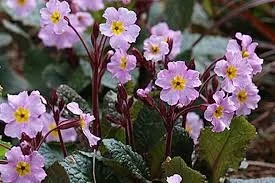
The purple stemmed, Irish ‘Guinevere’
Their tendency to hyrbridise means that named varieties can’t be propagated by seed but clumps can be divided every 3 to 4 years after flowering. Primroses do best moist humus-rich soil, and in partial shade under deciduous trees or shrubs where they will receive light in spring but protection from the full summer sun. This means they do brilliantly tucked into borders amongst summer flowering plants. Completely forgotten for the warmer months their evergreen rosettes are revealed as everything dies back and they provide welcome, delicate colour while the rest of the garden sleeps.
We all look to repeat the memories that mean most to us and last week I took my little Arthur, just under 2, to buy primulas for our garden. He was delighted at having free choice and inevitably picked all the colours I would have avoided, but his joy in selecting and planting them was a delight to watch and hopefully the first step in a passion that will stay with him for life. I will always be grateful to my grandmother for encouraging me in the garden and think of her whenever I see a primula in bloom.

Arthur in our garden busy planting

Chaenomeles
Japonica Jelly

Chaenomeles on an Edo period scroll by KANŌ Sigekata (1657-1699)
On winter walks, there are a few plants that I always find grabbing my attention and one of the best of these is Chaenomeles. It’s small, pear blossom flowers sing out at you from stark, bare branches at a time of year when everything else is a bit dour. Chaenomeles spend the rest of the year looking utterly unremarkable if not downright twiggy and unpromising, and anyone passing them in June might wonder what on earth people thought was so “superb” about them when Chaenomeles x superba was named. But the winter and early spring is their time to shine and they take full advantage of it.
This is, of course, exactly what they are trying to do. With very little else in bloom, winter-flowering shrubs have their moment in the limelight, but with limited pollinators braving the chilly weather, they have to make the most of their opportunity. Appearing when there are few, if any, leaves to contend with, the flowers seem particularly luxuriant against their bleak, bare stems, and look like they belong in an Edo period Japanese print, or on Chinese lacquer work. In fact, they are depicted on both, and our common name for these plants as “Japonicas” is a reference to their oriental origins. Chaenomeles x superba is a hybrid cross between C. japonica from Japan and C. speciosa from China and both cultures celebrated its blossom.

Chinese lacquer work screen depicting birds on a Chaenomeles bush
All of them will happily grow into a big tangled shrub if left to their own devices: impressive whilst in flower but rather forbidding the rest of the year. Training them against a wall or railings seems to do more justice to their delicate exoticism, displaying their flowers for appreciation and, more importantly, their fruit for easy picking.
I remember encountering Chaenomeles on walks as a child, and back then it was their fruit which would catch my eye more than their flowers. Weird and knobbly yellow pomes, somewhere between a large crab apple and a miniature pear, their fruit are arguably the most ‘superb’ thing of all. The genus is named from the Greek chaeno “to split” and melon “apple” based on a description by botanist Thunberg of the fruit splitting. Since then, this has been criticised as something that rarely, if ever happens, so I have decided instead that the name must have been meant as a rapturous instruction: ‘just split the fruit open’!
The moment you do their fragrance is incredible: lemony and sweet with a hint of pineapple. They smell so intoxicating you’d almost think it was a good idea to take a nibble, but raw the fruit are bitter and pithy. Luckily adding a tonne of sugar mitigates their bitterness, and their pithiness makes them a brilliant source of pectin – they’re perfect for making jelly. Since the fruit are small, you end up needing quite a few to make a good, useful quantity, and I’ve always kept a sort of urban foragers map of the Japonica hedges of our Brixton neighbourhood. Most people don’t have a first clue what to do with them and are happy enough to part with the fruit, especially if you leave a little jar of jelly on their doorstep a few weeks later.

Arty and I rescuing Japonicas off the ground in the park
Last weekend we went to a London park (which I will keep top secret) for a run-around and after we stopped for an outdoor coffee I suddenly noticed a Japonica covered in bright red blossom and last season’s fruit. Urban foraging is a noble art, and I would never pick the lumpy fruit off the branches in a public park in case some little child should wander past, see them at eye level (adults never look down and rarely look closely) and fall in love as I did. But fruit hidden on the ground I consider fair game. Twenty minutes later we were driving home with a bag of muddy fruit in the boot and the car smelling like a sweet shop.
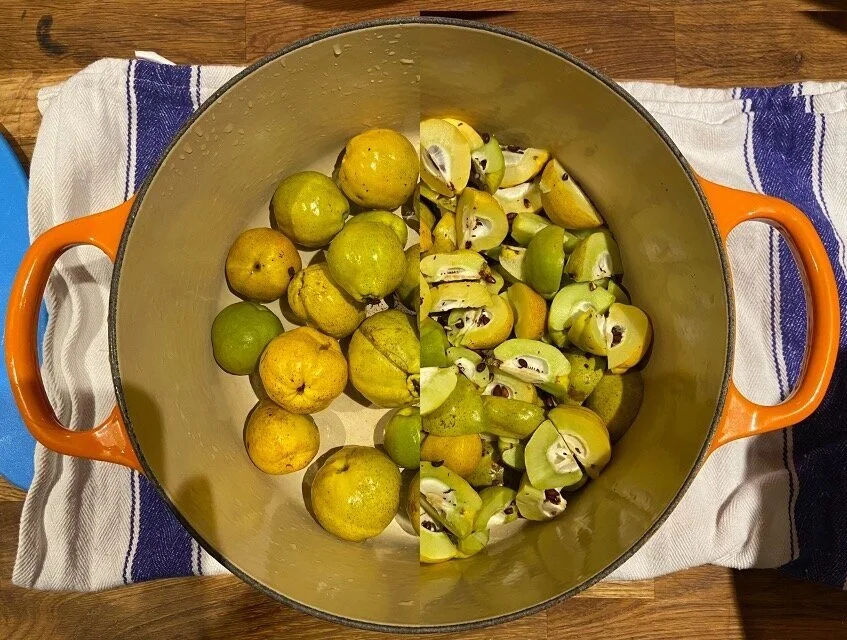
Credit to Toby for the unsolicited photoshoppery
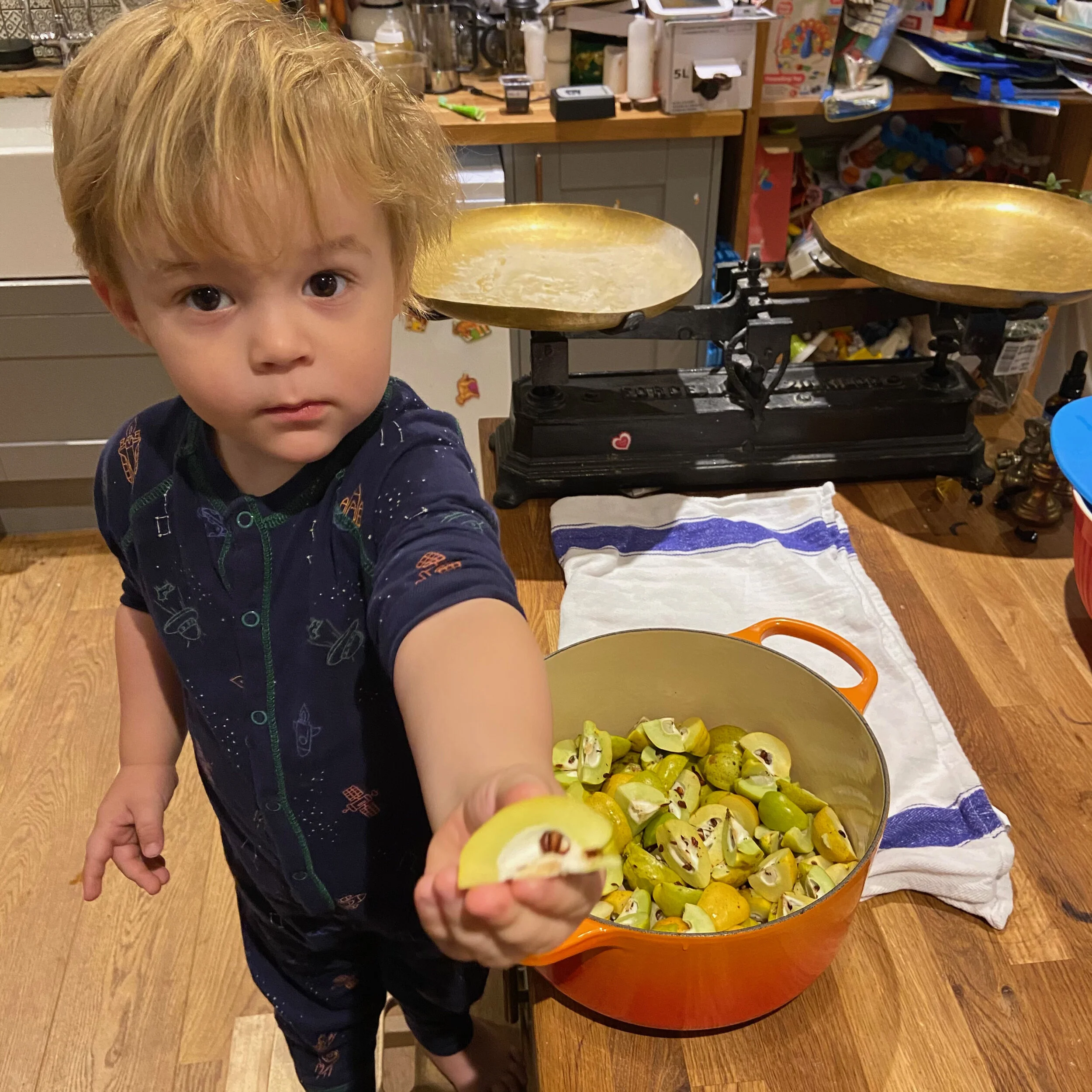
We chopped them up, covered them with water and stewed them until they were soft and pulpy. The whole mix was then suspended in a cheesecloth (or baby muslin) over a large mixing bowl overnight. Drip by drip, the resulting liquid was a rich and brilliant yellow. We measured it out into a heavy bottomed pan, adding one pound of sugar for every pint of liquid and then boiled its socks off for about 15 minutes, regularly dripping small quantities onto refrigerated plates and ho-humming about its consistency (when it starts to form a skin and hold together on the plate it’s ready).
The resulting amber jelly has a lovely lemony taste. So often food writers describe jam-making as capturing the very essence of summer; we have captured the subtle and exotic flavour of Japonicas in winter.

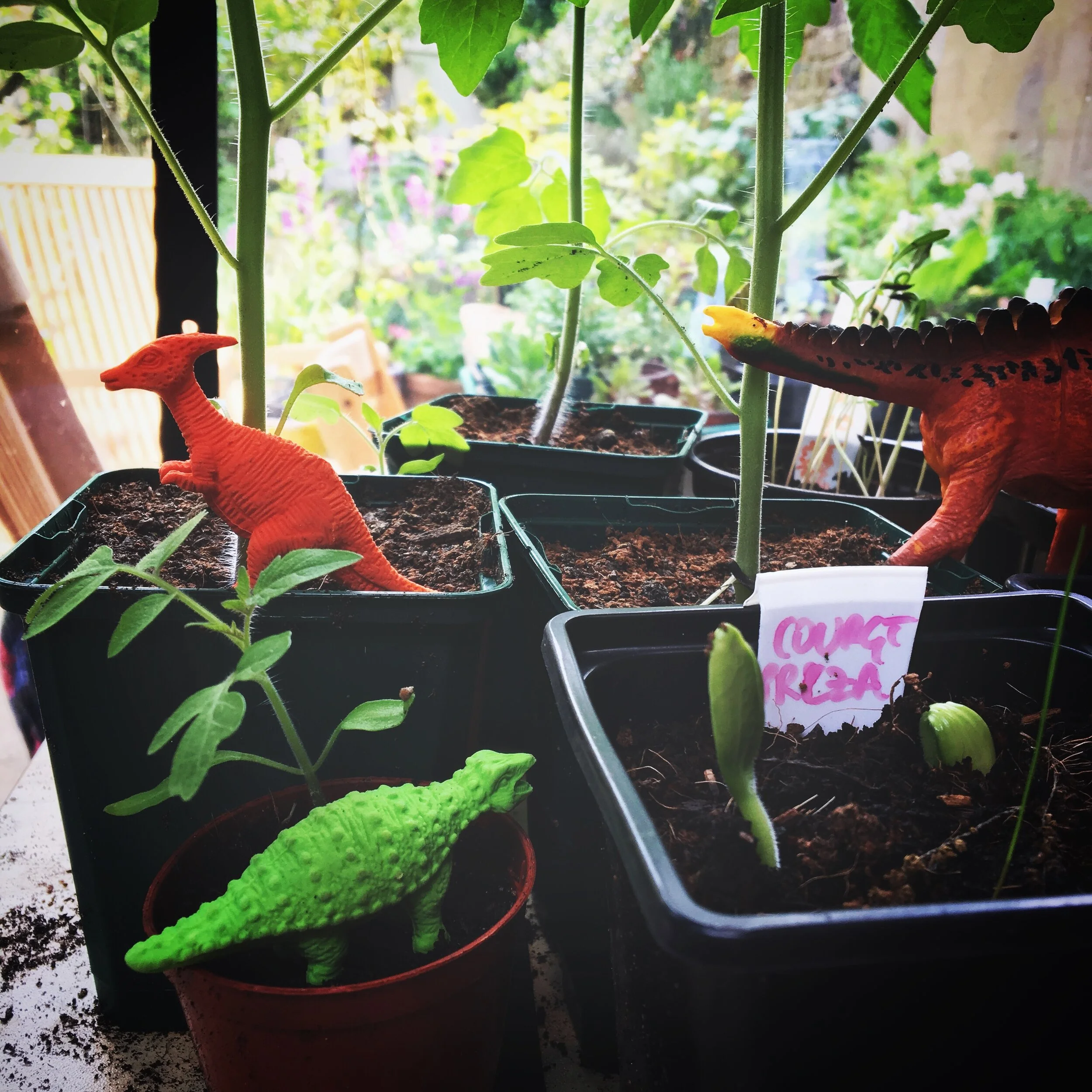
Parenting and Potting on
The trials of raising healthy, independent young plants
I can be a horribly inconsistent gardener. Each spring I am dillgent and spend all hours that my son sleeps busily getting on with things. But as the garden matures, my own commitment to its upkeep starts to slip. After years of feeling guilty about this, I’ve realised that it’s not because I’m fickle and lose interest or energy, it’s that the gardening jobs in early spring kindle hope and capture my imagination in a way that primping a garden in full bloom never will.
Of all the spring jobs I love, pricking out and potting on seedlings has to be my favourite. Yes, true, it helps that I can do it in the evening at the kitchen table accompanied by a good scotch or a crisp glass of wine. I also find it a very meditative task: repetitive enough to allow the mind free range but still requiring attention and care. Above all, it is a task that connects me to the garden, as I take the time to engage with and care for each of the plants that will go on to serve me so well for the rest of the year.

Pricking out seedlings with a glass of wine and an episode of House - the perfect way to spend a spring evening
This early care for a plant is not unlike early care for a child: providing an opportunity to bond but also the great responsibility of giving them the best possible start in life. The development and nurture of plants in their earliest stages goes on to have a huge impact on their final growth and, as with parenting, this can lead to no end of anxiety over getting it right. Consistent moisture early on allows seedlings to plump and fill out, setting the framework and structure for their form as they grow, while feeding them the right diet is just as important, although I’m finding this is at least much easier with passive seedlings than with a rebellious toddler.
I have already had several parenting fails this year. Struggling to find seed compost under lockdown and too impatient to wait for a better alternative, I sowed a number of seeds into quite a chunky multipurpose compost. They germinated well but have since struggled forward, their lower leaves showing signs of malnutrition and were rapidly overtaken by seed I sowed two weeks later in a good seed mix.
As plants head into their teenage the house begins to feel crowded with their gangly forms, but the responsibility of care is in no way diminished even if I try to give them the space to do their own thing. An over fussy parent, I quite like to sow things in trays where possible and them prick them out and pot them on several times, particularly with plants like cosmos and tomatoes which respond to being transplanted deeply by putting out new roots. In their early days, I cluck as my cosmos become increasingly stretched and thin (gardening is the only example of where being ‘leggy’ is not a compliment), and I try to fatten them up as I bury them deeper and deeper. In truth, there is always a period in April where many of my seedlings are a bit lanky and, like a kid wedded to their x-box, I can’t help but feel they need some time outside.
Finally they are ready to leave home, and the parent’s task becomes one of fostering independence, toughening them up for life on their own. I don’t have a cold frame, but small plants are moved onto our patio during day times and gradually hardened off to face the realities of the outside world. When they do finally move into the garden and put down roots I will still be there watching from a distance, trying to give them their independence but desperately worried about slugs or a sharp frost.

Young plants on our patio table, approaching graduation
Like parents, we can never get it 100% right no matter how hard we try, and will always blame ourselves for their failings and be uncertain how much credit we can take for their triumphs. But there is great consolation in the knowledge that, like children, young plants show remarkable resilience and, once we have nurtured them through these earliest days, they will go on to thrive without us, shaped subtly by our support and care, but brilliant adults in their own right.