
Chaenomeles
Japonica Jelly

Chaenomeles on an Edo period scroll by KANŌ Sigekata (1657-1699)
On winter walks, there are a few plants that I always find grabbing my attention and one of the best of these is Chaenomeles. It’s small, pear blossom flowers sing out at you from stark, bare branches at a time of year when everything else is a bit dour. Chaenomeles spend the rest of the year looking utterly unremarkable if not downright twiggy and unpromising, and anyone passing them in June might wonder what on earth people thought was so “superb” about them when Chaenomeles x superba was named. But the winter and early spring is their time to shine and they take full advantage of it.
This is, of course, exactly what they are trying to do. With very little else in bloom, winter-flowering shrubs have their moment in the limelight, but with limited pollinators braving the chilly weather, they have to make the most of their opportunity. Appearing when there are few, if any, leaves to contend with, the flowers seem particularly luxuriant against their bleak, bare stems, and look like they belong in an Edo period Japanese print, or on Chinese lacquer work. In fact, they are depicted on both, and our common name for these plants as “Japonicas” is a reference to their oriental origins. Chaenomeles x superba is a hybrid cross between C. japonica from Japan and C. speciosa from China and both cultures celebrated its blossom.

Chinese lacquer work screen depicting birds on a Chaenomeles bush
All of them will happily grow into a big tangled shrub if left to their own devices: impressive whilst in flower but rather forbidding the rest of the year. Training them against a wall or railings seems to do more justice to their delicate exoticism, displaying their flowers for appreciation and, more importantly, their fruit for easy picking.
I remember encountering Chaenomeles on walks as a child, and back then it was their fruit which would catch my eye more than their flowers. Weird and knobbly yellow pomes, somewhere between a large crab apple and a miniature pear, their fruit are arguably the most ‘superb’ thing of all. The genus is named from the Greek chaeno “to split” and melon “apple” based on a description by botanist Thunberg of the fruit splitting. Since then, this has been criticised as something that rarely, if ever happens, so I have decided instead that the name must have been meant as a rapturous instruction: ‘just split the fruit open’!
The moment you do their fragrance is incredible: lemony and sweet with a hint of pineapple. They smell so intoxicating you’d almost think it was a good idea to take a nibble, but raw the fruit are bitter and pithy. Luckily adding a tonne of sugar mitigates their bitterness, and their pithiness makes them a brilliant source of pectin – they’re perfect for making jelly. Since the fruit are small, you end up needing quite a few to make a good, useful quantity, and I’ve always kept a sort of urban foragers map of the Japonica hedges of our Brixton neighbourhood. Most people don’t have a first clue what to do with them and are happy enough to part with the fruit, especially if you leave a little jar of jelly on their doorstep a few weeks later.

Arty and I rescuing Japonicas off the ground in the park
Last weekend we went to a London park (which I will keep top secret) for a run-around and after we stopped for an outdoor coffee I suddenly noticed a Japonica covered in bright red blossom and last season’s fruit. Urban foraging is a noble art, and I would never pick the lumpy fruit off the branches in a public park in case some little child should wander past, see them at eye level (adults never look down and rarely look closely) and fall in love as I did. But fruit hidden on the ground I consider fair game. Twenty minutes later we were driving home with a bag of muddy fruit in the boot and the car smelling like a sweet shop.
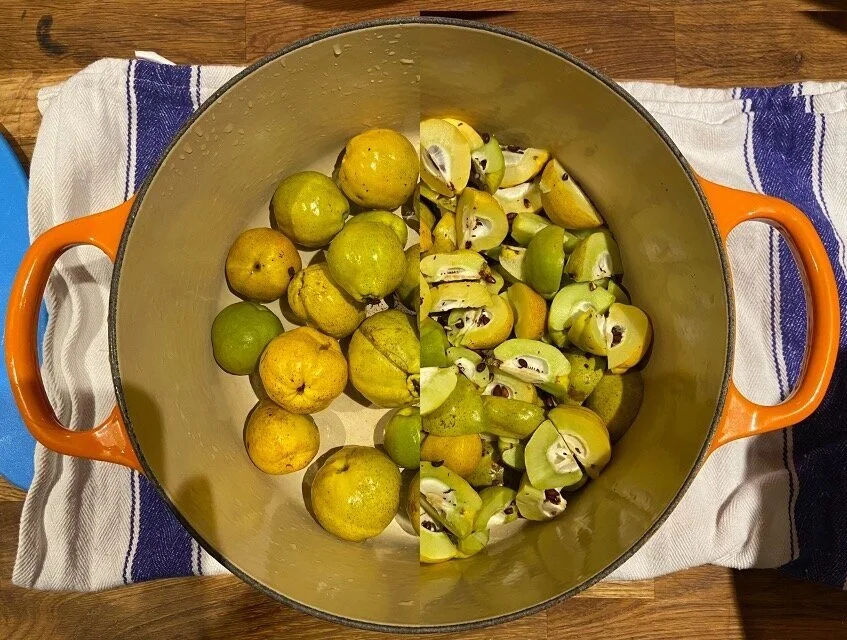
Credit to Toby for the unsolicited photoshoppery
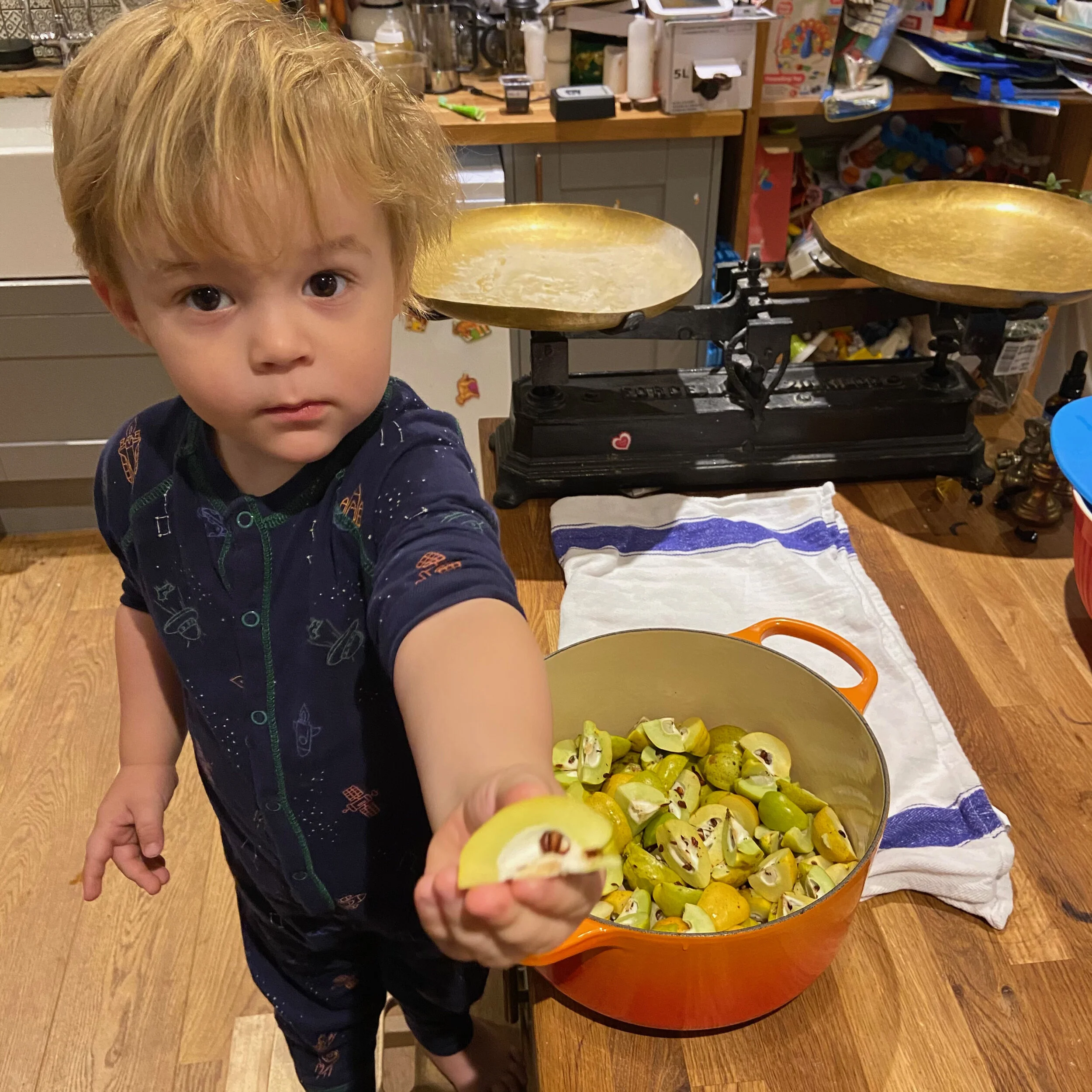
We chopped them up, covered them with water and stewed them until they were soft and pulpy. The whole mix was then suspended in a cheesecloth (or baby muslin) over a large mixing bowl overnight. Drip by drip, the resulting liquid was a rich and brilliant yellow. We measured it out into a heavy bottomed pan, adding one pound of sugar for every pint of liquid and then boiled its socks off for about 15 minutes, regularly dripping small quantities onto refrigerated plates and ho-humming about its consistency (when it starts to form a skin and hold together on the plate it’s ready).
The resulting amber jelly has a lovely lemony taste. So often food writers describe jam-making as capturing the very essence of summer; we have captured the subtle and exotic flavour of Japonicas in winter.

Parenting and Potting on
The trials of raising healthy, independent young plants
I can be a horribly inconsistent gardener. Each spring I am dillgent and spend all hours that my son sleeps busily getting on with things. But as the garden matures, my own commitment to its upkeep starts to slip. After years of feeling guilty about this, I’ve realised that it’s not because I’m fickle and lose interest or energy, it’s that the gardening jobs in early spring kindle hope and capture my imagination in a way that primping a garden in full bloom never will.
Of all the spring jobs I love, pricking out and potting on seedlings has to be my favourite. Yes, true, it helps that I can do it in the evening at the kitchen table accompanied by a good scotch or a crisp glass of wine. I also find it a very meditative task: repetitive enough to allow the mind free range but still requiring attention and care. Above all, it is a task that connects me to the garden, as I take the time to engage with and care for each of the plants that will go on to serve me so well for the rest of the year.

Pricking out seedlings with a glass of wine and an episode of House - the perfect way to spend a spring evening
This early care for a plant is not unlike early care for a child: providing an opportunity to bond but also the great responsibility of giving them the best possible start in life. The development and nurture of plants in their earliest stages goes on to have a huge impact on their final growth and, as with parenting, this can lead to no end of anxiety over getting it right. Consistent moisture early on allows seedlings to plump and fill out, setting the framework and structure for their form as they grow, while feeding them the right diet is just as important, although I’m finding this is at least much easier with passive seedlings than with a rebellious toddler.
I have already had several parenting fails this year. Struggling to find seed compost under lockdown and too impatient to wait for a better alternative, I sowed a number of seeds into quite a chunky multipurpose compost. They germinated well but have since struggled forward, their lower leaves showing signs of malnutrition and were rapidly overtaken by seed I sowed two weeks later in a good seed mix.
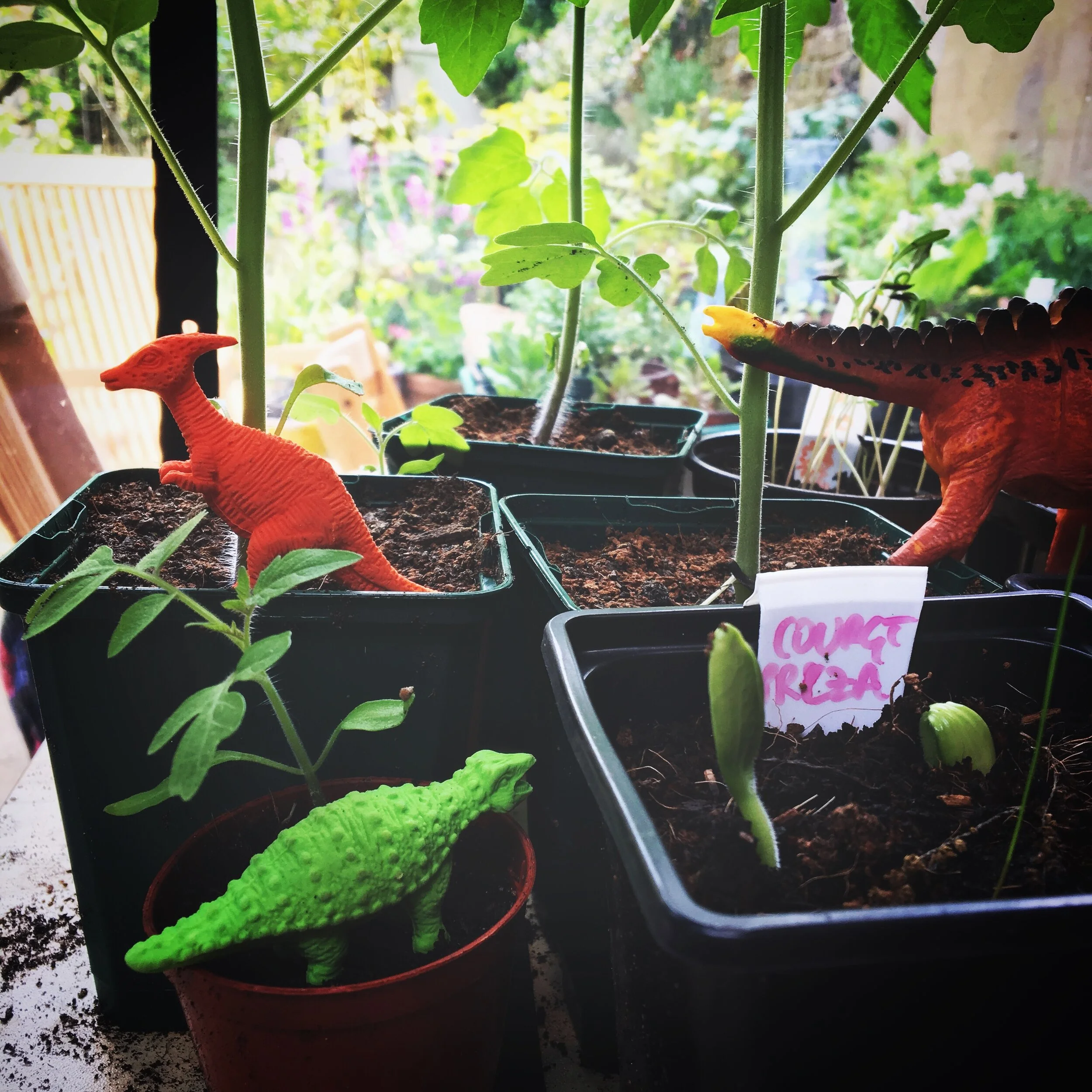
As plants head into their teenage the house begins to feel crowded with their gangly forms, but the responsibility of care is in no way diminished even if I try to give them the space to do their own thing. An over fussy parent, I quite like to sow things in trays where possible and them prick them out and pot them on several times, particularly with plants like cosmos and tomatoes which respond to being transplanted deeply by putting out new roots. In their early days, I cluck as my cosmos become increasingly stretched and thin (gardening is the only example of where being ‘leggy’ is not a compliment), and I try to fatten them up as I bury them deeper and deeper. In truth, there is always a period in April where many of my seedlings are a bit lanky and, like a kid wedded to their x-box, I can’t help but feel they need some time outside.
Finally they are ready to leave home, and the parent’s task becomes one of fostering independence, toughening them up for life on their own. I don’t have a cold frame, but small plants are moved onto our patio during day times and gradually hardened off to face the realities of the outside world. When they do finally move into the garden and put down roots I will still be there watching from a distance, trying to give them their independence but desperately worried about slugs or a sharp frost.

Young plants on our patio table, approaching graduation
Like parents, we can never get it 100% right no matter how hard we try, and will always blame ourselves for their failings and be uncertain how much credit we can take for their triumphs. But there is great consolation in the knowledge that, like children, young plants show remarkable resilience and, once we have nurtured them through these earliest days, they will go on to thrive without us, shaped subtly by our support and care, but brilliant adults in their own right.

Digging into toxoplasmosis
Advice for any pregnant gardeners
I am currently 34 weeks pregnant and gardening is getting complicated. I can garden standing up, or I can garden sitting down, but switching between the two regularly is now completely impossible. At Brockwell Park where I volunteer, I think the team are genuinely concerned I’m doing more damage than good to the garden as they see me lumbering into the middle of the borders, plants parting before me as before an elephant through the thicket.
Once you’re pregnant you are presented with a whole list of things you can’t do and mustn’t eat (coffee, alcohol, sushi, soft cheese). I was therefore thrilled when a friend recommended a brilliant book called ‘Expecting Better’ which debunks many of the myths around maternity and is incredibly permissive (perhaps why it’s so successful). Having read that I could drink the odd glass of wine and enjoy a coffee a day, I turned to pages about dangerous activities (hot tubs, flying, tattoos, cats) and on the last page I read:
‘The Bottom Line: Changing the cat litter is fine… but gardening is associated with an increased risk of toxoplasmosis. It should be avoided.’
I couldn’t believe it. At the time I was in my second trimester, sitting drinking a cup of tea with garden mud under my fingernails from a morning on the veg patch. I’d researched what I could and couldn’t do quite thoroughly, but no one had told me not to garden.
Toxoplasmosis is a disease caused by one of the world’s most common parasites, toxoplasma gondii which is found in infected meat, in cat faeces and, most frustratingly for gardeners, in the soil (thanks to the cats). For most adults, toxoplasmosis is completely harmless and symptomless. Unfortunately, whilst some risks are flagged in pregnancy to avoid discomfort to the mother rather than any risk to the baby (eg salmonella or lifting heavy bags), toxoplasmosis is not one of them. Catching it in pregnancy really is often disastrous, causing miscarriage and still birth, and for those babies that do survive, leading to ongoing complications, some of which only manifest themselves in a child’s teens. Reading about it as a pregnant gardener it is easy to get pretty scared.
Reassuringly, the transmission of toxoplasmosis is actually extremely rare and the most common way people catch it is through rare or cured meat. It can live in the soil for up to 18 months but would only get there if an infected animal had died there OR if an infected cat had defecated. Luckily, cats who are infected are only infectious for about 2-3 weeks, and most adult cats have already had it, so the chances are still fairly low. But because it poses such a huge problem if you do catch it, it is still definitely worth protecting yourself during pregnancy.
The first bit of good news is that once you’ve had it you’re immune for life and it is possible to be tested for it. In my first pregnancy, I wasn’t tested and didn’t even know you could be, but it turns out you can ask your midwife or GP to run a test for you if you garden a lot and you’re concerned. The test can tell you if you actively have it, but also if you have had it in the past and are now immune. If that result comes back, congratulations!! You can garden happily, safe in the comforting knowledge that cysts full of the little worms are snug and dormant, buried within your muscle and organs, protecting you for life.
I was convinced I had had it because:
I spent most of my time singing in France eating rare steak and vast quantities of salami
I have had cats and gardened since childhood
My London garden is a latrine for every cat in the neighbourhood
I never wore gardening gloves
I ate veg fresh from the garden
I was, therefore, a bit disappointed to discover that I haven’t had it, but I suppose that goes to show how rare it really is.
If you haven’t had it, gardening with good gloves and then washing your hands when you finish is the best thing you can do to protect yourself. Wash all your garden vegetables thoroughly (and shop-bought veg for the same reason). Some people suggest wearing a mask while gardening and perhaps in very dry weather if the soil is dusty that might be worth it…. I suspect in a British summer this isn’t really necessary.
So I am ploughing on through my last few weeks of pregnancy, and to be honest I can barely touch the ground anyway. I love gloves a lot of the time (e.g. slug collection) but there are moments where trying to protect myself from my own soil feels sad and disconnecting. Whilst other expectant mothers look forward to a martini, a rare steak and some opinionated cheese to follow, I am just looking forward to taking off my gardening gloves and putting my hands in the soil for the first time in 9 months.